
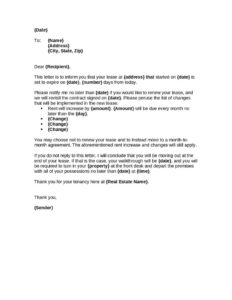
Landlord Lease Renewal Letter
Use a free Landlord Lease Renewal Letter template to offer tenants a new term, state rent changes, and confirm deadlines — free PDF and DOCX download.
DOCX
2 downloads
0
likes
Download Files
- DOCX
A Landlord Lease Renewal Letter is a written notice a property owner or manager sends to a current tenant offering to extend the tenancy beyond the existing lease end date. It is most commonly used to confirm a new lease term and any rent adjustment before the old agreement expires, so the unit stays occupied without interruption. You can download this template free in PDF and DOCX with no signup required.
What Is a Landlord Lease Renewal Letter?
A Landlord Lease Renewal Letter is a formal communication from the landlord to the tenant proposing that the rental relationship continue after the current lease ends. It documents the landlord’s intent to renew, the proposed new term, the rent for that term, and the date by which the tenant must respond. Unlike a brand-new lease, this letter is typically the first step — it signals the offer and outlines the key terms, after which a renewal lease or addendum is signed. Both landlords managing a single rental and property managers handling multiple units use it to keep records organized and to give tenants clear, advance notice of their options.
When Do You Need a Landlord Lease Renewal Letter?
This letter comes into play whenever a fixed-term lease is approaching its end and you want to keep a reliable tenant. Common situations include:
- A 12-month lease is expiring in 60 to 90 days and you want to offer another year before the tenant starts looking elsewhere.
- You are raising the rent and need to give the tenant written notice of the new amount along with the renewal offer.
- You want to convert a tenant from a fixed term to a shorter renewal, such as a six-month extension.
- A property manager is processing renewals for several units and needs a consistent, dated document for each tenant file.
- You want to lock in a good tenant and avoid the cost and vacancy of turning over the unit.
- Your jurisdiction requires advance written notice before a lease automatically rolls into a month-to-month tenancy, and you prefer a defined new term instead.
What a Lease Renewal Letter Should Have
A complete renewal letter leaves no ambiguity about what is being offered and when the tenant must decide. At minimum it should include the date of the letter, the landlord’s and tenant’s names, the rental property address, the current lease expiration date, the proposed new lease term and start date, the new monthly rent (or confirmation that rent is unchanged), and any changes to other terms such as pet policy or utilities. It should also state a clear response deadline, explain how the tenant should accept, and close with the landlord’s signature and contact information. A space for the tenant to acknowledge or accept is a helpful addition.
How to Fill Out a Landlord Lease Renewal Letter
- Enter the date you are sending the letter at the top so the notice period is documented.
- Add the tenant’s full name and the rental property address, including unit number, so the letter applies to the correct lease.
- Fill in your name as landlord or property manager and your return contact details.
- State the current lease expiration date to anchor the renewal timing.
- Specify the new lease term — for example, 12 months — and the renewal start date.
- Enter the monthly rent for the new term; if it is increasing, clearly note the new amount and the effective date.
- List any changes to terms, such as parking, pets, or maintenance responsibilities, or confirm all other terms stay the same.
- Set a response deadline and describe how to accept — signing the letter, signing a new lease, or replying in writing.
- Sign and date the letter, and provide a line for the tenant’s acknowledgment if you want written confirmation.
Renewal Letter vs. a New Lease
It helps to understand where this letter sits in the renewal process. The renewal letter is the offer and notice; it tells the tenant the terms on the table and the deadline to decide. In many cases, once the tenant accepts, the parties sign either a new full lease agreement or a short lease renewal addendum that references the original lease and updates only the term and rent. Some landlords treat a signed renewal letter itself as the binding extension, especially when no other terms change. Whichever route you choose, keep the original lease and any prior addenda together with the renewal so the full history of the tenancy is documented in one place.
Notice Timing and Delivery Tips
Timing matters because many leases and local rules require a set amount of advance notice before the term ends. Sending the renewal letter 60 to 90 days before expiration gives the tenant time to decide and gives you time to market the unit if they decline. Deliver the letter in a way you can prove — certified mail, hand delivery with a signed receipt, or email if your lease permits electronic notice. Keep a copy of the letter and any proof of delivery in your tenant file. If your lease specifies a required notice method or period, follow that exactly, since notice rules vary by location and lease terms.
Common Mistakes to Avoid
- Sending the letter too late, leaving the tenant no real time to respond before the lease ends.
- Leaving the new rent amount or effective date blank or vague, which creates disputes later.
- Forgetting to set a response deadline, so the offer drifts without resolution.
- Failing to state whether other lease terms are changing or staying the same.
- Not following the notice period or delivery method required by the original lease or local law.
- Keeping no proof of delivery, making it hard to show the tenant was properly notified.
Frequently Asked Questions
What is a Landlord Lease Renewal Letter? It is a written notice from a landlord to a tenant offering to extend the lease beyond its current end date. It states the proposed new term, the rent for that term, any changed conditions, and a deadline for the tenant to respond.
How much does this template cost? Nothing. You can download the Landlord Lease Renewal Letter free in both PDF and DOCX formats from Business Forms Pro, with no signup or account required. Edit it to match your property, term, and rent details.
How far in advance should I send the letter? Many landlords send it 60 to 90 days before the lease expires, but the right timing depends on your lease and local notice rules. Sending it early gives the tenant time to decide and gives you a head start on re-renting if they decline.
Does a lease renewal letter need to be notarized? Typically no. A renewal letter is usually valid with the landlord’s signature and the tenant’s acknowledgment, and notarization is rarely required. Requirements vary by jurisdiction, so check your local rules and lease terms if you are unsure.
Can I raise the rent in a renewal letter? Yes, a renewal letter is a common way to notify a tenant of a rent increase for the new term, as long as you clearly state the new amount and effective date. Some areas limit how much or how often rent can rise, so confirm any local rent regulations before setting the figure.
Is a signed renewal letter legally binding? When both parties sign and the terms are clear, a renewal letter can serve as a binding extension, though many landlords pair it with a new lease or addendum. To be safe, keep the original lease and the signed renewal together and confirm what your jurisdiction requires.
This template is a general example provided for informational purposes only and is not legal, financial, or tax advice. Landlord-tenant laws, notice periods, and rent rules vary by jurisdiction. Consult a qualified attorney or local housing authority before relying on this document.
Official resource: for the rules that apply to your situation, see HUD.
Related Forms
- Rental Lease Extension Request
- Lawn Care Form
- Open House Sign In Sheet
- Intent To Vacate Apartment
- Landlord Move-Out Letter
- Credit Drop Letter Of Explanation Mortgage
Browse more in Rental and Real Estate.