
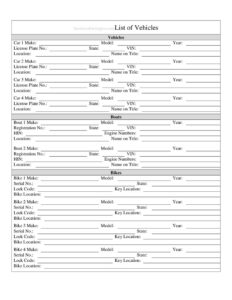
List of Vehicles
Use this free List of Vehicles template to record cars, boats, and bikes with VINs, titles, and locations in one place — free PDF and DOCX download.
PDF
DOCX
3 downloads
0
likes
Download Files
- DOCX
A List of Vehicles is a single document that records every car, boat, and bike you own — including make, model, year, VIN, license or registration numbers, and where each one is kept. People most often create one to keep an accurate inventory for insurance, estate planning, or family record-keeping, and you can download it here free in PDF and DOCX with no signup required.
What Is a List of Vehicles?
A List of Vehicles is a structured inventory form that captures identifying details for all the motorized and non-motorized vehicles a person or household owns. It is typically maintained by an individual, family, executor, or business owner who wants one reference sheet instead of scattered registration cards and titles. The form documents each vehicle’s manufacturer, year, identification numbers, the name listed on the title, and the physical location of the asset. Because it consolidates cars, boats, and bikes onto one page, it serves as a quick-reference asset record — useful any time someone needs to verify ownership, report property to an insurer, or pass along key information to a trusted person.
When Do You Need a List of Vehicles?
- Estate planning: Listing every vehicle with its title name and location helps an executor or family member locate and transfer assets after a death.
- Insurance review: Bring an accurate list to your agent when adding, removing, or comparing coverage on cars, boats, and bikes.
- Theft or loss recovery: Having VINs, HINs, serial numbers, and license plate details recorded in advance speeds up police reports and insurance claims.
- Divorce or property division: A clear inventory shows what vehicles exist and whose name appears on each title.
- Household organization: A central record keeps registration numbers, lock codes, and key locations in one trusted place.
- Selling or gifting: Quickly confirm the VIN, year, and title holder before listing a vehicle or transferring ownership.
What a List of Vehicles Should Have
A complete List of Vehicles separates assets by type and captures the details that uniquely identify each one. For cars, that means the make, model, year, license plate number and issuing state, the full VIN, where the vehicle is parked, and the name printed on the title. Boats require additional identifiers — a registration number, a Hull Identification Number (HIN), and engine numbers — because watercraft are titled and tracked differently from cars. Bikes, whether bicycles or motorbikes, benefit from a serial number, lock code, and notes on where the key and the bike itself are stored. The strongest lists also note the location of each item so anyone using the record can physically find the asset.
How to Fill Out a List of Vehicles
- Cars section: Starting with Car 1, enter the Make, Model, and Year.
- Record the License Plate No. and the State that issued it.
- Copy the full 17-character VIN exactly from the dashboard or door jamb.
- Note the Location (e.g., home garage, storage unit) and the Name on Title.
- Repeat for Car 2, Car 3, and Car 4 as needed.
- Boats section: For Boat 1, fill in Make, Model, and Year, then the Registration No. and State.
- Add the VIN, the HIN, and any Engine Numbers, followed by the Location and Name on Title. Repeat for Boat 2.
- Bikes section: For each bike, enter Make, Model, Year, and the Serial No. with its State.
- Record the Lock Code, Key Location, and Bike Location so the item can be secured and found.
Understanding the Identification Numbers
Each type of vehicle uses a different identifier, and recording the correct one matters. A car’s VIN (Vehicle Identification Number) is a unique 17-character code that links to title, registration, and insurance records. Boats use a HIN (Hull Identification Number) molded into the hull, plus separate registration and engine numbers because the engine is often titled or insured independently. Bicycles and many motorbikes carry a serial number stamped on the frame, which is essential for proving ownership if one is stolen and later recovered. Take a few minutes to copy these numbers carefully — a single transposed digit can make the record useless when you need it most. Photographing the source label alongside your written entry is a helpful backup.
Keeping Your List Secure and Current
Because this form may contain sensitive details such as lock codes and key locations, store completed copies somewhere safe — a locked drawer, a secure cloud folder, or alongside other estate documents. Share it only with people you trust, such as a spouse, executor, or attorney. Update the list whenever you buy, sell, or transfer a vehicle, renew a registration, or change where an item is stored. Reviewing it once a year keeps the information accurate and ready when an emergency, claim, or major life event makes a reliable record essential.
Common Mistakes to Avoid
- Transcribing VINs or HINs incorrectly — double-check every character against the source.
- Leaving the title name blank — ownership disputes hinge on whose name is recorded.
- Forgetting to note the state for plates, registrations, and serial numbers, which affects how each is tracked.
- Skipping the location field, leaving family or executors unable to find the asset.
- Recording lock codes on a copy that isn’t stored securely, creating a security risk.
- Letting the list go stale after selling a vehicle or moving it to a new location.
Frequently Asked Questions
What is a List of Vehicles used for? It is an inventory sheet that records the cars, boats, and bikes you own in one place, capturing make, model, year, identification numbers, title holder, and location. People use it for insurance, estate planning, theft recovery, and general household organization. Having it ready saves time whenever someone needs to verify ownership or report a vehicle.
How do I fill out the List of Vehicles? Work through each section in order — cars, then boats, then bikes — and complete every field you can for each item. Copy identification numbers such as VIN, HIN, and serial numbers directly from the vehicle, and be sure to note the issuing state and the name on the title. Add the location and any key or lock details so the record is genuinely useful.
Is this form legally binding? No. A List of Vehicles is a record-keeping and reference document, not a contract or title transfer. It does not by itself prove or change legal ownership, but it organizes the information you would rely on when handling insurance, claims, or estate matters.
Does a List of Vehicles need to be notarized? Generally no. Because it is an informational inventory rather than a legal instrument, notarization is not typically required. If you are attaching it to an estate document or formal proceeding, follow the instructions for that specific document or ask your advisor.
How much does this template cost? Nothing — it is completely free to download from Business Forms Pro in both PDF and DOCX formats, with no account or signup needed. You can fill it out by hand or type directly into the editable version.
Can I add more vehicles than the template lists? Yes. The template includes space for several cars, boats, and bikes, but you can duplicate a section in the DOCX version or attach an extra page if you own more items. Keep the same field layout so every vehicle is documented consistently.
This template is a general example provided for informational purposes only and is not legal, financial, or insurance advice. Requirements for documenting and transferring vehicle ownership vary by state and situation — consult a qualified professional for guidance specific to your circumstances.
Related Forms
- Project To Do List
- Auction Sell List
- Edit Log
- Hurricane Emergency Checklist
- General Journal
- Phone Message Log
Browse more in Log and Inventory.