
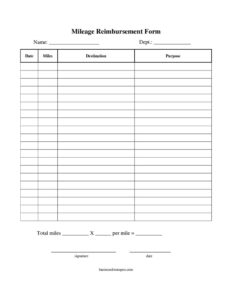
Mileage Reimbursement Form
Free mileage reimbursement form in PDF & DOCX. Learn how to calculate mileage, the IRS rate, whether it's taxable, and what it covers — download today.
PDF
DOCX
0
likes
Download Files
- DOCX
A mileage reimbursement form lets an employee record the business miles they’ve driven so their employer can pay them back fairly. This printable log captures every trip in one place. Download the free mileage reimbursement form below in PDF or DOCX. No signup or email required.
What Is Mileage Reimbursement?
Mileage reimbursement is money an employer pays an employee to cover the cost of using their personal vehicle for work. When you drive your own car for business — to visit a client, run a work errand, or travel between job sites — you’re spending money on gas, wear and tear, insurance, and maintenance. Rather than track each of those costs separately, most employers pay a set amount for each business mile driven. The mileage reimbursement form is how you report those miles: you log each trip’s date, destination, purpose, and distance, and the total is multiplied by the agreed per-mile rate to work out what you’re owed.
The IRS Standard Mileage Rate
In the United States, the IRS publishes a standard mileage rate each year that many employers use to reimburse business driving. It’s designed to approximate the real cost of operating a vehicle, and it changes annually as fuel and vehicle costs shift. For 2025, for example, the IRS business standard mileage rate was 70 cents per mile. Because the figure is updated every year — and separate rates apply to medical, moving, and charitable driving — you should always check the current rate for the year you’re claiming. Some employers reimburse at exactly the IRS rate; others set their own rate, which may be higher or lower.
How to Calculate Mileage Reimbursement
The math is straightforward: business miles × the per-mile rate = your reimbursement. If you drove 200 business miles in a month and your employer reimburses at 70 cents per mile, you’d be owed 200 × $0.70 = $140. The key is accurate mileage: record each trip as you take it, noting the destination and purpose, rather than estimating at the end of the month. Add up the miles for the period, multiply by your rate, and that’s the figure to submit. The form above totals your trips so the calculation is simple and easy to check.
Is Mileage Reimbursement Taxable?
Generally, no — mileage reimbursement is not taxable as long as it’s paid under an “accountable plan.” That means you have to substantiate the miles (with a log like this form), the reimbursement is for genuine business driving, and you’re paid at or below the IRS standard rate. When those conditions are met, the money is a reimbursement of an expense, not income, so it isn’t taxed. However, if an employer pays *more* than the IRS rate, or doesn’t require you to document the miles, the excess (or the whole amount) can become taxable wages. Keeping a clear mileage log is what keeps reimbursement tax-free.
Does Mileage Reimbursement Include Gas?
Yes — and more. A common misunderstanding is that the per-mile rate only covers fuel. In fact, the IRS standard mileage rate is meant to cover the *full* cost of operating a vehicle: gas, oil, maintenance and repairs, tires, insurance, registration, and depreciation. That’s why you generally can’t claim mileage *and* separately claim gas receipts for the same driving — the mileage rate already includes the fuel. Tolls and parking, however, are usually reimbursed on top of mileage, since the per-mile rate doesn’t cover them.
How to Fill Out a Mileage Reimbursement Form
- Enter your name and department.
- For each trip, record the date you drove.
- Write the destination — where the business travel took you.
- Note the purpose of the trip, so the business reason is clear.
- Enter the miles driven for that trip.
- Total the miles, multiply by your reimbursement rate, and submit the form for approval.
Tips for Tracking Mileage
Accurate records are everything, both for getting paid correctly and for keeping reimbursement tax-free. Log trips as they happen rather than reconstructing them later, since memory-based estimates are easy to get wrong and hard to defend. Note the purpose of each trip, not just the distance — “client meeting downtown” is far more useful than a bare number. Keep your odometer readings or a navigation record where you can, and submit your form on a regular schedule so miles don’t pile up and get forgotten.
Common Mistakes to Avoid
- Estimating miles at month-end instead of logging each trip
- Claiming mileage and gas receipts for the same driving (the rate already covers fuel)
- Forgetting to note the business purpose of each trip
- Using an outdated per-mile rate instead of the current year’s figure
- Including commuting miles, which usually aren’t reimbursable
Frequently Asked Questions
Is mileage reimbursement taxable? Generally no, if it’s paid under an accountable plan — meaning you document the miles and are paid at or below the IRS standard rate. Amounts above the IRS rate, or unsubstantiated payments, can become taxable.
How do I calculate mileage reimbursement? Multiply your business miles by the per-mile rate. For example, 200 miles at 70 cents per mile is $140. Record each trip and total the miles for the period.
What is the IRS mileage rate? A per-mile figure the IRS sets each year to approximate the cost of operating a vehicle for business. It changes annually, so check the current year’s rate (it was 70 cents per mile for business in 2025).
Does mileage reimbursement include gas? Yes. The standard mileage rate covers gas plus maintenance, insurance, depreciation, and more — so you generally don’t claim fuel separately. Tolls and parking are usually reimbursed on top.
What’s the difference between mileage reimbursement and a car allowance? Mileage reimbursement pays per actual business mile driven; a car allowance is a flat amount that may be treated differently for tax. Reimbursement under an accountable plan is typically tax-free.
How much does this template cost? It’s free to download in PDF and DOCX.
Related Forms
Expense Report · Travel Expense Report · Gas Mileage Log · Vehicle Expense Journal · Expense Reimbursement Request
This template is provided for general informational purposes only and is not tax advice. IRS rates and rules change yearly and vary by situation — confirm the current rate and your eligibility with the IRS or a tax professional.
Related Forms
- Travel Expense Report
- Balance Sheet Blank
- Expense Report
- Expense Reimbursement Request Report
- Check Register
- Gas Mileage Reimbursement
Browse more in Expense Reports.