
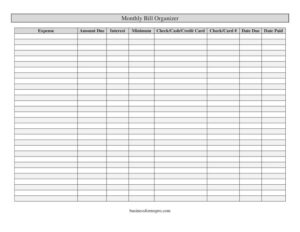
Monthly Bill Organizer
Track due dates, amounts, and payments with our free Monthly Bill Organizer template—download in PDF or DOCX to never miss a bill again.
PDF
DOC
3 downloads
0
likes
Download Files
- DOC
A Monthly Bill Organizer is a simple worksheet that lists every bill you owe in a given month, along with its due date, amount, and payment status, so nothing slips through the cracks. People most often use it to stop missing payments and avoid late fees. You can download this Monthly Bill Organizer free in PDF or DOCX, with no signup required.
What Is a Monthly Bill Organizer?
A Monthly Bill Organizer is a personal finance tracking sheet that gathers all of your recurring and one-time expenses into a single, at-a-glance layout. Instead of juggling paper statements, email reminders, and mental notes, you record each bill with its amount due, interest, minimum payment, due date, and the date you actually paid it. It is used by individuals, couples, and households who want a clear monthly snapshot of their obligations. The organizer documents not just what you owe but how and when you paid—by check, cash, or credit card—creating a tidy record you can reference later. It is a planning and record-keeping tool, not a legal contract.
When Do You Need a Monthly Bill Organizer?
This form is helpful any time the number of bills you manage outgrows what you can comfortably keep in your head. Common situations include:
- You have missed a payment recently and want a reliable system to prevent late fees and credit dings.
- You are managing multiple credit cards, loans, or subscriptions with different due dates each month.
- You share finances with a partner and need a single shared view of who pays what and when.
- You are following a budget or debt-payoff plan and want to track minimums versus what you actually paid.
- You recently moved, started a new job, or experienced a change in income and need to map your monthly cash outflow.
- You are helping a family member—such as an aging parent or a college student—stay on top of recurring bills.
What a Monthly Bill Organizer Should Have
A complete organizer captures enough detail to act on each bill without pulling the original statement. The essential elements are the name of each expense, the amount due, any interest rate or charge attached, the minimum payment accepted, the payment method, a check or card reference number, the date the bill is due, and the date you paid it. Together these columns let you see your total monthly obligation, prioritize by due date, confirm payments cleared, and keep a paper trail for disputes. A useful organizer also leaves room to total the amounts so you can compare your monthly bills against your income.
How to Fill Out a Monthly Bill Organizer
Work through the columns one bill per row:
- Expense: Write the name of the bill—for example, electric, rent, car loan, or a specific credit card. Use clear labels so each row is unambiguous.
- Amount Due: Enter the full balance requested on the statement for this billing cycle.
- Interest: Note the interest rate or any finance/interest charge applied, which helps you prioritize high-cost debt.
- Minimum: Record the minimum payment accepted, useful when cash is tight and you must pay at least that amount.
- Check/Cash/Credit Card: Mark how you intend to pay so you can plan which account funds each bill.
- Check/Card #: After paying, log the check number or the last digits of the card used for your records.
- Date Due: Enter the due date exactly as it appears on the statement; sort rows by this date.
- Date Paid: Fill this in only once payment is confirmed, then total your amounts at the bottom.
How to Get the Most From Your Organizer
Fill out the organizer at the start of each month using your most recent statements, then keep it somewhere visible—taped near your desk or saved on your phone. As payments go out, immediately complete the Date Paid and Check/Card # columns so you can tell at a glance which bills are still outstanding. The Interest and Minimum columns are especially valuable for debt payoff: paying more than the minimum on the highest-interest balance first (the avalanche method) saves the most money over time. Comparing your monthly total against your take-home pay reveals how much room you have for savings or extra debt payments.
Paper Versus Digital Tracking
The PDF version is ideal if you prefer to print a fresh sheet each month and write by hand—many people find physically checking off a paid bill satisfying and memorable. The DOCX version lets you type entries, copy last month’s recurring bills forward, and adjust columns or add rows for new expenses. Whichever you choose, keep finished sheets together in a folder or a single document so you build a month-by-month history. That archive makes it easy to spot rising costs, catch a charge that suddenly jumped, or prove you paid on time if a creditor reports otherwise.
Common Mistakes to Avoid
- Forgetting to fill in the Date Paid column, which leaves you unsure whether a bill was actually handled.
- Recording only the minimum payment and treating it as the full amount, which lets balances and interest grow.
- Leaving off irregular or quarterly bills—like insurance or annual subscriptions—because they don’t appear every month.
- Not sorting rows by due date, so you accidentally pay later-due bills before urgent ones.
- Skipping the check or card number, which makes it hard to trace a payment if there’s a dispute.
- Failing to total the amounts, so you never compare your obligations against your income.
Frequently Asked Questions
What is a Monthly Bill Organizer used for? It is used to list all your bills in one place and track each one’s amount, due date, and payment status. The goal is to avoid missed payments, late fees, and the stress of scattered statements. It also gives you a clear monthly total to compare against your income.
How do I fill out the Monthly Bill Organizer? Add one bill per row, entering the expense name, amount due, interest, minimum, and due date from your statement. Mark your planned payment method, then complete the date paid and check or card number once the payment clears. Sort rows by due date so the most urgent bills are easy to spot.
Is this Monthly Bill Organizer really free? Yes. You can download it from Business Forms Pro at no cost in either PDF or DOCX format, and no account or signup is required. Use it for as many months as you like.
Should I track the minimum or the full amount due? Track both—the form has separate columns for each. Knowing the minimum helps in tight months, but paying the full amount due whenever possible avoids interest charges and keeps debt from growing. The interest column helps you decide which balances to prioritize.
Can I use it for a whole household or shared finances? Absolutely. Many couples and families keep a single organizer so everyone can see what is owed, who is paying, and when. The DOCX version is handy here because you can edit and reprint it as bills change.
How is this different from a budget? A budget plans how you allocate income across categories, while a bill organizer focuses specifically on tracking individual bills and their payment status. The two work well together—use the organizer to feed accurate numbers into your monthly budget.
This template is provided as a general example for informational purposes only and is not financial, tax, or legal advice. Your specific obligations, interest terms, and payment options may vary—consult a qualified financial professional for guidance tailored to your situation.
Official resource: for the rules that apply to your situation, see the Consumer Financial Protection Bureau.
Related Forms
- List of Accounts
- Monthly Bookkeeping Record
- Projected Sales
- Car Insurance Exchange Form
- Debt Snowball Form
- Account Reconciliation Form
Browse more in Money.