
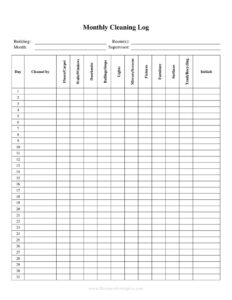
Monthly Cleaning Log
Track daily and weekly cleaning tasks with our free Monthly Cleaning Log template, perfect for verifying hygiene and accountability - free download in PDF and DOCX.
PDF
DOCX
9 downloads
0
likes
Download Files
- DOCX
A Monthly Cleaning Log is a simple tracking sheet used to record cleaning tasks performed across a month, showing what was cleaned, when, and by whom. People most often use it to prove that a space — an office, restroom, kitchen, or rental unit — is being maintained on a consistent schedule. You can download this Monthly Cleaning Log for free in both PDF and DOCX formats, with no signup required.
What Is a Monthly Cleaning Log?
A Monthly Cleaning Log is a record-keeping document that captures cleaning activity over a 30- or 31-day period. It is typically maintained by janitorial staff, facility managers, restaurant teams, healthcare workers, or property owners to document that recurring cleaning duties have actually been completed. Each entry usually notes the date, the area or task addressed, the person who performed the work, and a signature or initials confirming completion. The log serves as both a checklist that keeps tasks from being forgotten and a paper trail that can be reviewed during inspections, audits, or disputes. By consolidating a full month onto a single sheet, it gives managers an at-a-glance view of hygiene and accountability.
When Do You Need a Monthly Cleaning Log?
A cleaning log becomes valuable any time consistency, hygiene, or accountability matters. Common situations include:
- Commercial restrooms and kitchens where health codes require documented cleaning intervals throughout the day or week.
- Office buildings and shared workspaces where a janitorial crew rotates through floors and needs to confirm each area was serviced.
- Restaurants and food-service operations tracking sanitizing of prep surfaces, equipment, and storage areas for health-inspector review.
- Vacation rentals and property management, proving turnover cleaning was completed between guests or tenants.
- Medical, dental, and childcare facilities that must demonstrate routine disinfection of high-touch surfaces and treatment areas.
- Gyms, schools, and community centers coordinating volunteer or staff cleaning rotations across many rooms.
Daily, Weekly, and Monthly Task Tracking
Not every cleaning task happens on the same cadence. A well-designed log lets you separate daily chores like wiping counters and emptying trash from weekly jobs such as mopping floors or restocking supplies, and monthly deep-cleaning tasks like washing windows or descaling appliances. Grouping tasks by frequency on one monthly sheet helps teams see the bigger picture and prevents less-frequent jobs from slipping through the cracks.
What a Monthly Cleaning Log Should Have
A complete and useful Monthly Cleaning Log generally includes the following elements:
- A clear title and the month and year the log covers.
- The facility, building, or area name being tracked.
- A column or grid for each date in the month.
- A list of cleaning tasks or areas to be completed.
- Space for the name or initials of the person who performed each task.
- A field for time completed where timing matters.
- A notes or comments column for issues, supply shortages, or follow-up items.
- A spot for a supervisor signature or verification at the end of the month.
How to Fill Out a Monthly Cleaning Log
Follow these steps to complete the log accurately and keep it audit-ready:
- Write the month and year at the top so the record is unmistakably tied to a time period.
- Enter the location or facility name and any specific area, floor, or room the log applies to.
- List each cleaning task or area down the left side — for example, mop floors, sanitize counters, restock paper, empty bins.
- For each day a task is completed, mark the corresponding date column with a check, initials, or the time finished.
- Record the name or initials of the staff member who performed the work so responsibility is clear.
- Add the time of completion if your operation requires interval-based cleaning (common in restrooms and food service).
- Use the notes field to flag broken fixtures, low supplies, or anything needing attention.
- At month’s end, have a supervisor review and sign the log, then file or scan it for your records.
Tips for Keeping an Effective Cleaning Log
Treat the log as a living document rather than a formality completed at the last minute. Fill it in immediately after each task — back-filling a whole week from memory invites errors and undermines its value during an inspection. Post the sheet in or near the area being cleaned, such as inside a restroom door or on a supply-closet wall, so staff can mark it without hunting for it. Use consistent initials so anyone reviewing the log can identify who did what. Keep completed monthly logs together in a binder or digital folder, organized by month, so you can quickly pull a record if a customer complaint, health inspection, or tenant dispute arises.
Why Documentation Matters
Beyond simple organization, a signed cleaning log is evidence. If a health inspector questions sanitation practices, a guest reports a dirty unit, or a tenant claims a space was never maintained, a consistently completed log demonstrates a documented routine. It also protects employees by showing they performed their assigned duties, and it helps managers spot patterns — like a task that is repeatedly skipped on weekends — so they can adjust schedules or staffing. Good records turn cleaning from an invisible chore into a measurable, defensible process.
Common Mistakes to Avoid
- Filling it out in advance or all at once at the end of the month, which defeats the purpose and can be considered falsifying records.
- Leaving the date or location blank, making it impossible to tie the log to a specific time and place.
- Using unclear marks instead of initials, so no one can tell who completed a task.
- Ignoring the notes column and failing to flag broken equipment or missing supplies.
- Skipping the supervisor review, which removes the verification step that gives the log credibility.
- Not storing completed logs, so there is no history to reference during an audit or complaint.
Frequently Asked Questions
What is a Monthly Cleaning Log used for? It is used to track and verify that cleaning tasks have been completed over the course of a month. It serves as both a checklist for staff and a record for managers, inspectors, or property owners who need proof that an area is being maintained on schedule.
How do I fill out a Monthly Cleaning Log? List your cleaning tasks or areas, then mark each date column as tasks are completed, adding initials and the time when required. Note any issues in the comments field, and have a supervisor sign off at the end of the month to verify the record.
Does a cleaning log need to be signed? A signature or set of initials from the person performing the work is strongly recommended because it establishes accountability. Many businesses also add a supervisor signature at month’s end to verify the entries, though it is not a legal notarized document.
Who should keep a Monthly Cleaning Log? Facility managers, janitorial companies, restaurant operators, property managers, healthcare and childcare providers, and anyone responsible for maintaining a shared or regulated space can benefit. It is useful wherever consistent cleaning and documentation are expected.
Is this Monthly Cleaning Log template free? Yes. You can download it for free in both PDF and DOCX formats with no signup required, then print it or customize the tasks and columns to match your facility.
Can I customize the cleaning tasks on the log? Absolutely. The DOCX version lets you edit the task list, add or remove columns, and rename areas to fit your specific space, whether that is a restaurant kitchen, an office floor, or a rental property.
This Monthly Cleaning Log template is a general example provided for informational purposes only and does not constitute legal, health-code, or compliance advice. Cleaning and documentation requirements vary by industry and jurisdiction, so consult the applicable regulations or a qualified professional to ensure your records meet local standards.
Related Forms
- Weekly Blog Planner
- Elder Care Daily Log
- Employee Order Log
- Club Tracking Payments
- Vendor Price Analysis
- Nanny Daily Log
Browse more in Log and Inventory.