
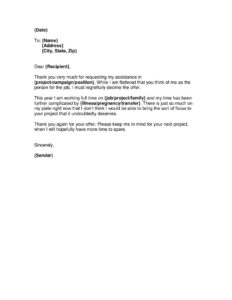
Personal Request Rejection
Politely decline a personal request with our free Personal Request Rejection letter template, available as a free download in PDF and DOCX formats.
PDF
DOCX
0
likes
Download Files
- DOCX
A Personal Request Rejection letter is a courteous written message used to decline a personal invitation, offer, or request for your help while preserving the relationship. People most often reach for it when they simply don’t have the time or capacity to take on a project, position, or favor but want to say no graciously. It’s free to download here in both PDF and DOCX formats, with no signup required.
What Is a Personal Request Rejection Letter?
A Personal Request Rejection is a short, polite letter that one person sends to another to formally turn down a request for assistance. It is typically issued by the individual being asked — not a company — and addressed directly to the person who reached out. The letter documents that the offer was received, expresses gratitude for being considered, and clearly communicates the decision to decline. Because it is personal rather than corporate, the tone is warm and appreciative while remaining unambiguous. It often closes by leaving the door open for future opportunities, so the relationship stays intact even though the answer is no this time around.
When Do You Need a Personal Request Rejection Letter?
This letter fits a wide range of everyday situations where you’ve been asked to commit your time, talent, or name and need to decline kindly. Common scenarios include:
- Declining an invitation to volunteer on a committee, board, or campaign you can’t dedicate time to.
- Turning down a freelance, consulting, or part-time position when your schedule is already full.
- Saying no to a friend or acquaintance who asked you to lead or contribute to a project.
- Respectfully refusing to be a speaker, mentor, judge, or guest when other commitments conflict.
- Declining a request to join a startup, club, or community initiative during a busy life season.
- Politely backing out of an ask when illness, pregnancy, a job change, or a family obligation limits your availability.
What a Personal Request Rejection Letter Should Have
A complete and effective rejection letter strikes a balance between clarity and warmth. The essential elements are: a date and the recipient’s name and mailing address; a polite salutation; a sincere thank-you acknowledging the specific request; a clear, unambiguous statement that you must decline; a brief, honest reason for declining without over-explaining; an expression of goodwill that keeps the relationship open; and a courteous closing with your signature. Naming the exact project, campaign, or position shows you took the request seriously, while a short note inviting future contact softens the no and signals genuine interest in staying connected.
How to Fill Out a Personal Request Rejection Letter
- Enter the Date you are writing the letter at the top.
- Fill in the recipient’s Name, Address, and City, State, Zip so the letter is properly addressed.
- Open with the salutation, replacing {Recipient} with the person’s name — for example, “Dear Maria.”
- In the opening thank-you, specify the {project/campaign/position} you were asked to help with so your gratitude feels genuine and tailored.
- State that you must regretfully decline the offer, keeping the wording polite but firm.
- Provide your reason by completing {job/project/family} to describe your current full-time commitment.
- Add the complicating circumstance in {illness/pregnancy/transfer} if it applies, or adjust this line to fit your situation.
- Keep the closing lines that thank the person again and invite them to keep you in mind for future projects.
- Sign off with “Sincerely” and enter your name in the {Sender} field, then add your handwritten signature on a printed copy.
How to Decline Without Damaging the Relationship
The art of a good rejection is saying no clearly while leaving the other person feeling respected. Lead with appreciation: acknowledging that they thought of you is flattering and worth naming. Be honest but concise about your reason — you don’t owe a lengthy justification, and a simple “my plate is full this year” is both true and gracious. Avoid vague phrases like “maybe” or “we’ll see,” which can leave the requester hanging and create false hope. Finally, offer something forward-looking, whether that’s a referral to someone else, a willingness to reconnect later, or a sincere note to keep you in mind next time. These small touches turn a disappointing answer into a positive interaction.
Personal vs. Business Rejection Letters
While both decline a request, a personal rejection letter is written in your own voice about your own time and is generally less formal than a corporate decline. A business rejection — such as turning down a vendor proposal or a job applicant — usually follows company protocol, may reference policies, and is often more neutral in tone. This personal template intentionally feels warmer and more individual, making it ideal for situations involving friends, peers, community groups, or one-on-one professional requests rather than formal organizational decisions.
Common Mistakes to Avoid
- Being vague about the answer. Soft language that never actually says no leaves the requester confused and waiting for a yes.
- Over-explaining your reasons. A brief, honest explanation is enough; a paragraph of justifications can sound defensive.
- Forgetting to name the specific request. Leaving the {project/campaign/position} field generic makes the letter feel impersonal.
- Delaying your reply. A late no can cost the requester valuable planning time; send the letter promptly.
- Sounding cold or curt. Skipping the thank-you or the goodwill closing can sour an otherwise good relationship.
- Making a promise you can’t keep. Only offer future help or a referral if you genuinely mean it.
Frequently Asked Questions
What is a Personal Request Rejection letter? It is a polite written message used to decline a personal request for your help, time, or participation. It acknowledges the request, thanks the person for thinking of you, and clearly states that you cannot take it on. Its goal is to say no while keeping the relationship warm and intact.
How do I fill out this template? Add the date and the recipient’s name and address, then personalize the body by naming the exact project, campaign, or position you were asked about and the reason you must decline. Adjust the optional complicating-circumstance line to fit your situation, and sign with your name. The whole letter takes only a few minutes to complete.
Do I need to give a detailed reason for declining? No. A brief, honest reason — such as being committed to a full-time job, project, or family obligation — is perfectly acceptable and usually appreciated. You are not obligated to share private details, and a concise explanation often reads as more confident and respectful than a lengthy one.
Does this letter need to be notarized or witnessed? No. A personal request rejection is an informal courtesy letter, not a legal contract, so it does not require notarization, witnesses, or any formal filing. Your signature at the bottom is simply a personal touch that confirms the message comes from you.
Can I send it by email instead of mail? Yes. While the template includes a mailing address block, you can easily adapt the same wording for an email by keeping the salutation, thank-you, decline statement, and goodwill closing. Email is often the faster, more practical choice for declining a casual or time-sensitive request.
Is this template really free to download? Yes, it is completely free to download in both PDF and DOCX formats with no signup required. You can edit the DOCX version to match your situation, print it, or copy the text into an email. Use it as often as you need for any personal request you want to decline politely.
This template is provided as a general example for informational purposes only and does not constitute legal, professional, or other advice. Requirements and best practices for written communications may vary by situation and jurisdiction. For matters that carry contractual or professional consequences, consult a qualified professional before sending.
Related Forms
- Credit Card Authorization Form
- Shareholder Ballot
- Maintenance Request
- Supplies Requisition Form
- Request To Terminate Unauthorized Service
- Work Order
Browse more in Request and Authorization.