
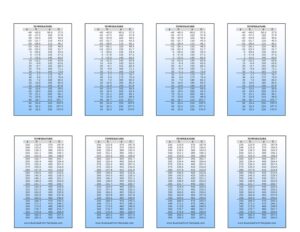
Pocket Temperature Converter
Download a free Pocket Temperature Converter template in PDF and DOCX to quickly convert Celsius, Fahrenheit, and Kelvin anywhere, free download.
PDF
DOCX
3 downloads
0
likes
Download Files
- DOCX
A Pocket Temperature Converter is a compact, printable reference sheet that helps you translate temperatures between Celsius, Fahrenheit, and Kelvin without a calculator or internet connection. People most often use it as a quick-glance tool while cooking, traveling, working in a lab, or monitoring equipment, and you can download it free in PDF and DOCX with no signup required.
What Is a Pocket Temperature Converter?
A Pocket Temperature Converter is a small, single-page reference document that pairs conversion formulas with a ready-made lookup table for common temperature values. It is used by anyone who regularly switches between measurement systems: cooks following recipes from another country, students in science classes, technicians reading instrument gauges, healthcare aides checking fevers, and travelers interpreting weather forecasts. Rather than recalculating each time, you fold the sheet into a wallet, tape it inside a cabinet, or pin it to a corkboard for instant answers. The template documents the core relationships between Celsius, Fahrenheit, and Kelvin, then lists frequently needed conversions so you can find a value at a glance instead of doing mental arithmetic under pressure.
When Do You Need a Pocket Temperature Converter?
This tool earns its place anywhere temperatures matter but units differ. Common situations include:
- Cooking and baking: Converting an oven recipe written in Celsius to your Fahrenheit dial, or vice versa, so a cake bakes at the right heat.
- International travel: Making sense of a foreign weather report or thermostat that uses a system you are not used to.
- Science and education: Helping students and lab assistants move between Celsius, Fahrenheit, and the Kelvin scale used in physics and chemistry.
- Healthcare and home care: Reading a thermometer that displays a different scale than you expect when checking a temperature.
- Trades and maintenance: Interpreting HVAC settings, kiln readings, brewing temperatures, or equipment gauges marked in another unit.
- Outdoor and hobby use: Brewing, candle-making, gardening, or grilling where precise heat ranges affect the result.
What a Pocket Temperature Converter Should Have
A genuinely useful converter combines formulas with a reference table. The essential elements are the three conversion directions you will need most, a clearly labeled lookup table of common values, and a few fixed reference points that anchor the scales. A complete sheet should include:
- The formula to convert Celsius to Fahrenheit and Fahrenheit to Celsius.
- The formula linking Celsius to Kelvin for scientific use.
- A table of common temperatures shown side by side in each unit.
- Familiar landmarks such as freezing point, body temperature, and boiling point.
- A compact layout sized to fold, print, or pin where you need it.
How to Fill Out a Pocket Temperature Converter
Because this is a reference template rather than a data-entry form, “filling it out” means customizing it for your needs and using it correctly:
- Add a title and purpose: Label the sheet for its setting, such as “Kitchen Oven Conversions” or “Lab Reference.”
- Confirm the formulas: For Celsius to Fahrenheit, multiply by 9/5 and add 32. For Fahrenheit to Celsius, subtract 32 and multiply by 5/9. For Kelvin, add 273.15 to the Celsius value.
- Build your lookup table: List the temperatures you use most in the left column, then fill the converted values across.
- Mark key reference points: Note water freezing at 0°C / 32°F, body temperature near 37°C / 98.6°F, and water boiling at 100°C / 212°F.
- Highlight your common range: Bold the oven temperatures, weather range, or process settings you check most often.
- Print and place it: Print to PDF for a clean wallet copy or edit the DOCX to add your own values, then post it where it is handy.
Understanding the Three Scales
Each temperature scale serves a different purpose, and knowing why they exist makes the converter easier to use. Celsius sets 0 at the freezing point of water and 100 at its boiling point, which is why most of the world uses it for weather and cooking. Fahrenheit places freezing at 32 and boiling at 212, giving finer whole-number gradations that many people in the United States find intuitive for daily temperatures. Kelvin starts at absolute zero, the theoretical point of no molecular motion, and shares the same step size as Celsius, which makes it the standard for scientific work. Keeping all three on one sheet means you can move between everyday and technical contexts without losing track of which scale a number belongs to.
Tips for Accurate Conversions
Small habits keep your conversions reliable. Always note the unit symbol next to a number so you never confuse 40°C with 40°F. When precision matters, carry one decimal place rather than rounding too early, since rounding before converting can shift an oven temperature by several degrees. Remember that the two scales cross at exactly -40, where -40°C equals -40°F, which is a handy sanity check. For Kelvin, never use a degree symbol, because the unit is written simply as K. If you laminate the printed sheet, you can write on it with a dry-erase marker and reuse it for different projects.
Common Mistakes to Avoid
- Skipping the order of operations: Forgetting to add or subtract 32 before multiplying scrambles the result.
- Mixing up the fractions: Using 5/9 when you need 9/5 reverses the conversion direction.
- Rounding too soon: Trimming decimals early introduces errors that compound in sensitive recipes or experiments.
- Dropping the unit label: A bare number is meaningless if you cannot tell which scale it represents.
- Adding a degree symbol to Kelvin: Kelvin values are written without the degree mark.
- Trusting an outdated table: If you edited the DOCX, double-check that every converted value matches the formula.
Frequently Asked Questions
What is a Pocket Temperature Converter used for? It is a quick-reference sheet that lets you convert between Celsius, Fahrenheit, and Kelvin without a calculator. People keep it handy in kitchens, labs, workshops, and travel bags so they can read any temperature in the scale they understand best.
How do I convert Celsius to Fahrenheit by hand? Multiply the Celsius value by 9/5, then add 32. For example, 20°C becomes 36, plus 32, which equals 68°F. The reverse is to subtract 32 first, then multiply by 5/9.
Where does Kelvin fit in? Kelvin shares the same degree size as Celsius but starts at absolute zero. To convert, simply add 273.15 to a Celsius reading, so 0°C equals 273.15 K. It is mainly used in physics and chemistry rather than everyday weather or cooking.
Can I edit the template to add my own values? Yes. Download the DOCX version to type in the specific temperatures you use most, such as oven settings or process targets, and rearrange the table. The PDF version is ideal if you just want a clean, ready-to-print copy.
Is the temperature converter accurate enough for cooking and science? The formulas it uses are exact, so accuracy depends on how carefully you apply them and how much you round. For ovens, rounding to the nearest five degrees is usually fine; for lab work, keep extra decimal places to stay precise.
How much does this template cost? It is completely free to download in both PDF and DOCX, with no signup or account required. You can print as many copies as you like for personal, classroom, or workplace use.
This Pocket Temperature Converter template is provided as a general reference for informational purposes only and is not professional, scientific, or technical advice. For applications where precise temperature control affects safety or results, verify your figures against calibrated instruments and consult a qualified professional.
Related Forms
- Backstage Pass
- Days Without An Accident Sign
- Entry Form
- Customer Complaint Form
- Copyright Notice
- Entry Form White
Browse more in Miscellaneous.