
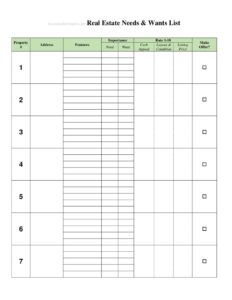
Real Estate Needs Wants Checklist
Use this free Real Estate Needs Wants Checklist template to define your must-haves and nice-to-haves before house hunting—free download in PDF and DOCX.
PDF
DOCX
2 downloads
0
likes
Download Files
- DOCX
A Real Estate Needs Wants Checklist is a simple planning worksheet that helps buyers and renters separate their non-negotiable requirements from their wish-list preferences before they start touring properties. Most people use it to focus their search, communicate clearly with an agent, and avoid emotional decisions during showings. It’s free to download here in both PDF and DOCX formats, with no signup required.
What Is a Real Estate Needs Wants Checklist?
A Real Estate Needs Wants Checklist is a structured document that organizes everything a buyer or renter is looking for in a home into two columns: things they truly need and things they would simply want. It’s typically used by homebuyers, renters, real estate agents, and relocation specialists at the very start of a property search. The checklist documents priorities such as location, price range, number of bedrooms and bathrooms, lot size, and lifestyle features. By writing these down in advance, you create a shared reference point that keeps everyone aligned and makes it easier to compare properties objectively rather than reacting to whichever home looks most appealing on the day.
When Do You Need a Real Estate Needs Wants Checklist?
This checklist is useful any time you’re about to make a major housing decision and want to stay focused. Common situations include:
- Starting a home search — first-time buyers who want to clarify their priorities before contacting an agent or browsing listings.
- Working with a real estate agent — handing your agent a completed checklist so they can filter listings to match your true requirements.
- Renting a new apartment or house — defining must-have amenities like in-unit laundry, parking, or pet policies before scheduling viewings.
- Relocating for a job — quickly narrowing down neighborhoods and home types in an unfamiliar city.
- Buying with a partner or family — aligning everyone’s expectations so disagreements surface on paper instead of mid-showing.
- Downsizing or upsizing — reassessing what features matter now that household needs have changed.
What a Needs Wants Checklist Should Have
A complete checklist gives you a clear, usable picture of your ideal property. The strongest versions include a defined budget or price range, preferred locations or neighborhoods, the minimum number of bedrooms and bathrooms, property type (single-family, condo, townhome, apartment), and a column to mark each item as a need versus a want. It should also leave room for lifestyle features—garage, yard, home office, outdoor space, school district, commute time—and a notes area for anything unique to your situation. Ranking or prioritizing items helps when you have to make trade-offs. The goal is a one- or two-page snapshot you can scan during a showing and use to score each property fairly.
How to Fill Out a Real Estate Needs Wants Checklist
- Set your budget. Write your maximum purchase price or monthly rent and note your financing or pre-approval status at the top so everything else stays realistic.
- Define location. List target neighborhoods, cities, or ZIP codes, plus acceptable commute times and proximity to work, schools, or family.
- Specify size requirements. Enter the minimum bedrooms and bathrooms, desired square footage, and any lot or yard size that matters to you.
- Choose property type. Indicate whether you want a single-family home, condo, townhouse, multi-family, or apartment.
- List interior features. Note items like an updated kitchen, home office, basement, central air, or in-unit laundry.
- List exterior and community features. Add garage, parking, pool, fenced yard, HOA preferences, or pet-friendly policies.
- Mark each item Need or Want. Go line by line and check the appropriate column so non-negotiables stand out.
- Rank and add notes. Prioritize your top needs and record any deal-breakers in the notes section.
Needs Versus Wants: How to Decide
The hardest part of this exercise is being honest about which features are truly essential. A useful test: a need is something that, if missing, would make you walk away from a home regardless of how nice the rest of it is—such as being within a specific school district, having ground-floor access for mobility reasons, or staying under a firm price ceiling. A want is something that would delight you but could be added later or lived without, like a finished basement, a particular countertop material, or a soaking tub. Many features fall in a gray zone, so it helps to imagine two homes that are identical except for one feature and ask whether you’d actually pay more or compromise elsewhere to get it. Keeping your true needs list short—often five to eight items—keeps your search realistic in competitive markets.
Using the Checklist During Showings
Bring a printed copy or open the DOCX on your phone for every property tour. As you walk through, mark which needs the home satisfies and jot quick notes about wants. After visiting several homes, your completed checklists become an easy side-by-side comparison, which is far more reliable than memory. Share the document with your agent and any co-buyers so feedback stays consistent. If you find that no homes in your budget meet all your needs, the checklist makes it obvious which requirement to revisit—price, location, or size—rather than abandoning the search in frustration.
Common Mistakes to Avoid
- Labeling everything a need. If half your list is non-negotiable, you’ll never find a match—be ruthless about what’s truly essential.
- Ignoring the budget reality. Listing features that exceed your price range only leads to disappointment; tie wants to what you can realistically afford.
- Skipping location specifics. Vague answers like “good area” are hard to act on—name neighborhoods, commute limits, or school zones.
- Forgetting future needs. A growing family or remote work can change requirements; factor in the next few years, not just today.
- Not updating the list. Markets and priorities shift, so revise the checklist if your search stalls or your budget changes.
- Leaving co-buyers out. Filling it out alone when buying with a partner guarantees conflict later—complete it together.
Frequently Asked Questions
What is a Real Estate Needs Wants Checklist used for? It’s used to organize and prioritize what you’re looking for in a home before you start touring properties. By separating must-haves from nice-to-haves, it keeps your search focused and helps you and your agent compare homes objectively.
How do I fill out the checklist? Start with your budget and preferred locations, then list size requirements, property type, and interior and exterior features. Mark each item as a need or a want, rank your top priorities, and add any deal-breakers in the notes section.
Is this checklist legally binding? No. It’s a personal planning tool, not a contract or offer. It carries no legal weight and is meant only to guide your search and communication with your agent or co-buyers.
How many items should be on my needs list? There’s no fixed rule, but keeping your true needs to roughly five to eight items keeps your search realistic. If too many features are marked as needs, you may struggle to find any home that qualifies.
Can I use this for renting as well as buying? Yes. Renters can adapt the same checklist to capture priorities like monthly rent limits, lease length, pet policies, parking, and amenities, making it equally useful for apartment and rental house searches.
How much does this template cost? It’s completely free to download here in both PDF and DOCX formats, with no signup or payment required. You can fill it in digitally or print it to carry along on property tours.
This template is a general example provided for informational purposes only and does not constitute legal, financial, or real estate advice. Property requirements, market conditions, and contractual obligations vary by location—consult a qualified real estate professional or advisor for guidance specific to your situation.
Official resource: for the rules that apply to your situation, see HUD.
Related Forms
- Intent To Vacate Apartment
- Landlord Move-Out Letter
- Lease Extension Approval
- Property Management Agreement
- Apartment Hunting Checklist
- Credit Drop Letter Of Explanation Mortgage
Browse more in Rental and Real Estate.