
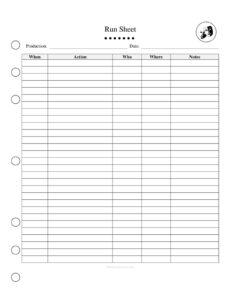
Run Sheet
Download a free run sheet template for theater productions to track cues, scene changes, and timing — free PDF and DOCX download, no signup needed.
PDF
DOC
17 downloads
0
likes
Download Files
- DOC
A run sheet is the backbone document that guides a live theater production from the first preshow check through the final blackout, listing every cue, scene change, and crew action in the exact order they happen. Stage managers, crew chiefs, and assistant stage managers reach for it most often to keep a show running smoothly and consistently from night to night. You can download this run sheet free in both PDF and DOCX formats, with no signup required.
What Is a Run Sheet?
A run sheet is a chronological, time-ordered list of every action a crew member or stage manager must perform during a performance. Typically created and maintained by the stage management team, it documents lighting and sound cues, scenery and prop movements, fly system operations, actor entrances tied to cues, and the timing between each event. Unlike a script, which captures dialogue, a run sheet translates the show into actionable instructions: who does what, when, and on whose call. It serves as the single source of truth during the run, so a substitute crew member or a new assistant can step in and execute the show exactly as rehearsed and approved by the director and technical team.
When Do You Need a Run Sheet?
A run sheet becomes essential the moment a production grows beyond a single performer and a bare stage. Common situations include:
- Tech rehearsals — assembling and refining the order of cues before opening night, when timing and sequencing get locked in.
- Multi-night runs — ensuring every performance is executed identically so audiences and reviewers see a consistent show.
- Crew handoffs — onboarding a swing crew member, deck hand, or substitute stage manager who must learn the show quickly.
- Quick-change and scene-change choreography — coordinating prop movements, furniture resets, and costume changes that happen in seconds during blackouts.
- Fly and rigging operations — tracking which line sets move in and out and on which cue, where safety and timing are critical.
- Touring productions — adapting the same show to different venues while keeping the cue sequence reliable.
Types of Run Sheets
Productions often maintain several specialized run sheets that together cover the whole show. A deck run sheet lists scenery and prop moves for the crew working the stage floor. A fly run sheet covers all line set movements for the fly operator. A props run sheet tracks preset locations, hand-offs, and resets. Larger shows may also keep a wardrobe run sheet for quick changes and a sound or follow-spot run sheet. The master version, usually held by the stage manager, ties everything to the calling script so each department executes its own cues in harmony.
What a Run Sheet Should Have
A complete run sheet should capture every element needed to run the show without guesswork. At minimum it includes the production title and performance date, the act or scene reference, the cue number or label, a clear description of the action, the person or department responsible, the placement or location on stage, and the timing or trigger. Many run sheets also add columns for preset checks, notes, and standby warnings. The goal is clarity under pressure: anyone reading the sheet in a dim wing should instantly understand what to do and when.
How to Fill Out a Run Sheet
Build your run sheet step by step so it mirrors the show in real time:
- Header: Enter the production name, performance date or run period, and the venue at the top so the sheet is unmistakable.
- Act / scene: Divide the document into acts and scenes in performance order to anchor each entry.
- Cue number or label: Assign a unique identifier to each event (for example LX 12, SQ 4, or Fly 3) that matches the calling script.
- Action description: Write a concise, action-first instruction — “Strike sofa, set dining table SR.”
- Responsible party: Name the crew member or department executing the action.
- Location / placement: Specify stage-left, stage-right, upstage, or the exact line set or position.
- Timing / trigger: Note what initiates the action — a line of dialogue, a blackout, or a standby-and-go call.
- Notes: Add reminders, safety cautions, or preset checks in the final column.
Tips for a Reliable Run Sheet
Keep entries short and consistent so they can be scanned in low light. Use the same abbreviations the calling stage manager uses on headset, and bold or highlight high-risk moves such as fly cues or actor flying. Sequence everything strictly in the order it happens, even when actions overlap, and add a standby note a few lines before a critical cue. Update the master copy immediately whenever a change is made in rehearsal, then distribute fresh copies to every department so no one is working from an outdated version. Laminating or printing a clean final copy for each station prevents confusion mid-show.
Run Sheet vs. Cue Sheet
These terms overlap but are not identical. A cue sheet usually belongs to a single department — lighting or sound — and lists only that department’s cues with technical settings. A run sheet is broader and crew-focused, describing physical actions like moving scenery, setting props, and operating the fly system across the whole performance. The calling script, meanwhile, is the master document the stage manager reads from to call standbys and gos. Together they keep every moving part synchronized.
Common Mistakes to Avoid
- Vague action descriptions — “move the table” without saying which table or where leads to mid-show hesitation.
- Out-of-order entries — listing actions out of sequence forces crew to hunt for the next move.
- Outdated versions in circulation — failing to redistribute after a change causes crew to execute old blocking.
- Missing responsible party — an action with no assigned person is an action that may not happen.
- No standby cues — omitting warnings before critical moves invites missed or late cues.
- Overcrowded formatting — cramming too much into one line makes the sheet unreadable in the dark.
Frequently Asked Questions
What is a run sheet in theater? A run sheet is a chronological list of every crew action, cue, and scene change during a performance, organized in the order they occur. It tells each crew member what to do, where, and on what trigger, so the show runs the same way every night.
Who creates and maintains the run sheet? The stage management team — typically the stage manager and assistant stage managers — builds the run sheet during tech rehearsals. They update it as cues change and distribute current copies to deck crew, fly operators, and other departments.
How is a run sheet different from a cue sheet? A cue sheet is department-specific and focuses on technical settings for lighting or sound, while a run sheet covers physical crew actions across the entire production. The run sheet is action-oriented and crew-facing, whereas a cue sheet is more technical.
Does a run sheet need to follow a strict order? Yes. The entire value of a run sheet comes from listing events in the exact sequence they happen during the show. Keeping entries chronological lets crew flow from one action to the next without searching.
Can I customize this run sheet template? Absolutely. Because it downloads in editable DOCX as well as PDF, you can add columns for standbys, presets, or department-specific notes, and adapt headings to match your production’s calling system.
Is this run sheet template free to download? Yes. This run sheet template is completely free to download in both PDF and DOCX formats with no signup or account required, so you can start building your show paperwork right away.
This run sheet template is a general example provided for informational purposes only and does not constitute professional production-management advice. Theater practices, safety procedures, and venue requirements vary — consult your venue’s technical director and qualified production professionals for guidance specific to your show.
Related Forms
- Sound Inventory Sheet
- Understudy Tracker
- Costume Changes
- Preliminary Props List
- Scene Breakdown Actors
- Rehearsal Schedule
Browse more in Theater.