
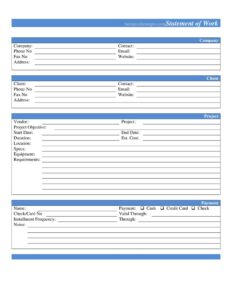
Statement of Work
Free statement of work (SOW) template in PDF & DOCX. Learn what an SOW is, what to include, and how to write one — download a printable copy today.
PDF
DOCX
1 downloads
0
likes
Download Files
- DOCX
A statement of work (SOW) is a document that defines exactly what a project will deliver — the tasks, timeline, costs, and responsibilities — so a client and a vendor share the same expectations. Download the free SOW template below in PDF or DOCX. No signup or email required.
What Is a Statement of Work?
A statement of work, often shortened to SOW, is the document that turns a vague “let’s work together” into a clear, agreed plan. It spells out what’s being delivered, who does what, when it happens, where the work takes place, and how much it costs. An SOW is commonly used between a client and a vendor or contractor — in consulting, construction, software, marketing, and many other fields — and it usually sits alongside or inside a larger contract. Its whole purpose is to prevent the misunderstandings that derail projects: by writing the objectives, deliverables, and deadlines down before work begins, both sides can point to one source of truth if questions come up later.
Statement of Work vs. Scope of Work vs. Contract
These terms get used loosely, but they’re distinct. The scope of work is one *part* of the SOW — the section that describes the specific tasks and deliverables. The statement of work is the broader document that contains the scope plus the timeline, costs, location, requirements, and terms. A contract is the overarching legal agreement; the SOW often becomes an attachment or exhibit to it, supplying the project-specific detail the contract refers to. Confusingly, “SOW” can stand for both *statement* and *scope* of work, so it’s worth confirming which one a client means.
When Do You Need a Statement of Work?
- Hiring a contractor, agency, or consultant for a defined project
- Starting any engagement where deliverables, deadlines, and costs need to be explicit
- Setting clear acceptance criteria so everyone agrees what “done” looks like
- Protecting both sides from scope creep and billing disputes
- Documenting a project as an attachment to a master services agreement
Key Components of a Statement of Work
A strong SOW leaves little to interpretation. It identifies the parties (company, client, and vendor), the project and its objective, the deliverables, the timeline (start date, end date, and duration), the cost and payment terms, the location where work happens, and any specifications, equipment, or requirements. The clearer each of these is, the less room there is for disagreement once the work is underway.
How to Fill Out a Statement of Work
- Enter the company, client, and vendor details — contact name, phone, email, and address for each.
- Name the project and write a clear project objective describing what it will achieve.
- Set the start date, end date, and duration, plus the location where the work will be performed.
- List the specifications, equipment, and requirements that define the deliverables and how they’ll be judged complete.
- Enter the estimated cost and the payment details — method (cash, credit card, or check), amount, and installment frequency if it’s paid in stages.
- Add any notes, then have both parties review and sign to confirm the scope and terms.
Tips for Writing a Clear SOW
The best statements of work are specific and measurable. Define deliverables in concrete terms — “a five-page website with contact form and CMS,” not “a website” — and attach acceptance criteria so there’s an objective test for completion. Break the timeline into milestones, and tie payments to them where possible. Spell out what’s *not* included as clearly as what is, since unstated assumptions are the usual source of scope creep. Finally, agree a process for handling change requests up front, so additions to the project are priced and approved rather than absorbed.
Common Mistakes to Avoid
- Vague deliverables that can’t be objectively marked complete
- No acceptance criteria, so “done” becomes a matter of opinion
- Leaving out the timeline or tying nothing to milestones
- Ignoring change management, which invites uncontrolled scope creep
- Failing to state what’s excluded, leading to assumptions and disputes
Who Uses a Statement of Work?
Statements of work appear in almost any industry where one party delivers a defined project for another. Consultants and agencies use them to scope marketing campaigns, design work, or strategy engagements. Construction firms and trades use them to define the build, materials, and timeline. Software and IT teams use them for development projects and managed services. Even internal departments use a lightweight SOW to agree what one team will deliver to another. Wherever money changes hands for a specific outcome, an SOW protects both sides by making the deliverables, schedule, and cost explicit before work starts — which is exactly why clients increasingly ask for one before approving any budget.
Frequently Asked Questions
What is a statement of work? It’s a document that defines a project’s deliverables, timeline, costs, location, and responsibilities so a client and vendor share the same expectations.
How do I write a statement of work? Identify the parties, state the objective and deliverables, set the timeline and cost, list requirements and acceptance criteria, and have both sides sign. The template above provides the structure.
What’s the difference between a statement of work and a scope of work? The scope of work is the part of an SOW that lists the specific tasks and deliverables; the statement of work is the broader document that also covers timeline, cost, and terms.
Is a statement of work a contract? Not exactly. It’s often an attachment to a contract that supplies the project-specific detail, though a signed SOW can carry contractual weight depending on how it’s written.
What is a statement of work in project management? It’s the foundational document that defines a project’s scope, schedule, and deliverables, giving the team and stakeholders a shared reference for what’s being built and when.
Who signs a statement of work? Both the client and the vendor or contractor sign it, confirming they agree on the scope, schedule, and cost before any work begins. A signed SOW becomes the shared reference both sides rely on throughout the project.
How much does this template cost? It’s free to download in PDF and DOCX.
Related Forms
Project Schedule · Project Status Report · Contract Modification · Business Quote Form · Requisition Form
This template is provided for general informational purposes only and is not legal advice. An SOW can create binding obligations — have important agreements reviewed by a qualified professional.
Need to work out sales tax? Use our free Sales Tax Calculator to add or remove sales tax from any amount in seconds.
Official resource: for the rules that apply to your situation, see the U.S. Small Business Administration.
Related Forms
- Letter to Confirm Verbal Order
- Receiving Record
- Replacement Parts Order Form
- Outstanding Invoices
- Purchase Order
- Tailor Alterations Form
Browse more in Invoices and Order Forms.