
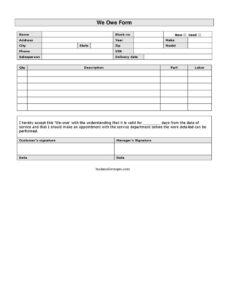
We Owe Form
Download a free We Owe form template for auto dealers to document parts, labor, and items owed to a customer after a vehicle sale. Free PDF and DOCX download.
PDF
DOCX
4 downloads
0
likes
Download Files
- DOCX
A We Owe form is a short dealership document that records any parts, accessories, repairs, or services a customer is still owed after purchasing a vehicle. Dealers most often use it to put promised but undelivered items—like a second key, floor mats, a touch-up, or a scheduled service—in writing at delivery. You can download this We Owe form free in both PDF and DOCX, with no signup required.
What Is a We Owe Form?
A We Owe form (sometimes written “We-Owe”) is issued by an auto dealership to acknowledge goods or services that were part of a vehicle sale but were not provided at the time of delivery. It documents what the dealer still owes the buyer, who agreed to it, and the vehicle it relates to. Because cars often leave the lot before a missing accessory arrives or a minor repair is scheduled, the form creates a paper trail both parties can rely on. It typically lists the customer, the salesperson, the vehicle details, and an itemized list of outstanding parts and labor, along with signatures from the customer and a manager.
When Do You Need a We Owe Form?
Any time something promised during the sale isn’t delivered on the spot, this form protects everyone involved. Common situations include:
- A second key fob, owner’s manual, or cargo cover is on backorder and must be ordered.
- Promised accessories such as floor mats, mud flaps, a bed liner, or window tint still need to be installed.
- A cosmetic touch-up, dent repair, or detailing is scheduled for a later appointment.
- A part that was missing or damaged at delivery—like a wheel cap or trim piece—needs to be replaced.
- The customer takes delivery after hours and a final service or inspection item is deferred.
- A trade-in or finance condition requires follow-up work the service department will complete later.
What a We Owe Form Should Have
A complete We Owe form ties the promise to a specific buyer and a specific vehicle so there is no confusion later. It should clearly identify the customer and their contact details, the salesperson who made the commitment, and the vehicle by stock number, year, make, model, and VIN. It must itemize each owed part or service with a description and indicate whether it is parts, labor, or both. Finally, it needs a validity window (the number of days the offer remains good), space for the customer to sign their acceptance, and a manager’s signature authorizing the commitment. Without dated signatures and a VIN, the document loses much of its value.
How to Fill Out a We Owe Form
- Enter the customer’s name, address, city, state, zip, and phone so the dealer can reach them to schedule the work.
- Record the salesperson who handled the deal and made the promise.
- Fill in the vehicle’s stock no, year, make, model, and VIN, and check whether it is new or used.
- Note the delivery date the vehicle was handed over to the customer.
- In the itemized section, list each owed item with its qty, a clear description, and mark whether it involves part, labor, or both.
- Complete the validity statement by entering the number of days the We Owe remains valid from the date of service.
- Have the customer review and sign in the customer’s signature line, the manager’s signature line is signed to authorize it, and add the date.
Why the Validity Window and Appointment Note Matter
This template includes a key acknowledgment: the customer accepts the We Owe with the understanding that it is valid for a set number of days from the date of service and that an appointment with the service department must be made before the listed work can be performed. That clause does two things. First, it sets a clear expiration so commitments don’t linger indefinitely—fill in a reasonable, dealership-standard number of days. Second, it manages expectations: the customer knows they need to schedule the work rather than simply show up. Spelling this out at signing prevents disputes weeks later when a backordered part finally arrives or when the customer expected same-day service.
Keeping Good Records After the Form Is Signed
Once signed, give the customer a copy and keep the dealership’s copy with the deal jacket or in your DMS. When the parts arrive or the service slot is booked, reference the stock number and VIN so the right vehicle and the right promise are matched. Mark the form as fulfilled once the work is complete, and consider having the customer initial or sign again to confirm they received everything owed. Treating the We Owe as a living record—not a one-time slip of paper—reduces the chance of a forgotten obligation and keeps your customer satisfaction (and CSI scores) intact.
Common Mistakes to Avoid
- Leaving the VIN or stock number blank, which makes it hard to match the owed work to the correct vehicle.
- Writing vague descriptions like “extras” instead of naming the specific part, accessory, or service.
- Forgetting to fill in the number of valid days, leaving the commitment open-ended.
- Skipping the manager’s signature, so no one with authority has actually approved the obligation.
- Not giving the customer a copy or failing to keep one on file with the deal paperwork.
- Promising work verbally and never documenting it on the form, which leads to disputes after delivery.
Frequently Asked Questions
What is a We Owe form used for? It documents parts, accessories, repairs, or services that a dealership promised during a vehicle sale but did not deliver at the time the car was handed over. It creates a written record both the buyer and the dealer can reference until the obligation is fulfilled.
Is a We Owe form legally binding? When signed by both the customer and an authorized dealership manager, it generally serves as evidence of the dealer’s commitment to provide the listed items. Its enforceability depends on the terms, your sale documents, and local law, so the validity window and clear descriptions matter.
Does a We Owe form need to be notarized? No. A We Owe form typically does not require notarization or witnesses; the customer’s signature and the manager’s authorizing signature are usually sufficient. Always follow your dealership’s own policies and any applicable state requirements.
How long is a We Owe form valid? This template lets the dealer specify the number of days it stays valid from the date of service. Choose a reasonable window based on parts availability and dealership policy, and make sure the customer schedules an appointment before that period expires.
Who signs the We Owe form? The customer signs to accept the terms and confirm the items owed, and a dealership manager signs to authorize the commitment. The salesperson who arranged the deal is named on the form for reference.
How much does this We Owe form cost? Nothing—you can download it free from Business Forms Pro in both PDF and DOCX formats with no signup. Edit the DOCX version to add your dealership name, logo, and standard validity period before printing.
This We Owe form template is a general example provided for informational purposes only and is not legal, financial, or tax advice. Requirements and enforceability vary by jurisdiction and by dealership policy, so consult a qualified professional before relying on this document for your business.
Official resource: for the rules that apply to your situation, see your state DMV.
Related Forms
- Motor Vehicle Bill of Sale
- Fuel Tracker
- Vehicle Loan Payment Calculator
- Vehicle Inspection Report
- Salesperson Commission Voucher
- Car Bill of Sale
Browse more in Auto Sales.