
Non-Cash Contribution Letter
Download a free Non-Cash Contribution Letter template to acknowledge in-kind donations and give donors a tax receipt — free PDF and DOCX download.
PDF
DOCX
1 downloads
0
likes
Download Files
- DOCX
A Non-Cash Contribution Letter is a written acknowledgement that a charity, church, or nonprofit sends to a donor confirming receipt of a donated item or property rather than money. People most often use it to give donors a receipt they can keep for tax purposes when claiming a deduction for an in-kind gift. This template is free to download in PDF and DOCX, with no signup required.
What Is a Non-Cash Contribution Letter?
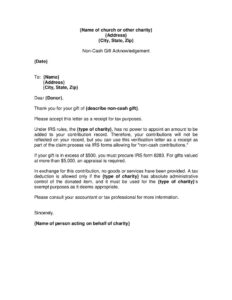
A Non-Cash Contribution Letter is a formal donation receipt issued by a qualifying organization to acknowledge a gift of goods, property, or other non-monetary items. It is typically signed by someone acting on behalf of the charity and sent to the donor after the gift is received. The letter describes the donated item, confirms the date, and states whether any goods or services were provided in return. Because the IRS does not allow the charity to assign a dollar value to most donated property, the letter serves as proof that the contribution occurred — leaving the valuation to the donor and their tax advisor. It supports the donor’s recordkeeping when claiming a charitable deduction.
When Do You Need a Non-Cash Contribution Letter?
Organizations and donors rely on this letter whenever a gift is given in a form other than cash. Common situations include:
- A church receives a donated vehicle, furniture, or office equipment and needs to thank the donor while documenting the gift.
- A nonprofit accepts donated clothing, books, or household goods and must provide a receipt for the donor’s tax records.
- A charity is given stock, artwork, or collectibles and needs to acknowledge the contribution without stating a value.
- A food bank or shelter receives in-kind supplies and wants to confirm that no goods or services were exchanged.
- A donor requests written verification of a gift valued over $500 so they can complete IRS Form 8283.
- An organization needs a consistent template to acknowledge all property donations throughout the year.
What a Non-Cash Contribution Letter Should Have
A complete letter establishes the charity’s identity, identifies the donor, and clearly describes the gift. It should include the organization’s name and address, the date of the acknowledgement, the donor’s name and address, and a plain description of the non-cash gift. Critically, it must state that no goods or services were provided in exchange for the contribution (or describe them if they were), because the IRS requires this statement for deductions. It should also note the donor’s responsibility to obtain IRS Form 8283 for gifts over $500 and an appraisal for gifts over $5,000, and remind the donor to consult a tax professional. A signature from an authorized representative completes the document.
How to Fill Out a Non-Cash Contribution Letter
- At the top, enter the Name of church or other charity, followed by its Address and City, State, Zip so the donor can identify the issuing organization.
- Add the Date the acknowledgement is being issued.
- In the “To” block, fill in the donor’s Name, Address, and City, State, Zip.
- Open with the salutation by inserting the Donor name after “Dear.”
- In the thank-you line, complete the describe non-cash gift field with a clear, specific description of the item donated — for example, “a 2015 Toyota sedan” or “three boxes of children’s books.” Do not assign a dollar value.
- Where the template references the type of charity, insert the appropriate organizational description (such as “church” or “501(c)(3) organization”) so the IRS language reads correctly.
- Review the standard statements about Form 8283, the $5,000 appraisal threshold, and the “no goods or services” confirmation.
- Sign off and enter the Name of person acting on behalf of charity beneath “Sincerely.”
Valuation, Form 8283, and Appraisals
One of the most important features of this letter is what it deliberately does not do: it does not state a value for the donated item. Under IRS rules, the charity cannot appoint or certify the amount of a non-cash gift — that responsibility falls to the donor. The donor uses the letter as verification of the contribution and then determines fair market value for their own records. For gifts valued above $500, the donor generally must file IRS Form 8283 with their return. For gifts valued above $5,000, a qualified appraisal is typically required. The letter also confirms the charity has full administrative control of the item and will use it for its exempt purposes, which is a condition for the deduction to be allowed.
How It Differs From a Cash Donation Receipt
A cash donation receipt can simply state the dollar amount given, because the value is objective and undisputed. A non-cash acknowledgement is different: it describes the property but leaves valuation to the donor, since the worth of goods, vehicles, or securities is a matter of fair market value rather than a fixed sum. This distinction is why the letter focuses on a detailed description and the “no goods or services” statement instead of a figure. Keeping the two types of receipts separate helps both the organization and the donor stay compliant and keeps records clean at tax time.
Common Mistakes to Avoid
- Stating a dollar value for the donated item — the charity should describe the gift, not appraise it.
- Forgetting the required statement that no goods or services were provided in exchange, which can jeopardize the donor’s deduction.
- Writing a vague description like “miscellaneous items” instead of a specific, identifiable description of the gift.
- Leaving out the date or the donor’s full name and address, which weakens the letter as a receipt.
- Failing to mention the Form 8283 and appraisal thresholds for larger gifts.
- Sending the letter without a signature from an authorized representative of the organization.
Frequently Asked Questions
What is a Non-Cash Contribution Letter used for? It is used by a charity or church to acknowledge a gift of property or goods and to give the donor a written receipt for tax purposes. It documents that the contribution was received and that nothing of value was given in return. The donor keeps it as part of their charitable deduction records.
Can the charity put a dollar amount on the donated item? No. Under IRS rules, the organization generally cannot assign or certify a value to a non-cash gift. The letter describes the item, and it is the donor’s responsibility to determine fair market value, often with the help of a tax professional or appraiser.
Do I need IRS Form 8283? If the donated gift is valued over $500, the donor typically must file Form 8283 with their tax return. For gifts valued at more than $5,000, a qualified appraisal is generally required as well. The acknowledgement letter supports these filings but does not replace them.
Does this letter need to be notarized or witnessed? No, a Non-Cash Contribution Letter does not normally require notarization or witnesses. It only needs an accurate description of the gift, the required IRS statements, and a signature from an authorized representative of the organization. Keep a copy for your records.
Is a Non-Cash Contribution Letter legally required? Donors are generally required to keep written acknowledgement to substantiate charitable deductions, so issuing this letter is good practice and often necessary for the donor. Requirements and thresholds vary, so the organization and donor should confirm current IRS rules. The letter helps both parties maintain proper records.
How much does this template cost? The template is completely free to download here in both PDF and DOCX formats, with no signup required. You can edit it to match your organization’s name, the donor’s details, and the specific gift. Reuse it for any qualifying non-cash donation.
This template is provided as a general example for informational purposes only and is not legal, financial, or tax advice. IRS rules and substantiation requirements can change and may vary by situation, so consult a qualified accountant or tax professional before relying on this document.
Related Forms
- Affidavit Of Non Collusion
- Affidavit Of Marriage
- Affidavit Of Survivorship
- Affidavit Of Loss
- Affidavit Of Residence
- Affidavit Of Financial Support
Browse more in Affidavits.