
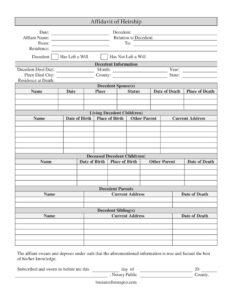
Affidavit Of Heirship
Free affidavit of heirship template in PDF & DOCX. Learn what it is, who can sign it, whether it transfers title, and how to fill it out — download today.
PDF
DOC
3 downloads
0
likes
Download Files
- DOC
An affidavit of heirship is a sworn document that identifies the legal heirs of someone who has died, often used to transfer property when there is no will or probate. Download the free affidavit of heirship template below in PDF or DOCX. No signup or email required.
What Is an Affidavit of Heirship?
An affidavit of heirship is a notarized statement, made under oath, that establishes who the rightful heirs of a deceased person (the “decedent”) are. It records the family history — the decedent’s marriage(s), children, and surviving relatives — so that property can pass to those heirs without a full, lengthy probate process. It’s most commonly used for real estate, but it can also help with vehicles, bank accounts, and other assets, depending on local rules. Because it’s a sworn legal document, it must be accurate and complete, and it’s typically signed by people who knew the decedent and the family well.
When Is an Affidavit of Heirship Used?
This affidavit is most useful when someone dies without a will (intestate) and the estate is relatively simple, so the family wants to avoid the time and cost of formal probate. Common situations include transferring a house or land into the heirs’ names, clearing the title on a property so it can be sold or refinanced, or distributing a modest estate among clear heirs. It works best when there’s no dispute about who the heirs are. If the estate is large, contested, or involves complex assets, formal probate or legal guidance is usually the safer route.
Who Can Sign an Affidavit of Heirship?
The person who signs an affidavit is called the affiant. Ideally, the affiant is someone who knew the decedent and their family for many years but who does *not* personally stand to inherit — a “disinterested” witness such as a longtime friend, neighbor, or distant relative. The reason is credibility: a statement about who the heirs are carries more weight when it comes from someone with no financial stake in the outcome. Many jurisdictions prefer or require two disinterested witnesses. The affiant swears the information is true, which is why the document must be notarized.
What Information It Requires
The affidavit asks for detailed family history so the chain of heirs is clear. The template above gathers the date, the decedent’s name and information, the affiant’s name and relationship to the decedent, and whether the decedent left a will. It then records the decedent’s death details — date, place, and residence at death — along with information about any spouse(s) (including dates of marriage, death, or divorce) and every child, with their dates and places of birth and current addresses. Capturing this accurately is the whole point: errors or omissions can cloud the title later.
How to Fill Out an Affidavit of Heirship
- Enter the date, the decedent’s name, and the affiant’s name and relationship to the decedent.
- State the affiant’s residence and how long they knew the decedent and the family.
- Indicate whether the decedent left a will or did not, and provide the decedent’s death details — day, month, year, place died (city, county, state), and residence at death.
- List each spouse: name, dates of marriage, and status (living, deceased with date, or divorced).
- List every child — living and deceased — with name, date and place of birth, the other parent, and current address.
- Sign before a notary, ideally with the required number of disinterested witnesses, then file or record it as your jurisdiction requires.
Does an Affidavit of Heirship Transfer Title?
This is the most important question, and the honest answer is: not by itself, and it depends on your state. An affidavit of heirship doesn’t automatically re-title property the way a probate court order does. Instead, it creates a sworn public record of who the heirs are, which title companies, county clerks, and buyers can rely on. In many states, once it’s recorded and a waiting period passes without challenge, it effectively allows the heirs to deal with the property. In others, it’s supporting evidence that must be paired with additional steps. Before relying on it to sell or refinance, confirm how your county and a title company treat it.
Common Mistakes to Avoid
- Using an interested heir as the only affiant instead of a disinterested witness
- Leaving out a child, marriage, or prior spouse, which can cloud the title
- Failing to notarize, or skipping witnesses where they’re required
- Assuming it instantly transfers title without checking local rules
- Guessing at dates or details rather than confirming them from records
Frequently Asked Questions
What is an affidavit of heirship? It’s a sworn, notarized statement identifying the legal heirs of someone who has died, used to help transfer property — often when there is no will.
Does an affidavit of heirship transfer title? Not on its own in most places. It creates a public record of the heirs that title companies and clerks rely on, but transferring or selling property may require recording it and meeting additional state requirements.
Who can sign an affidavit of heirship? The affiant should be someone who knew the decedent and family for years but doesn’t stand to inherit — a disinterested witness. Many areas prefer two such witnesses.
Can I do my own affidavit of heirship? You can prepare one using a template like this, gather the family details, and have it notarized. For valuable property or any uncertainty, it’s wise to have a title company or attorney review it first.
How do I fill out an affidavit of heirship? Record the decedent’s death details, marriages, and all children, have a disinterested witness swear to the information, and notarize it. The template above walks through each field.
How much does this template cost? It’s free to download in PDF and DOCX.
Related Forms
Affidavit of Survivorship · Affidavit of Domicile · Affidavit of Title · Affidavit of Identity · Beneficiaries List
This template is provided for general informational purposes only and is not legal advice. Heirship and property-transfer laws vary significantly by state — consult an attorney or title company before relying on this document.
Related Forms
- Affidavit Of Gift
- Non-Cash Contribution Letter
- Affidavit Of Non Collusion
- Affidavit Of Correction
- Affidavit Of Title
- Affidavit Of Domicile
Browse more in Affidavits.