
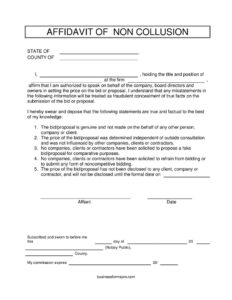
Affidavit Of Non Collusion
Download a free Affidavit of Non-Collusion template in PDF and DOCX to certify your bid was prepared independently — no signup, instant free download.
PDF
DOCX
12 downloads
0
likes
Download Files
- DOCX
An Affidavit of Non-Collusion is a sworn statement in which a bidder certifies that their bid or proposal was prepared independently and without any secret agreement to fix prices or rig the outcome. It is most commonly required when submitting a bid for a government contract or public procurement, and you can download it free in PDF and DOCX formats with no signup required.
What Is an Affidavit of Non-Collusion?
An Affidavit of Non-Collusion is a notarized document signed by an authorized representative of a bidding company, swearing under oath that the firm did not coordinate, communicate, or conspire with competitors to manipulate the bidding process. It is typically issued by the company submitting a bid and provided to the agency or organization soliciting proposals. The affidavit documents that the price was set independently, that no kickbacks or improper inducements were involved, and that the bidder understands false statements amount to fraud. Public agencies require it to protect the integrity of competitive bidding and ensure taxpayers receive fair pricing through genuine competition rather than collusion among vendors.
When Do You Need an Affidavit of Non-Collusion?
This affidavit appears most often in formal procurement and contracting settings. You may need one in the following situations:
- Government and public contracts: Federal, state, county, or municipal agencies frequently require a non-collusion affidavit as a mandatory part of any sealed bid package.
- Construction and infrastructure projects: Contractors bidding on roads, schools, utilities, or public buildings submit this affidavit alongside their proposal.
- School district and university purchasing: Educational institutions often demand the affidavit when awarding supply, service, or construction contracts.
- Large private RFPs: Some corporations and nonprofits adopt similar requirements to ensure competitive integrity among vendors.
- Grant-funded procurement: Organizations spending public grant money may be required to collect non-collusion affidavits to comply with funding conditions.
- Vendor pre-qualification: Agencies maintaining approved-vendor lists sometimes require the affidavit before accepting a firm into the pool.
What an Affidavit of Non-Collusion Should Have
To be valid and acceptable to a procuring agency, the affidavit should contain several core elements. It must identify the state and county where the oath is administered, name the affiant and their official title, and identify the firm on whose behalf they are speaking. It should include a clear statement that the affiant is authorized to set the bid price, an acknowledgment that misstatements constitute fraudulent concealment, and a sworn declaration that the statements are true. Finally, it requires the affiant’s signature, the notary’s jurat with the date, the notary’s signature and county, and the notary’s commission expiration date. Without proper notarization, most agencies will reject the document.
How to Fill Out an Affidavit of Non-Collusion
- State and County: Enter the state and county where you are signing and where the notary is commissioned at the top of the form.
- Affiant name: After “I,” write the full legal name of the person making the sworn statement.
- Title and position: Enter your official role, such as President, Owner, or Authorized Agent, confirming you can speak on pricing.
- Firm name: Fill in the complete legal name of the company submitting the bid or proposal.
- Sworn statements: In the open area provided, list the specific non-collusion declarations required by the soliciting agency, or attach the agency’s prescribed language.
- Affiant signature: Sign on the line labeled “AFFIANT” — but do not sign until you are in front of the notary.
- Notary jurat: The notary completes the day, month, and year, signs as Notary Public, states their county, and enters the commission expiration date.
Why Agencies Require Non-Collusion Affidavits
Competitive bidding only works when each vendor prices its proposal independently. Collusion — such as bid rigging, price fixing, or arranging which competitor will “win” a particular contract — undermines fair competition and inflates costs for the public. By requiring this affidavit, agencies create a documented, sworn record that holds bidders accountable. Because the statement is made under oath and notarized, a false declaration can expose the affiant and the firm to penalties for perjury, contract disqualification, and potentially civil or criminal liability under antitrust and procurement laws. The affidavit therefore serves both as a deterrent and as evidence should an investigation arise later.
Notarization and Submission Tips
Because this is a sworn affidavit, notarization is almost always mandatory. Bring valid photo identification to the notary, and confirm with the procuring agency whether the affidavit must accompany the sealed bid or be submitted separately. Keep a complete copy for your records, and review the solicitation documents for any agency-specific wording — some entities supply their own exact text that must be used verbatim. Submit the affidavit by the bid deadline; a missing or late affidavit can cause an otherwise winning bid to be rejected as non-responsive. When multiple owners or board members are involved, make sure the signer is genuinely authorized to bind the company on price.
Common Mistakes to Avoid
- Signing before the notary: The affiant must sign in the notary’s presence; pre-signing invalidates the jurat.
- Using an unauthorized signer: The person signing must have authority to set the bid price for the company.
- Leaving blanks unfilled: Empty state, county, title, or firm fields make the affidavit incomplete and may trigger rejection.
- Ignoring agency-specific language: Many agencies require their own exact wording rather than a generic template.
- Missing the commission expiration: An incomplete notary block can void the document.
- Submitting after the deadline: A late affidavit can render the entire bid non-responsive.
Frequently Asked Questions
What is an Affidavit of Non-Collusion? It is a notarized sworn statement in which a bidder certifies that their bid was prepared independently and without any agreement to fix prices or rig the bidding process. It is most often required as part of a government or public procurement bid package.
Does an Affidavit of Non-Collusion need to be notarized? Yes, in nearly all cases. Because the form includes a jurat where the affiant swears the statements are true before a notary public, you must sign in front of a notary who then completes the notarization. Most agencies will reject an affidavit that is not properly notarized.
Who should sign the affidavit? The affiant must be a person authorized to set the bid price and speak on behalf of the company, board, and owners — typically an owner, officer, or designated authorized agent. The form specifically asks for the signer’s title and position to confirm this authority.
Is the affidavit legally binding? Yes. Because it is sworn under oath, a false statement can be treated as fraudulent concealment and may expose the signer to perjury charges, disqualification from the contract, and potential civil or criminal liability under procurement and antitrust laws.
How much does this template cost? The Affidavit of Non-Collusion template is completely free to download here in both PDF and DOCX formats, with no signup or payment required. You can edit the DOCX version to match the language your soliciting agency requires.
Can I edit the template to fit my bid? Yes. The DOCX version is fully editable, so you can insert the specific non-collusion declarations your agency prescribes. Always check the solicitation documents, because some agencies require their exact wording to be used without changes.
This template is provided as a general example for informational purposes only and does not constitute legal, financial, or procurement advice. Requirements for non-collusion affidavits vary by jurisdiction and by the soliciting agency — consult the bid instructions and a qualified attorney before submitting.
Related Forms
- Affidavit Of Title
- Affidavit Of Financial Support
- Affidavit Of Birth
- Affidavit Of Heirship
- Affidavit Of Residence
- Non-Cash Contribution Letter
Browse more in Affidavits.