
Affidavit Of Non-Military Service
Download a free Affidavit of Non-Military Service template in PDF and DOCX to confirm a defendant's military status before a default judgment.
PDF
DOCX
3 downloads
0
likes
Download Files
- DOCX
An Affidavit of Non-Military Service is a sworn statement used to confirm that a defendant in a lawsuit is not currently serving on active duty in the U.S. armed forces. People most commonly use it before requesting a default judgment, because federal law requires the court to know a defendant’s military status before entering judgment against an absent party. You can download this Affidavit of Non-Military Service free in PDF and DOCX, with no signup required.
What Is an Affidavit of Non-Military Service?
An Affidavit of Non-Military Service is a notarized document in which the person signing (the affiant) swears, under penalty of perjury, that the defendant in a court case is not on active military duty. It is typically filed in connection with a request for a default judgment, where the defendant has failed to respond or appear. The affidavit exists because the Servicemembers Civil Relief Act (SCRA) protects active-duty members from having default judgments entered against them without certain safeguards. By documenting the defendant’s status, the affidavit lets the court proceed while respecting those protections. The statement is usually supported by personal knowledge or a Department of Defense status certificate.
When Do You Need an Affidavit of Non-Military Service?
Courts and litigants rely on this affidavit whenever military status could affect a defendant’s legal rights. Common situations include:
- Requesting a default judgment against a defendant who never answered the complaint.
- Filing in a debt collection or breach-of-contract case where the defendant did not appear.
- Pursuing an eviction or unlawful detainer action against a non-responsive tenant.
- Finalizing a divorce or family law matter where one spouse failed to respond.
- Foreclosure proceedings that require confirmation the borrower is not active-duty.
- Any civil action where the court rules require proof of military status before judgment is entered.
What an Affidavit of Non-Military Service Should Have
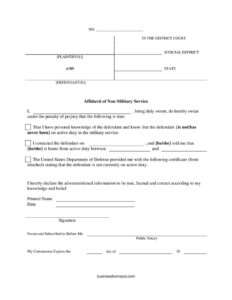
A complete affidavit clearly identifies the court and case so it can be filed in the correct proceeding. It should include the case number, the judicial district, and the state, along with the names of the plaintiff(s) and defendant(s). The body must contain a sworn statement of the affiant’s knowledge of the defendant’s military status, supported either by personal knowledge or an attached Department of Defense certificate. It also needs the affiant’s printed name, signature, and date, plus a notary section in which a notary public attests that the affidavit was subscribed and sworn before them. Without the notarization, courts will generally not accept it as valid evidence.
How to Fill Out an Affidavit of Non-Military Service
- Enter the case number at the top, then identify the judicial district and state where the matter is pending.
- Fill in the plaintiff(s) and defendant(s) names exactly as they appear in the court caption.
- Write your full legal name as the affiant in the line beginning “I, ______, being duly sworn.”
- Select the statement that fits: that the defendant is not / has never been on active duty.
- If you contacted the defendant, enter the date of contact and the dates the defendant said they are home from active duty.
- If you obtained a Department of Defense certificate, note it and attach the certificate to the affidavit.
- Print your name, add the date, and sign on the affiant line.
- Sign in front of a notary, who completes the day, month, and year, signs as Notary Public, names the county, and records the commission expiration.
Personal Knowledge vs. a DOD Certificate
This affidavit gives two ways to establish military status, and many courts prefer the stronger one. A statement based on personal knowledge means you genuinely know the defendant and their employment or service situation — for example, a family member, neighbor, or business partner. The more reliable method is attaching a military status certificate from the Department of Defense Manpower Data Center (SCRA verification), which provides an official record of whether a person is currently on active duty. If you check the box stating a DOD certificate was provided, you must physically attach that certificate to the affidavit. When in doubt, obtaining the official certificate reduces the chance the court rejects your filing or delays the judgment.
Notarization and Filing
Because this is a sworn affidavit, the signature must be notarized. Do not sign the document in advance — the notary needs to witness your signature and confirm your identity. After notarization, file the affidavit with the clerk of the court handling the case, usually alongside your motion or request for default judgment. Keep a copy for your records and verify any local formatting rules, such as caption style, paper size, or required attachments. Some courts have their own version of this form, so confirm whether the clerk accepts a general affidavit or requires a court-specific one before you submit.
Common Mistakes to Avoid
- Filing without the notary section completed — an unsworn statement is typically rejected.
- Failing to attach the DOD certificate after checking the box that says one was provided.
- Listing party names that don’t match the official court caption, causing filing errors.
- Stating personal knowledge when you have none — making a false sworn statement risks perjury charges.
- Leaving the case number, district, or state blank, so the clerk can’t match it to the case.
- Signing the affidavit before appearing in front of the notary public.
Frequently Asked Questions
What is an Affidavit of Non-Military Service used for? It is used to formally confirm to a court that a defendant is not on active military duty. This is usually required before a court will enter a default judgment, because federal law protects active-duty servicemembers from having judgments entered against them without additional safeguards.
Does the affidavit need to be notarized? Yes. An affidavit is a sworn statement, so it must be signed in the presence of a notary public who attests that you swore to its truth. Sign only when the notary is present, and let them complete the subscription and commission information.
Do I need a Department of Defense certificate to file it? Not always, but it is the strongest form of proof. You may rely on personal knowledge of the defendant’s status, though many courts prefer or require an official military status certificate from the DOD Manpower Data Center attached to the affidavit.
Who can sign this affidavit? Any person with personal knowledge of the defendant’s military status, or who has obtained a DOD verification certificate, can serve as the affiant. This is often the plaintiff, their attorney, or someone familiar with the defendant’s circumstances.
Is this affidavit legally binding? Once notarized and filed, it is a sworn legal statement made under penalty of perjury. Providing false information can result in serious legal consequences, so only state facts you genuinely know to be true.
How much does this template cost? This Affidavit of Non-Military Service template is completely free to download in PDF and DOCX from Business Forms Pro, with no signup or payment required. You only pay any notary or court filing fees charged where you live.
This template is a general example provided for informational purposes only and is not legal advice. Court requirements and military verification rules vary by jurisdiction and case type. Consult a qualified attorney to confirm the correct procedure and documentation for your specific situation.
Related Forms
- Affidavit Of Consent
- Affidavit Of Heirship
- Affidavit Of Domicile
- Affidavit Of Birth
- Affidavit Of Correction
- Affidavit Of Title
Browse more in Affidavits.