
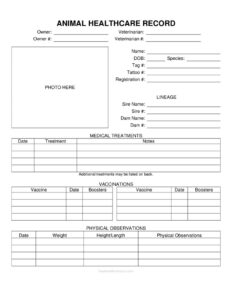
Animal Healthcare Record
Track vaccinations, treatments, and lineage with this free Animal Healthcare Record template — download in PDF or DOCX free, no signup needed.
PDF
DOC
7 downloads
0
likes
Download Files
- DOC
An Animal Healthcare Record is a single-sheet document used to track an individual animal’s identity, medical history, vaccinations, and treatments over its lifetime. Livestock owners, breeders, and hobby farmers most often use it to keep a complete, vet-ready health history in one place. You can download it free in PDF or DOCX, with no signup required.
What Is an Animal Healthcare Record?
An Animal Healthcare Record is a structured form that documents everything related to a single animal’s health and identity. It combines identification details — such as name, species, tag number, tattoo, and registration number — with a running log of vaccinations, boosters, medical treatments, and physical observations. Breeders also use it to record lineage through the dam and sire, while owners use it to monitor weight, height, and overall condition. Issued and maintained by the owner (often in coordination with a veterinarian), the record serves as the animal’s medical passport. It is especially valuable when an animal changes hands, enters a show, or needs urgent veterinary care, because it gives any handler instant access to the full health picture.
When Do You Need an Animal Healthcare Record?
This form is useful any time you need a documented, verifiable history for an animal. Common situations include:
- Routine herd or flock management — tracking annual vaccinations and booster schedules for cattle, sheep, goats, horses, or other livestock.
- Selling or transferring an animal — providing a buyer with proof of vaccinations, treatments, and registered lineage.
- Breeding programs — recording dam and sire details, registration numbers, and offspring health to maintain pedigree integrity.
- Veterinary visits — giving the vet a quick, accurate summary of past treatments and observed health issues.
- Shows, fairs, and competitions — meeting entry requirements that call for current vaccination and identification records.
- Emergency care or new caretakers — ensuring anyone handling the animal knows its medical background and known conditions.
What an Animal Healthcare Record Should Have
A complete record blends identification, lineage, and medical history so the document stands on its own. The essential elements are clear animal identification (name, species, tag, tattoo, registration), owner contact details, physical baseline measurements such as weight and height/length, and a chronological log of vaccinations and treatments. Strong records also include the attending veterinarian’s name and number, lineage through the sire and dam, a photograph for visual identification, and a notes area for ongoing observations. The more consistently each entry is dated, the more useful the record becomes as a timeline of the animal’s health.
How to Fill Out an Animal Healthcare Record
- Enter the animal’s Name and Species at the top, then record the Date the record is created or updated.
- Add identification details: Tag #, Tattoo #, and Registration # so the animal can be matched to other paperwork.
- Fill in the Owner name and Owner # (owner ID or contact number) for accountability.
- Record the DOB (date of birth), then capture baseline measurements under Weight and Height/Length.
- Complete the lineage section: Lineage overview plus Dam Name, Dam #, Sire Name, and Sire #.
- Attach or affix a clear image in the Photo Here space for visual identification.
- Log medical history in the Vaccinations, Vaccine, Boosters, Medical Treatments, and Treatment fields, dating each entry.
- Note your findings under Physical Observations, then enter the Veterinarian name and Veterinarian #. Use Notes for anything else, and continue on the back if you run out of room.
Tracking Vaccinations and Treatments Over Time
The medical sections are the heart of this form. For each vaccine, write the product name in the Vaccine field, the date it was given, and the scheduled date for any Booster. For Medical Treatments and the Treatment log, note the condition treated, the medication or procedure used, dosage, and the date. Because many vaccines and dewormers follow a recurring schedule, dating every entry lets you spot when the next dose is due and avoid gaps in protection. If a treatment involves a withdrawal period before an animal can enter the food chain, record that date clearly in the Notes section so it is never overlooked.
Why Lineage and Identification Matter
For registered or breeding animals, the dam and sire fields connect the individual to its pedigree, which affects value, breeding decisions, and eligibility for breed registries. Multiple identifiers — tag, tattoo, and registration number — guard against mix-ups in larger herds where animals can look alike. The photograph and physical observations provide a visual and descriptive backup if a tag is lost or a tattoo fades. Keeping these details accurate from the start prevents costly confusion later, especially during sales or disputes over an animal’s identity or history.
Common Mistakes to Avoid
- Leaving entries undated — without dates, the vaccination and treatment log loses its value as a timeline.
- Skipping identification fields — omitting the tag, tattoo, or registration number makes it hard to match the record to the right animal.
- Recording vaccines without booster dates — this leads to missed follow-up doses and lapsed immunity.
- Forgetting withdrawal periods — failing to note treatment withdrawal times can create food-safety problems for production animals.
- Not updating after vet visits — an outdated record can lead to duplicate treatments or missed care.
- Storing only one copy — keep a backup, since a lost record means losing the animal’s entire documented history.
Frequently Asked Questions
What is an Animal Healthcare Record used for? It is used to document a single animal’s identity, lineage, and complete medical history in one place. Owners, breeders, and veterinarians rely on it to track vaccinations, treatments, and physical condition over time. It is especially helpful during sales, shows, and emergency veterinary visits.
How do I fill out an Animal Healthcare Record? Start with the animal’s name, species, and identification numbers, then add owner and lineage details. Record baseline weight and height, attach a photo, and log each vaccination and treatment with its date. Finish by noting physical observations and the attending veterinarian’s information.
Is an Animal Healthcare Record a legal document? On its own it is primarily a management and recordkeeping tool rather than a binding contract. However, accurate health records can support sales, registry submissions, and compliance with local livestock regulations. Requirements vary by region and by breed registry, so check the rules that apply to you.
Do I need a veterinarian to complete it? No — owners can maintain the record themselves for routine entries like tags, weights, and observations. That said, vaccinations and medical treatments are often administered or verified by a licensed veterinarian, whose name and contact number should be recorded. Having vet-confirmed entries strengthens the record’s credibility.
Can I use this form for multiple animals? Each form is designed to track one animal so its history stays clear and uncluttered. For a herd or flock, print or save a separate copy for every animal, using the tag, tattoo, or registration number to keep them organized. This makes individual records easy to locate and update.
How much does this template cost? The Animal Healthcare Record template is completely free to download from Business Forms Pro in both PDF and DOCX formats. There is no signup or subscription required. You can fill it out digitally or print it for the barn or office.
This template is provided as a general example for informational purposes only and does not constitute veterinary, legal, or regulatory advice. Animal health, recordkeeping, and treatment requirements vary by jurisdiction, species, and breed registry. Consult a qualified veterinarian or the appropriate authority for guidance specific to your situation.
Related Forms
- Dairy Animal ID List
- Farm Equipment Record
- Farm Store Order Form
- Monthly Farm Expenses Form
- Monthly Farm Store Sales Record
- Farm Store Price Sheet
Browse more in Agriculture.