
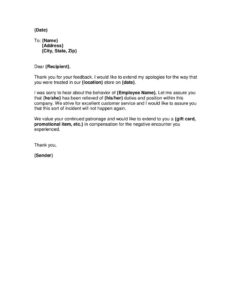
Apology For Employee Behavior
Download a free Apology for Employee Behavior letter template to professionally address customer complaints and rebuild trust — free PDF and DOCX download.
PDF
DOCX
9 downloads
1
likes
Download Files
- DOCX
An Apology for Employee Behavior letter is a formal business letter sent by a company to a customer to acknowledge poor treatment by a staff member, apologize for the incident, and explain how the situation has been addressed. Businesses most often use it after receiving a complaint about rude, unprofessional, or unacceptable conduct, and it’s free to download here in both PDF and DOCX formats with no signup required.
What Is an Apology for Employee Behavior Letter?
An Apology for Employee Behavior letter is a written response from a business owner, manager, or customer service representative to a customer who experienced unsatisfactory treatment from an employee. It documents that the company has heard the complaint, takes responsibility for the encounter, and is taking corrective action. The letter typically names the location, the date of the incident, and the employee involved, and it often offers a goodwill gesture such as a gift card or promotional item. Beyond simple courtesy, it serves as a record that the business responded promptly and professionally — useful for customer-relations files, internal documentation, and demonstrating a commitment to service standards.
When Do You Need an Apology for Employee Behavior Letter?
Customers notice how a company responds to a bad experience far more than the experience itself. A well-written apology can turn a frustrated person back into a loyal patron. Consider sending this letter in situations such as:
- A customer submits feedback describing rude, dismissive, or hostile treatment at one of your retail locations.
- An employee made an offensive remark or behaved inappropriately during a transaction or service visit.
- A complaint escalated publicly — for example, on social media or a review site — and you want to respond privately and professionally.
- A guest was treated unfairly and you have already taken disciplinary or personnel action you want to communicate.
- You want to retain a valued, long-standing customer after a single negative encounter.
- Corporate or franchise headquarters needs to respond on behalf of a specific store or branch.
What an Apology Letter Should Include
A complete and effective apology letter is sincere, specific, and solution-focused. To do its job, it should contain:
- The date the letter is written and the customer’s full name and mailing address.
- A warm opening that thanks the customer for sharing their feedback.
- A clear, direct apology for the specific incident, including the store location and date.
- Acknowledgment of the employee involved and the conduct that occurred.
- A statement of the corrective action taken or the company’s renewed commitment to service.
- A goodwill gesture or compensation, when appropriate.
- A courteous closing and the sender’s name and title.
How to Fill Out an Apology for Employee Behavior Letter
- Enter the Date at the top of the letter — the day you are writing and sending it.
- In the recipient block, fill in the customer’s Name, Address, and City, State, Zip so the letter is properly addressed.
- Open with the Dear {Recipient} salutation, using the customer’s name for a personal tone.
- Confirm the opening thank-you for their feedback, then insert the location of the store where the incident occurred.
- Add the date of the incident so the customer knows you are referring to their specific visit.
- Enter the Employee Name involved, and select the correct pronouns (he/she, his/her) when describing the action taken.
- Review the corrective-action and service-commitment language to make sure it reflects what your company actually did.
- Specify the compensation you are offering in the {gift card, promotional item, etc.} placeholder.
- Close with your name in the Sender field, adding your title and company if helpful.
Tips for Writing a Sincere, Effective Apology
The tone of this letter matters as much as its content. Keep the apology direct and avoid defensive language — phrases like “we’re sorry you feel that way” can read as dismissive. Take genuine ownership of the experience and focus on the customer’s feelings rather than excuses. Be specific about what happened so the reader knows you actually reviewed their complaint rather than sending a form letter. If you describe disciplinary action, only state what is true; never overstate consequences you have not actually carried out. Finally, make the compensation proportional to the inconvenience — a small token for a minor issue, something more meaningful for a serious one.
A Note on Privacy and Internal Records
While this letter references an employee by name, remember that the version you send to the customer and the records you keep internally serve different purposes. Be careful about disclosing detailed personnel decisions to a customer; in many cases it is enough to assure them that the matter has been handled appropriately. Internally, keep a copy of the letter alongside any documentation of the corrective action taken, since this can be important if the complaint resurfaces or if a pattern of behavior develops. Employment and privacy rules around discussing staff discipline vary, so when in doubt keep customer-facing statements general.
Common Mistakes to Avoid
- Sending a generic, copy-paste apology that fails to mention the specific incident, location, or date.
- Being defensive or shifting blame onto the customer instead of taking responsibility.
- Promising compensation or disciplinary action you cannot or will not actually deliver.
- Leaving placeholder fields like {Employee Name} or {location} unfilled in the final version.
- Waiting too long to respond — a delayed apology can feel insincere and worsen the situation.
- Misstating employment actions in a way that could create legal exposure for the company.
Frequently Asked Questions
What is an Apology for Employee Behavior letter? It is a formal business letter that a company sends to a customer to apologize for poor treatment by an employee. It acknowledges the incident, expresses regret, explains any corrective action, and often offers a goodwill gesture to retain the customer’s trust and patronage.
How do I fill out this apology letter? Start with the date and the customer’s name and mailing address, then personalize the greeting. Fill in the store location, the date of the incident, and the employee’s name, choose the correct pronouns, specify the compensation you are offering, and sign with your name and title.
Should I name the employee in the letter? The template includes a field for the employee’s name, but you should use discretion. Sometimes it reassures the customer to know the person was identified; in other cases it is wiser to keep personnel details general to protect employee privacy and avoid legal complications.
Do I have to offer compensation? No, compensation is optional and should match the severity of the incident. A gift card, discount, or promotional item can demonstrate goodwill and help retain a valued customer, but a sincere, well-written apology alone is often enough for minor issues.
Is this letter legally binding? An apology letter is a courtesy and customer-relations document, not a contract, so it is generally not legally binding on its own. However, be cautious about statements regarding employee discipline or guarantees, as careless wording could create unintended obligations or exposure.
How much does this template cost? Nothing — the Apology for Employee Behavior letter template is completely free to download from Business Forms Pro in PDF and DOCX formats, with no signup or subscription required. You can edit it freely to match your company’s tone and the specific situation.
This template is provided as a general example for informational purposes only and does not constitute legal, employment, or professional advice. Requirements and best practices for customer and personnel communications vary by jurisdiction and situation — consult a qualified professional before relying on this document.
Related Forms
- Request For Goods On Approval
- Cease and Desist Slander
- Cease and Desist Harassment
- Final Demand For Payment
- Demand Payment on Promissory Note
- Employee Termination For Poor Performance
Browse more in Business Letters.