
Cease and Desist Copyright
Download a free cease and desist copyright letter template in PDF and DOCX to formally demand someone stop infringing your copyrighted work — free download.
PDF
DOCX
0
likes
Download Files
- DOCX
A cease and desist copyright letter is a formal written notice demanding that an individual or business immediately stop using your copyrighted work without permission. People most commonly use it as a first step to halt online or commercial infringement before involving lawyers or courts. This template is free to download in both PDF and DOCX formats, with no signup required.
What Is a Cease and Desist Copyright Letter?
A cease and desist copyright letter is a written demand sent by a copyright owner (or their representative) to a party who is allegedly reproducing, distributing, displaying, or otherwise using protected creative work without authorization. It documents your claim of ownership, identifies the infringing activity, and sets a firm deadline for the recipient to stop. The letter serves two purposes: it puts the infringer on formal notice and creates a paper trail showing you asserted your rights before any litigation. While it carries no automatic legal force on its own, it signals serious intent and often resolves disputes quickly because most recipients prefer to comply rather than risk a lawsuit over statutory damages.
When Do You Need a Cease and Desist Copyright Letter?
- Someone has copied your photographs, illustrations, or graphics and posted them on their website or social media without permission.
- A competitor is using your written content, marketing copy, or product descriptions verbatim.
- Your music, video, software code, or other original creative work is being distributed or sold without a license.
- A reseller or third party is reproducing your branded designs, logos, or packaging artwork.
- You discover your copyrighted material in someone else’s book, course, app, or printed publication.
- An online seller is offering counterfeit or unauthorized copies of your registered work.
What a Cease and Desist Copyright Letter Should Have
To be effective, the letter must clearly establish your ownership and the specific infringement. A complete letter includes your full contact information as the sender, the recipient’s name and address, an unambiguous identification of the copyrighted work, the date the work was created or registered, and a precise description of the infringing activity. It should state the legal basis for your claim, reference the statutory damages the infringer may face, demand specific actions (such as removing or recalling the material), and set a clear deadline for a response. Finally, it should warn that legal action will follow non-compliance and be signed and dated by you or your authorized representative.
How to Fill Out a Cease and Desist Copyright Letter
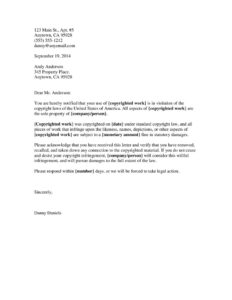
- At the top, enter your return address, phone number, and email so the recipient can respond. The template shows a sample street address, city, state, ZIP, phone, and email — replace each with your own.
- Add the current date below your contact block.
- Enter the recipient’s name and full mailing address (the template uses “Andy Anderson” and a sample property address as placeholders).
- Open with a salutation addressed to the recipient by name.
- Insert the name or description of your {copyrighted work} everywhere the placeholder appears so the protected material is clearly identified.
- Fill in the {company/person} field with the legal name of the rights holder asserting ownership.
- Enter the {date} the work was copyrighted or registered.
- State the {monetary amount} of statutory damages the infringer could face.
- Specify the {number} of days you are giving the recipient to respond and comply.
- Sign the letter at the bottom in place of the sample signature.
How to Send and Document the Letter
How you deliver the letter matters as much as what it says. Send it by a method that provides proof of delivery — certified mail with a return receipt is the traditional choice, and many people also send a copy by email so there is a timestamped electronic record. Keep a dated copy of the exact letter you sent, along with evidence of the infringement: screenshots, URLs, photographs, archived web pages, and the dates you discovered them. This documentation strengthens your position if the matter escalates. If the infringing content is hosted on a platform like a social network, marketplace, or web host, you may also consider a separate takedown request to that platform in addition to contacting the infringer directly.
Cease and Desist vs. a DMCA Takedown Notice
A cease and desist letter and a DMCA takedown notice are related but distinct tools. A cease and desist letter is sent directly to the alleged infringer and broadly demands they stop the infringing conduct. A DMCA takedown notice, by contrast, is sent to an online service provider (such as a host or platform) asking it to remove specific infringing content under a defined legal process. Many copyright owners use both: the cease and desist puts the infringer on notice, while the DMCA notice gets the material taken down faster. Choose the approach that fits where and how the infringement is occurring.
Common Mistakes to Avoid
- Failing to clearly identify the exact copyrighted work and the specific infringing use, leaving the demand too vague to act on.
- Leaving placeholder text like {copyrighted work} or {monetary amount} in the final letter.
- Setting an unreasonably short deadline, or no deadline at all, for the recipient to respond.
- Sending the letter to the wrong person or address, or without any proof of delivery.
- Overstating your rights or threatening remedies you do not actually intend or have the standing to pursue.
- Sending threats before confirming you genuinely own or control the copyright in question.
Frequently Asked Questions
Is a cease and desist copyright letter legally binding? The letter itself is not a court order and does not by itself compel anyone to act. It is a formal demand that puts the recipient on notice and creates evidence that you asserted your rights. If the infringement continues, you may then pursue legal remedies through the courts.
Do I need a lawyer to send one? No, you can draft and send a cease and desist letter yourself, and this template makes that easier. However, if the infringement is significant, the recipient disputes your claim, or large damages are at stake, consulting an intellectual property attorney is wise before escalating.
Does my work need to be registered to send this letter? You can claim copyright in original creative work without registration, and you can send a cease and desist regardless. That said, formal registration can strengthen your position and may be required before filing certain lawsuits, so registering is generally beneficial.
How much does this template cost? The cease and desist copyright letter template is completely free to download here in both PDF and DOCX formats, with no signup or payment required. You only edit the placeholder fields with your own details.
What happens if the recipient ignores the letter? If the recipient does not respond or comply by your stated deadline, you may treat the conduct as willful infringement and pursue legal action, which can include seeking damages and an injunction. Keep all documentation of the infringement and your delivery proof for that purpose.
How long should I give the recipient to respond? There is no universal rule, but a window of around 10 to 14 days is common and reasonable. Choose a deadline that gives the recipient enough time to act while signaling that you expect prompt compliance, and state the exact number of days in the letter.
This template is a general example provided for informational purposes only and is not legal advice. Copyright laws and enforcement procedures vary by jurisdiction, and individual circumstances differ. Consult a qualified intellectual property attorney before sending a cease and desist letter or taking legal action.
Related Forms
- Employee Termination For Gross Misconduct
- Billing Error Apology Letter
- Sales Order Confirmation
- Very Late Reply to Customer
- Offer To Settle Disputed Account
- Response to An Unsolicited Idea
Browse more in Business Letters.