
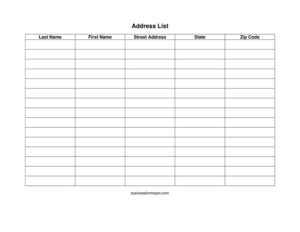
Address List
Download a free Address List template to organize contacts by name, street address, state, and zip code—simple, printable, free download in PDF and DOCX.
PDF
DOCX
9 downloads
0
likes
Download Files
- DOCX
An Address List is a simple organizational document used to record and store the names and mailing addresses of a group of people or businesses in one tidy place. The most common reason people use it is to keep a single, reliable directory of contacts for mailings, events, or record-keeping. You can download this Address List free in PDF and DOCX—no signup required.
What Is an Address List?
An Address List is a structured record that collects the essential contact details—last name, first name, street address, state, and zip code—for many individuals or organizations in one consolidated format. It is typically created and maintained by an individual, office manager, club secretary, or small business owner who needs to track who lives or works where. Unlike a full contact database with phone numbers and emails, this list focuses specifically on physical mailing information. It serves as a quick reference for sending letters, invitations, holiday cards, invoices, or packages. Because it is plainly formatted, it can be printed, filed, shared, or copied into a spreadsheet whenever needed.
When Do You Need an Address List?
An Address List is useful any time you have to keep mailing details for more than a handful of people organized and accessible. Common real-world scenarios include:
- Holiday or event mailings: Sending greeting cards, party invitations, or save-the-dates to family, friends, or members.
- Club and organization rosters: Tracking the home addresses of members for a sports league, church group, HOA, or volunteer team.
- Small business customer records: Keeping a clean list of clients to send invoices, statements, or promotional postcards.
- Family and emergency reference: Compiling relatives’ addresses so anyone in the household can quickly send a letter or gift.
- School and class directories: Maintaining a roster of students’ or parents’ addresses for newsletters and notices.
- Bulk mailing preparation: Organizing recipients before printing labels or running a mail-merge campaign.
What an Address List Should Have
A complete Address List is consistent, legible, and easy to scan. Each entry should capture the same set of fields so the list can be sorted, searched, or merged without gaps. At minimum, a useful Address List should include the contact’s last name and first name for identification, a complete street address including any apartment or unit number, the state, and the correct zip code. A clear column header row keeps everything aligned, and consistent formatting—such as always writing the state as a two-letter abbreviation—makes the list far easier to work with. Leaving room for additional rows allows the list to grow over time without becoming cramped or disorganized.
How to Fill Out an Address List
Filling out this Address List is straightforward because the template uses a clear, repeating set of columns. Work through it one row at a time:
- Last name: Enter the contact’s surname first. Listing by last name makes it easy to alphabetize and locate entries later.
- First name: Add the person’s given name in the next field so you can distinguish individuals who share a last name.
- Street address: Write the full street number and name, including any apartment, suite, or unit number. Accuracy here is critical to ensure mail actually arrives.
- State: Record the state, ideally using the standard two-letter postal abbreviation (for example, NY, TX, or CA) for consistency.
- Zip code: Enter the correct five-digit zip code—or the full nine-digit ZIP+4 if you have it—to help speed up delivery.
Repeat these steps for each new contact, keeping one person per row. When you finish, scan the list once more to confirm spelling, complete addresses, and matching formatting throughout.
Tips for Keeping Your Address List Accurate
An Address List is only as valuable as it is current. Review the list periodically—at least once a year is a good rhythm—and update entries when someone moves. If you maintain the DOCX version, you can quickly edit, add, or delete rows; the PDF version is ideal for printing a clean copy to post on a fridge or file in a binder. For larger lists, consider sorting alphabetically by last name so duplicate or outdated entries are easy to spot. If you plan to use the list for label printing or a mail merge, keeping every field in its own column makes that process seamless.
Address List vs. a Full Contact Directory
It helps to know how this document differs from a broader contact directory. An Address List intentionally focuses on physical mailing information—names and street addresses—rather than phone numbers, email addresses, or notes. This narrow focus makes it lighter and faster to fill out when your goal is sending physical mail. If you need to track digital contact details or relationship notes as well, a more comprehensive contact sheet may suit you better. Many people keep both: a simple Address List for mailings and a fuller directory for everyday communication.
Common Mistakes to Avoid
- Inconsistent formatting: Mixing full state names with abbreviations makes sorting and merging unreliable—pick one style and stick to it.
- Incomplete street addresses: Forgetting apartment or unit numbers is a leading cause of returned or misdelivered mail.
- Wrong or outdated zip codes: A single transposed digit can delay or misroute a letter; double-check each one.
- Skipping the last name field: Recording only first names makes it impossible to alphabetize or distinguish similar contacts.
- Letting the list go stale: Failing to update addresses after people move leaves you mailing to old locations.
- Cramming multiple people in one row: Keep one contact per line so the list stays sortable and clear.
Frequently Asked Questions
What is an Address List used for? An Address List is used to store the mailing details of many contacts in one organized place. People use it for holiday cards, event invitations, club rosters, customer mailings, and any situation where they need quick access to accurate street addresses.
How do I fill out the Address List template? Enter one contact per row, completing the last name, first name, street address, state, and zip code fields. Use consistent formatting—such as two-letter state abbreviations—and add a new row for each additional person you want to track.
Is the Address List free to download? Yes. This Address List template is completely free to download in both PDF and DOCX formats, and no signup or account is required. You can print it as-is or edit the DOCX version to fit your needs.
Should I list contacts by first or last name? The template places last name first, which is the most practical choice because it lets you alphabetize entries and easily locate or distinguish people who share a surname. You can still sort however suits your purpose.
Can I use this list for a mail merge or label printing? Yes. Because each detail sits in its own field, you can copy the entries into a spreadsheet or word processor and run a mail merge or print mailing labels directly from the data.
Does an Address List need to be notarized or signed? No. An Address List is an informal organizational document, not a legal contract, so it does not require signatures, witnesses, or notarization. Its only requirement is that the information be accurate and up to date.
This Address List template is provided as a general example for informational and organizational purposes only and does not constitute legal, financial, or professional advice. Privacy and data-handling requirements may vary by jurisdiction—consult a qualified professional if you have questions about storing personal contact information.
Related Forms
- Supplier Contact Info
- Team Roster
- Address Book Large Print Tabs
- Petsitter Information
- Address Change notification letter
- Outgoing Calls
Browse more in Contact.