
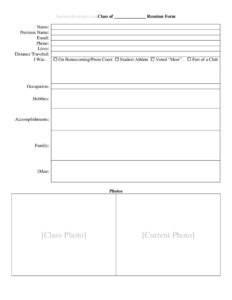
Class Reunion Student Update Form
Collect classmate contact details, news, and RSVPs with our free Class Reunion Student Update Form template, available as a free download in PDF and DOCX.
PDF
DOCX
1 downloads
0
likes
Download Files
- DOCX
A Class Reunion Student Update Form is a simple questionnaire that reunion committees send to former classmates to collect current contact information, life updates, and event preferences. People most often use it to rebuild a scattered alumni mailing list and gauge interest before planning a reunion. It’s free to download here in both PDF and DOCX formats, with no signup required.
What Is a Class Reunion Student Update Form?
A Class Reunion Student Update Form is a contact and information sheet used by reunion organizers, class committees, or alumni associations to gather up-to-date details from graduates of a particular class. It documents how to reach each classmate, captures who has moved, married, or changed names, and records whether someone plans to attend the upcoming gathering. The form turns an outdated yearbook roster into a living, accurate directory. Committees typically distribute it by email, social media, or postal mail ahead of a milestone anniversary, then compile the responses into a master spreadsheet used for invitations, name tags, and memory books.
When Do You Need a Class Reunion Student Update Form?
- Kicking off planning for a milestone reunion — the 10th, 25th, or 50th anniversary, when the original contact list is badly out of date.
- Locating lost classmates whose phone numbers, addresses, or maiden names have changed over the years.
- Gauging interest and headcount before booking a venue, catering, or printing materials.
- Building a memory or yearbook update where classmates share careers, families, and life milestones since graduation.
- Collecting payment and meal preferences for a ticketed dinner or banquet.
- Maintaining an ongoing alumni directory so future reunions are easier to organize and notifications reach everyone.
What a Class Reunion Student Update Form Should Have
A complete update form balances enough detail to reach and recognize each classmate without feeling like a burden to fill out. At minimum it should capture the graduate’s current legal name and the name they used in school, reliable contact channels, and a clear RSVP question. Beyond the basics, useful sections invite a short personal update, ask about guests, and offer space to suggest classmates the committee may have lost track of. Including a small note about how the information will be used — and a checkbox for those who prefer not to be listed publicly — keeps responses honest and respects privacy. Keep the layout clean so people can finish it in a few minutes.
How to Fill Out a Class Reunion Student Update Form
- Current name: Enter your full legal name as it appears today.
- Name during school years: Add the name classmates would remember, including any maiden name, so the committee can match you to the roster.
- Graduation year and class: Confirm the year you graduated and any homeroom, team, or section detail that helps identify you.
- Mailing address: Write your full current street address, city, state, and ZIP for postal invitations.
- Email address: Provide the address you check most often — this is usually the primary way the committee will reach you.
- Phone number: List a cell or home number as a backup contact.
- Life update: Share a few sentences about your career, family, or news since graduation for the memory book.
- RSVP and guests: Indicate whether you plan to attend and how many guests you will bring.
- Lost classmates: Note names and any contact leads for people the committee may be missing.
- Sign or date the form and return it by the deadline.
Distributing the Form and Collecting Responses
How you send the form shapes how many replies you get. Email and class social media groups are fast and free, and the DOCX version can be pasted directly into a message or turned into an online form. The PDF works well as a printable attachment or a mail-in sheet for classmates who prefer paper or are harder to reach online. Whatever channel you use, set a clear return deadline and send at least one friendly reminder — response rates climb sharply with a gentle nudge. Designate one committee member to enter every reply into a central spreadsheet so nothing is lost, and back up the data regularly. As updates arrive, cross-reference them against your existing list to flag duplicates and confirm spellings before printing name tags or invitations.
Privacy and Handling Classmate Information
Contact details are personal, and classmates are sharing them in good faith. Be transparent about why you’re collecting the information and who will see it. A short statement at the top of the form — explaining that details are used only for reunion communications and won’t be sold or posted publicly without permission — builds trust and improves participation. Offer an opt-out for anyone who wants to attend but keep their address off a shared directory. Store responses securely, limit access to the planning team, and delete or archive the data responsibly once the event is over. Treating the information carefully protects classmates and keeps your committee’s reputation intact for future reunions.
Common Mistakes to Avoid
- Forgetting the school-era name field — without a maiden or former name, the committee can’t match responses to the original class roster.
- Leaving out a deadline, which causes responses to trickle in too late to finalize the headcount.
- Asking for too much — long forms get abandoned, so keep optional questions clearly optional.
- Skipping the guest count, making it hard to plan seating and catering accurately.
- Not confirming email spelling, which bounces invitations and breaks the contact chain.
- Ignoring privacy by sharing addresses publicly without asking permission first.
Frequently Asked Questions
What is a Class Reunion Student Update Form used for? It is used to collect current contact information, life updates, and RSVP details from former classmates ahead of a reunion. Committees use the responses to rebuild an accurate mailing list, plan headcount, and assemble memory materials. It replaces guesswork with reliable, up-to-date data.
How do I fill out the form? Enter your current name and the name you used in school, then add your address, email, and phone number. Share a short life update if you’d like, indicate whether you plan to attend and how many guests you’ll bring, and note any lost classmates. Return it to the committee by the stated deadline.
Is this form legally binding? No, it is an informal contact and information sheet, not a contract. Indicating that you plan to attend is a courtesy estimate, not a binding commitment, though it helps organizers plan accurately. Always check any ticket or payment terms separately if the reunion charges a fee.
Does the form need to be notarized or witnessed? No. A reunion update form is a casual planning document and requires no notary, witnesses, or official signatures. A simple signature or name and date is more than enough.
How much does this template cost? Nothing — it’s a free download here in both PDF and DOCX formats with no signup required. You can edit the DOCX version to add your school’s name, class year, and any custom questions before sending it out.
Can I send this form online? Yes. You can email the PDF or DOCX, share it in a class social media group, or copy the questions into an online form builder for instant digital responses. Whichever method you choose, set a deadline and keep all replies in one central place.
This template is a general example provided for informational purposes only and is not legal, financial, or privacy-compliance advice. Data-handling requirements vary by jurisdiction — if you collect personal information at scale, consult a qualified professional about applicable privacy rules.
Related Forms
- Contacts Conversation Log
- Address List
- Address Book Large Print Tabs
- Address Book Large Print
- Standard Contact Form
- Memo Template
Browse more in Contact.