
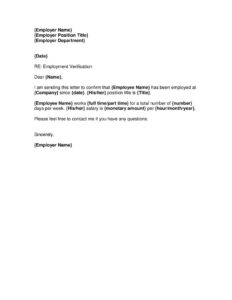
Employment Confirmation Letter
Download a free Employment Confirmation Letter template to verify a worker's job title, dates, and salary — free PDF and DOCX download, no signup.
PDF
DOCX
2 downloads
0
likes
Download Files
- DOCX
An Employment Confirmation Letter is a short, signed document an employer issues to verify that a person works (or has worked) for the company, along with key facts like their job title, start date, and salary. People most often request one when applying for a loan, renting an apartment, or arranging a visa. You can download this template for free in PDF and DOCX formats — no signup required.
What Is an Employment Confirmation Letter?
An Employment Confirmation Letter — sometimes called an employment verification letter or proof of employment letter — is an official statement written by an employer to confirm that a named individual is employed by the company. It is usually addressed to a third party, such as a bank, landlord, or government agency, who needs to verify the employee’s working status. The letter typically confirms the employee’s start date, position title, whether the role is full or part time, hours worked, and salary. Issued on company letterhead and signed by a manager or HR representative, it carries the employer’s authority and serves as trusted, written evidence of someone’s employment for official purposes.
When Do You Need an Employment Confirmation Letter?
Requests for this letter come up in many everyday financial and administrative situations. Common scenarios include:
- Applying for a mortgage or loan — lenders require proof of stable income and ongoing employment before approving financing.
- Renting an apartment — landlords and property managers often ask for written confirmation of employment and salary before signing a lease.
- Immigration or visa applications — embassies and immigration offices frequently request proof that an applicant has steady employment in their home country.
- Opening a credit card or financing a vehicle — creditors verify employment to assess repayment ability.
- Government benefits or assistance programs — some programs require documentation of current income and work status.
- Background checks for a new job — a prospective employer may ask a current or former employer to confirm dates and title.
What an Employment Confirmation Letter Should Have
A complete and credible letter should clearly identify both the employer and the employee, and state the verifiable facts the recipient needs. Essential elements include the company name and contact details (ideally on letterhead), the date the letter is written, the name and title of the person signing, the employee’s full name, their start date, their job title, whether they work full or part time, the number of days or hours per week, and their salary with a clear pay period. It should also invite the recipient to follow up with questions and close with a signature. Keeping the letter factual and limited to confirmed details protects both the employer and the employee.
How to Fill Out an Employment Confirmation Letter
This template is designed to be completed quickly. Work through the fields in order:
- Enter the Employer Name, Employer Position Title, and Employer Department at the top so the recipient knows who is issuing the letter.
- Add the Date the letter is written.
- Keep the subject line as RE: Employment Verification so the purpose is immediately clear.
- In the greeting, insert the recipient’s Name (the contact at the bank, agency, or landlord’s office).
- State the Employee Name and the Company where they are employed, followed by the start date they began working.
- Fill in the employee’s position Title and select the correct pronoun (his/her).
- Indicate whether the employee works full time or part time, then enter the number of days worked per week.
- Enter the salary as a monetary amount and choose the matching pay period — hour, month, or year.
- Close with the offer to answer questions, then sign as the Employer Name.
Who Should Sign and Issue the Letter
The letter should be written and signed by someone with the authority to confirm employment details — typically a direct manager, an HR representative, or a business owner. The signer’s position title and department, captured in the template’s header fields, lend credibility and give the recipient a clear point of contact. Whenever possible, print the letter on company letterhead and include a phone number or email so the recipient can verify the document directly. Employees usually request the letter from their HR department or supervisor, sometimes providing the recipient’s details and any specific information the requesting party requires.
Keep It Factual and Respect Privacy
Employment verification letters should include only information that is accurate and relevant to the request. Some recipients only need confirmation of dates and title, while others — such as lenders — specifically require salary. It is good practice to confirm with the employee what details they are comfortable sharing, and to disclose salary only when the request genuinely calls for it. Avoid adding opinions about performance or conduct unless they have been specifically and appropriately requested, since unnecessary commentary can create complications. Privacy expectations and rules vary by region, so when in doubt, share only what is needed.
Common Mistakes to Avoid
- Incorrect dates — double-check the start date and any salary figures against payroll records before signing.
- Choosing the wrong pay period — make sure the salary clearly states whether it is per hour, month, or year to avoid confusing the recipient.
- Leaving out contact details — without a phone number or email, the recipient cannot verify the letter, which may delay an approval.
- Not using letterhead — a letter without company branding or a signature looks less official and may be rejected.
- Sharing salary without consent — confirm the employee is comfortable disclosing pay when it is included.
- Overstating details — stick to confirmed facts and avoid promises about future employment or raises.
Frequently Asked Questions
What is an Employment Confirmation Letter used for? It is used to prove to a third party that someone is employed by a company. Common uses include mortgage and loan applications, apartment rentals, visa and immigration paperwork, and background checks. The letter confirms facts such as job title, start date, hours, and salary.
Who should write the employment confirmation letter? It should be written by someone authorized to confirm employment details, typically a manager, HR representative, or business owner. The signer’s name, title, and department appear in the header so the recipient knows who is vouching for the information. Employees normally request the letter from their HR department or supervisor.
Does an employment confirmation letter need to include salary? Not always. Some recipients only need confirmation of job title and employment dates, while lenders and landlords often require salary. Include salary only when the request calls for it and the employee is comfortable sharing it, and always state the correct pay period.
Is this letter legally binding? An employment confirmation letter is a factual statement rather than a contract, so it does not itself create legal obligations the way an employment agreement does. However, the information should be accurate, since the recipient relies on it to make decisions. Knowingly providing false details could create liability.
Does it need to be notarized? In most cases no notarization is needed — a signature on company letterhead is usually sufficient. Some immigration or legal processes may request a notarized or certified version, so check the requirements of the requesting party in advance.
Is this template really free to download? Yes. You can download this Employment Confirmation Letter template for free in both PDF and DOCX formats with no signup required. Edit the fields to fit your situation, print it on company letterhead, and sign it.
This template is a general example provided for informational purposes only and is not legal, financial, or tax advice. Employment and privacy requirements vary by jurisdiction and by employer policy — consult a qualified professional or your HR department before issuing or relying on an employment confirmation letter.
Official resource: for the rules that apply to your situation, see the U.S. Department of Labor.
Related Forms
- Harassment Log
- Job Interview Schedule
- Tarjeta De Tiempo Manual Miniatura
- Project Time Card With Approval
- Adverse Action Notice
- Report of Absence for Military Duty
Browse more in Employment.