
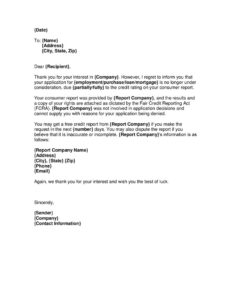
Adverse Action Notice
Download a free Adverse Action Notice template in PDF and DOCX to notify applicants of FCRA-compliant decisions based on consumer reports — free template.
PDF
DOCX
3 downloads
0
likes
Download Files
- DOCX
An Adverse Action Notice is a written letter that tells an applicant a decision about their employment, purchase, loan, or mortgage was made—wholly or partly—because of information in a consumer report. Employers, lenders, and landlords most often use it to satisfy the disclosure requirements of the Fair Credit Reporting Act (FCRA) after they decline an application. You can download this Adverse Action Notice free in both PDF and DOCX formats, with no signup required.
What Is an Adverse Action Notice?
An Adverse Action Notice is a formal communication issued by a company or individual who took a negative action against someone based on data pulled from a consumer report. Under the FCRA, when a credit rating or background screening influences a denial, the recipient has the right to know which reporting agency supplied the information and how to respond. The notice documents the reason for the decision, identifies the consumer reporting company, and explains the applicant’s rights—including the right to a free copy of the report and the right to dispute inaccuracies. It protects the recipient’s interests and shows the sender complied with federal disclosure obligations.
When Do You Need an Adverse Action Notice?
You generally need to send an Adverse Action Notice whenever a consumer report contributes to an unfavorable decision. Common situations include:
- Declining a job applicant after a background or credit check returns concerning information.
- Denying a loan or line of credit because of a low credit score or negative credit history.
- Rejecting a mortgage application based on data in the borrower’s consumer report.
- Refusing a purchase financed on credit terms after reviewing the buyer’s report.
- Approving an application but on less favorable terms (higher rate or larger deposit) due to report findings.
- Turning down a rental or service application that relied on a tenant or consumer screening report.
In each case, the law gives the applicant a window to obtain the report and challenge anything they believe is wrong, so prompt, clear notice matters.
What an Adverse Action Notice Should Have
A complete notice contains a handful of essential elements that make it both courteous and compliant. It should clearly state that an adverse action was taken and whether the consumer report was a partial or full factor. It must name the consumer reporting company that supplied the report, along with that company’s full contact information. The notice must explain that the reporting agency did not make the decision and cannot provide reasons for it. Finally, it must inform the recipient of their right to a free copy of the report within a set number of days and their right to dispute inaccurate or incomplete information. A copy of the recipient’s FCRA rights summary should be attached.
How to Fill Out an Adverse Action Notice
- Enter the Date the notice is being sent at the top of the letter.
- Add the recipient’s Name, Address, and City, State, Zip so the letter is correctly addressed.
- Open with the salutation, inserting the Recipient name after “Dear.”
- Fill in your Company name where you thank the applicant for their interest.
- Specify the application type—employment, purchase, loan, or mortgage—that is no longer under consideration.
- Indicate whether the credit rating was a partial or full reason for the decision.
- Name the Report Company that provided the consumer report and reference the attached results and rights summary.
- Enter the number of days within which the recipient may request a free report.
- Complete the reporting agency’s contact block: Report Company Name, Address, City, State, Zip, Phone, and Email.
- Sign off with the Sender name, Company, and your Contact Information.
Understanding the FCRA Disclosure Requirements
The Fair Credit Reporting Act sets the framework behind this notice. When a consumer report plays any role in a denial or less favorable terms, the federal rules generally require the decision-maker to disclose specific information so the consumer can verify and correct their data. The key idea is transparency: the person affected should learn that a report was used, which agency produced it, and that the agency itself did not decide the outcome. Attaching the standardized “Summary of Your Rights Under the FCRA” alongside the letter is a common practice that helps the recipient understand how to obtain and dispute their report. Exact timing and content rules can vary by context and jurisdiction, so review current federal guidance and any applicable state requirements before sending.
Timing and Delivery Tips
Send the notice promptly after the decision is finalized so the recipient has the full benefit of their dispute window. Many senders deliver the letter by mail, though email or another documented method may be appropriate depending on the situation and any prior consent. Keep a dated copy of the notice and the attachments for your records; this documentation can be valuable if the applicant later questions how the decision was made. If your process involves a pre-adverse action step—where you give the applicant a chance to review the report before the final decision—make sure the adverse action notice follows after that period has elapsed.
Common Mistakes to Avoid
- Forgetting to name the Report Company or omitting its full contact details, which the recipient needs to request or dispute the report.
- Leaving the partial/full reason blank, which makes the basis of the decision unclear.
- Failing to attach the FCRA rights summary that the letter references.
- Stating a vague or missing number of days for the free report request.
- Implying the reporting agency made the decision rather than your company.
- Sending the notice late, which can shorten the recipient’s effective dispute window.
Frequently Asked Questions
What is an Adverse Action Notice used for? It informs an applicant that you declined or modified their employment, loan, mortgage, or purchase application based on information in a consumer report. The notice tells them which reporting agency supplied the data and how to obtain a free copy and dispute errors. Its purpose is to give the affected person a fair chance to review and correct their record.
Is an Adverse Action Notice legally required? Under the FCRA, businesses that take adverse action based on a consumer report are generally required to provide notice and disclose certain information. The specific obligations depend on the type of decision and your situation. Because requirements can change and vary by jurisdiction, confirm current federal and state rules before relying on any template.
How do I fill out the Adverse Action Notice? Enter the date, recipient details, your company name, and the application type, then indicate whether the report was a partial or full factor. Add the consumer reporting agency’s name and contact information and the number of days to request a free report. Finish by signing with your name, company, and contact information, and attach the report results and rights summary.
Does an Adverse Action Notice need to be notarized? No, an Adverse Action Notice does not require notarization or witnesses. It is a disclosure letter, not a sworn document. What matters most is that it contains the required information and reaches the recipient in a timely, documented way.
How many days should I give for the free report request? The notice asks you to specify a number of days, which should align with current FCRA guidance and any applicable state rules. A defined window lets the recipient act on their rights without delay. Check the latest official guidance to choose an appropriate timeframe.
Is this Adverse Action Notice template free to download? Yes. You can download this Adverse Action Notice template free in PDF and DOCX with no signup required. Edit it to match your company, the application type, and the consumer reporting agency you used.
This Adverse Action Notice template is a general example provided for informational purposes only and is not legal, financial, or compliance advice. Requirements under the Fair Credit Reporting Act and applicable state laws vary and change over time. Consult a qualified attorney or compliance professional to ensure your notice meets current obligations for your situation.
Official resource: for the rules that apply to your situation, see the U.S. Department of Labor.
Related Forms
- Request To Attend Training
- Salary Review Request
- Arrival And Departure Record
- Direct Deposit Authorization
- Employment Confirmation Letter
- Employee Self Evaluation
Browse more in Employment.