
Attendance Record
Track employee attendance, absences, and leave with our free Attendance Record template — download as PDF or DOCX, no signup required.
PDF 2
DOCX 2
0
likes
Download Files
- DOCX
- DOCX
An Attendance Record is a simple tracking sheet employers use to document when an employee is present, absent, on vacation, or on leave throughout a given month or year. The most common reason people use one is to keep an accurate, organized log of attendance for payroll, scheduling, and HR record-keeping. You can download this Attendance Record free in PDF and DOCX formats, with no signup required.
What Is an Attendance Record?
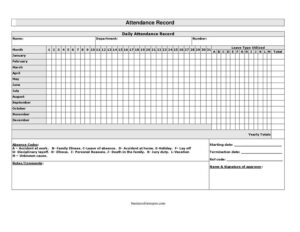
An Attendance Record is a structured document — usually a calendar-style grid — that captures an individual employee’s daily presence and absences over time. It is typically maintained by a supervisor, HR coordinator, or the employee themselves, then reviewed by management. The form records who the employee is, which department they belong to, the period being tracked, and a coded entry for each day showing the reason for any absence. Beyond simply marking “in” or “out,” a good attendance record uses absence codes to distinguish vacation from illness, jury duty from a leave of absence, or a holiday from an unexcused absence. This makes the document useful for payroll accuracy, compliance, performance reviews, and resolving disputes about time worked.
When Do You Need an Attendance Record?
Attendance records are useful in nearly every workplace, but they become especially important in the following situations:
- Running payroll — reconciling worked days against paid time off, sick days, and unpaid leave before issuing paychecks.
- Managing paid time off — tracking how many vacation and personal days an employee has used versus their annual allotment.
- Documenting patterns of absence — identifying frequent illness, recurring late starts, or unexplained gaps that may need a conversation.
- Supporting disciplinary action — providing a clear, dated history when attendance problems lead to warnings or a disciplinary layoff.
- Handling leave and benefits claims — backing up requests related to family illness, an accident at work, or a death in the family.
- Onboarding and offboarding — noting an employee’s starting date and termination date so partial-month attendance is recorded correctly.
What an Attendance Record Should Have
A complete attendance record combines clear employee identification with a consistent coding system. At a minimum, it should include the employee’s name, department, and employee number; the month or year being tracked; a daily grid for marking each day; and a legend of absence codes. The codes are what give the document its value — entries such as illness, vacation, holiday, jury duty, personal reasons, leave of absence, accident at work, accident at home, family illness, death in the family, lay off, disciplinary layoff, and unknown cause let anyone reading the sheet understand the reason behind each absence at a glance. A space for notes or comments, a reference code, and a signature line round out the record.
How to Fill Out an Attendance Record
- Enter the employee details. Write the employee’s name, department, and employee number at the top so the record is clearly attributable.
- Set the tracking period. Indicate the month being recorded, or use the January-through-December columns to maintain a full-year overview on one sheet.
- Record the employment dates. Fill in the starting date and, if applicable, the termination date so partial periods are accounted for.
- Mark each day. For every working day, note whether the employee was present or absent. Leave present days blank or marked as worked, and flag absences for coding.
- Apply the absence codes. For each absence, enter the matching code — for example vacation, illness, holiday, jury duty, family illness, leave of absence, accident at work, disciplinary layoff, or unknown cause.
- Add notes and reference. Use the notes/comments field for context and add the ref code for filing.
- Sign and date. Complete the name & signature line to confirm the record’s accuracy.
Understanding the Absence Codes
The coding system is the backbone of this attendance record, so consistency matters. Group the codes into categories you can explain to staff: paid leave typically covers vacation and holiday; health-related covers illness, family illness, accident at work, and accident at home; protected or special leave includes jury duty, leave of absence, and death in the family; and employer-driven entries include lay off and disciplinary layoff. The personal reasons code handles approved time off that doesn’t fit elsewhere, while unknown cause flags absences that still need to be explained. Decide in advance how each code affects pay and benefits, and document those rules so different supervisors apply them the same way. A shared key prevents one manager from logging the flu as “illness” while another marks it “personal reasons.”
Keeping Records Accurate and Confidential
Because an attendance record can contain sensitive information — illness, family bereavement, or disciplinary matters — store it securely and limit access to those who genuinely need it. Update the sheet daily or weekly rather than reconstructing a whole month from memory, which invites errors. Retain completed records for the period your organization or local regulations require, since they may be needed for payroll audits, benefits verification, or employment disputes. If you maintain both paper and digital copies, make sure they match.
Common Mistakes to Avoid
- Inconsistent coding — using different codes for the same type of absence makes totals unreliable.
- Leaving the unknown cause code unresolved — flagged absences should be followed up and reclassified once the reason is confirmed.
- Forgetting the starting or termination date — missing these distorts attendance percentages for partial months.
- Filling it out from memory — delayed entries lead to forgotten days and disputes.
- Skipping the signature — an unsigned record carries far less weight if attendance is ever questioned.
- Recording sensitive notes carelessly — keep comments factual and store the document confidentially.
Frequently Asked Questions
What is an Attendance Record used for? It is used to document an employee’s daily presence and absences over a month or year. Employers rely on it for payroll, tracking paid time off, monitoring absence patterns, and supporting HR decisions. The absence codes make it easy to see why someone was out on any given day.
How do I fill out the absence codes? Choose the code that best matches the reason for each absence — for example vacation, illness, jury duty, or leave of absence — and enter it in the cell for that day. Keep a visible legend so everyone uses the codes consistently. Use the notes field to add detail the codes can’t capture.
Is an Attendance Record a legally binding document? On its own it is a business record rather than a contract, but it can serve as important supporting evidence in payroll audits, benefits claims, or employment disputes. Its value depends on accuracy and consistency. Signing and dating it strengthens its reliability.
Does an Attendance Record need to be signed? A signature is not always strictly required, but the form includes a name and signature line because a signed record is more credible. The signature confirms that the person completing it stands behind the entries. Some organizations also have the employee acknowledge the record.
How long should I keep attendance records? Retention periods vary by employer policy and local employment regulations, so check the rules that apply to you. Many businesses keep records for several years to cover payroll and audit needs. When in doubt, retain longer rather than shorter.
How much does this Attendance Record template cost? It is completely free to download from Business Forms Pro in both PDF and DOCX formats, with no signup required. You can use the PDF as-is or edit the DOCX version to match your codes and pay periods. Reuse it for as many employees as you need.
This Attendance Record template is a general example provided for informational purposes only and does not constitute legal, financial, or tax advice. Employment and record-keeping requirements vary by jurisdiction and by organization. Consult a qualified HR or legal professional to ensure your attendance practices comply with applicable laws.
Official resource: for the rules that apply to your situation, see the U.S. Department of Labor.
Related Forms
- Key Assignment Form
- Employee Personnel Data Change
- Job Offer Letter
- Job Application Form
- New Hire Checklist
- Bi-Weekly Time Card With Approval
Browse more in Employment.