
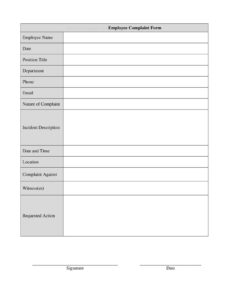
Employee Complaint Form
Document workplace concerns clearly with our free Employee Complaint Form template, available as a free download in PDF and DOCX for easy HR use.
PDF
DOCX
0
likes
Download Files
- DOCX
An Employee Complaint Form is a standardized document used to formally record a workplace concern, grievance, or violation so that an employer can investigate and respond appropriately. It is most commonly used when an employee needs to report harassment, discrimination, unsafe conditions, or a dispute with a coworker or manager in writing. This template is free to download in both PDF and DOCX formats, with no signup required.
What Is an Employee Complaint Form?
An Employee Complaint Form is an internal HR document that allows a worker to submit a written account of a problem they have experienced or witnessed in the workplace. It is typically issued by the human resources department or made available through an employee handbook, and it is completed by the complaining employee. The form documents the nature of the complaint, the people involved, the date and location of the incident, and any supporting details or witnesses. Its purpose is to create a clear, dated record that triggers a fair and consistent investigation process. By putting concerns in writing, both the employee and employer protect themselves and ensure the issue is handled through proper channels rather than informally.
When Do You Need an Employee Complaint Form?
This form is useful any time a workplace concern needs to be documented formally rather than raised casually. Common situations include:
- Harassment or discrimination: An employee experiences or witnesses behavior based on a protected characteristic such as race, gender, age, religion, or disability.
- Bullying or hostile behavior: Repeated intimidation, verbal abuse, or unfair treatment from a coworker or supervisor.
- Health and safety hazards: Unsafe equipment, blocked exits, or working conditions that put staff at risk.
- Wage and hour disputes: Concerns about unpaid overtime, missed breaks, or incorrect pay.
- Policy violations: A manager or colleague breaking company rules, ethics standards, or codes of conduct.
- Retaliation: An employee believes they were punished for raising an earlier concern or participating in an investigation.
Types of Employee Complaints
Not every complaint carries the same weight, and the form often helps categorize the issue. Interpersonal complaints involve conflicts between individuals, such as personality clashes or communication breakdowns. Behavioral complaints cover misconduct like harassment, threats, or theft. Policy or procedural complaints relate to how rules are applied — scheduling, pay, or promotions. Safety and compliance complaints address physical hazards or legal violations. Identifying the type early helps HR route the complaint to the right person and apply the correct investigation timeline.
What an Employee Complaint Form Should Have
A complete Employee Complaint Form should capture enough detail to allow a fair investigation without forcing the employee to write a legal brief. Essential elements include the complainant’s name and contact details, their job title and department, the date the form is submitted, and a clear description of the complaint. It should identify any other parties involved, the date, time, and location of the incident, and the names of any witnesses. Strong forms also include a space for the desired resolution, the employee’s signature, and a section for HR to record receipt, follow-up actions, and the outcome.
How to Fill Out an Employee Complaint Form
- Enter your personal information: Write your full name, job title, department, and contact details such as phone number or email so HR can follow up.
- Add the date: Record the date you are completing the form, which establishes a clear timeline.
- Identify the parties involved: List the name and role of anyone the complaint concerns, including coworkers, supervisors, or third parties.
- State the incident details: Note the date, time, and exact location where the issue occurred.
- Describe the complaint: Write a factual, chronological account of what happened. Stick to observable facts, quotes, and actions rather than opinions or assumptions.
- List witnesses: Include the names and contact information of anyone who saw or heard the incident.
- Attach supporting evidence: Reference any emails, photos, messages, or documents you are submitting with the form.
- Suggest a resolution: Describe the outcome you are seeking, such as mediation, policy enforcement, or disciplinary action.
- Sign and date: Add your signature to confirm the information is accurate, then submit the form to HR or your designated contact.
What Happens After You Submit
Once the form reaches HR, the employer typically acknowledges receipt and begins a review. Depending on the severity of the complaint, this may involve interviewing the complainant, the accused party, and any witnesses, as well as reviewing documents or video. The employer should keep the complaint confidential to the extent possible and protect the complainant from retaliation. After the investigation, the employer usually communicates an outcome and any corrective action. Keep a copy of your completed form for your own records, since it serves as proof of when and how you raised the concern.
Tips for Writing an Effective Complaint
Clarity strengthens your complaint. Use specific dates, times, and direct quotes rather than vague summaries. Separate facts from feelings — describe what was said or done, and note the impact afterward. Avoid exaggeration, which can undermine credibility, and resist editorializing about someone’s motives. If multiple incidents occurred, list them in order with separate dates. Submitting the form promptly, while details are fresh, makes the account more reliable and helps the investigation move quickly.
Common Mistakes to Avoid
- Being vague: Writing “he was rude to me” without specifics gives investigators nothing to act on.
- Mixing facts with assumptions: Stating what you believe someone intended rather than what they actually did.
- Leaving out witnesses: Forgetting to name people who could corroborate your account.
- Skipping the date and signature: An undated or unsigned form weakens the record and may delay action.
- Waiting too long: Delaying submission makes details harder to verify and can affect deadlines.
- Not keeping a copy: Submitting the only version means you have no proof of what you reported.
Frequently Asked Questions
What is an Employee Complaint Form used for? It is used to formally document a workplace concern such as harassment, discrimination, safety issues, or policy violations. The written record allows the employer to investigate the matter through a consistent, fair process and protects both parties by establishing a clear timeline.
How do I fill out an Employee Complaint Form? Enter your contact details, the date, the people involved, and a factual description of the incident including date, time, and location. List any witnesses, attach supporting evidence, describe the resolution you want, then sign and submit the form to HR.
Does an Employee Complaint Form need to be notarized? No, an internal Employee Complaint Form does not normally require notarization or witnesses. It is an internal document submitted to your employer, so your signature and the date are usually sufficient to confirm its accuracy.
Is the information I submit kept confidential? Employers generally keep complaints confidential to the extent practical, sharing details only with those who need to know to investigate. However, complete anonymity may not be possible if the complaint requires interviewing the people involved.
Can my employer retaliate against me for filing a complaint? Retaliation for raising a good-faith complaint is prohibited under many employment laws, and protections vary by jurisdiction. If you believe you have been punished for filing, document it and consider reporting the retaliation through the same process or to an outside agency.
How much does this Employee Complaint Form cost? Our template is completely free to download in PDF and DOCX formats with no signup required. You can edit the DOCX version to match your organization’s branding, policy language, and routing procedures.
This Employee Complaint Form template is provided as a general example for informational purposes only and does not constitute legal, HR, or employment advice. Workplace laws and complaint procedures vary by jurisdiction and employer policy — consult a qualified employment professional or attorney to ensure your process meets applicable requirements.
Official resource: for the rules that apply to your situation, see the U.S. Department of Labor.
Related Forms
- Key Assignment Form
- Job Description Template
- Bi-Weekly Time Card With Approval
- Employee Fired For Cause
- Employee Termination Notice
- Grievance Report
Browse more in Employment.