
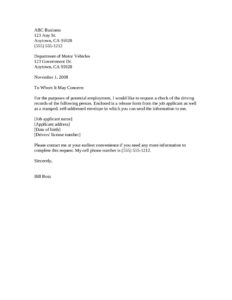
Check Driving Record
Download a free Check Driving Record request letter template to ask the DMV for an applicant's driving history — free PDF and DOCX download, no signup.
DOCX
1 downloads
0
likes
Download Files
- DOCX
A Check Driving Record letter is a formal request an employer sends to the Department of Motor Vehicles asking for a job applicant’s driving history. The most common reason people use it is to verify a candidate’s driving record before hiring them for a role that involves operating a company vehicle. This template is free to download in PDF and DOCX, with no signup required.
What Is a Check Driving Record Letter?
A Check Driving Record letter is a written request issued by a prospective employer (or a hiring manager on the company’s behalf) to a state motor vehicle agency. It identifies a specific job applicant and asks the agency to release that person’s driving record for employment screening purposes. The letter documents who is making the request, on whose authority, and for what reason. Because driving records are protected information, the letter is typically accompanied by a signed release form from the applicant and a self-addressed stamped envelope so the agency can return the report. It serves as both a formal cover letter and a paper trail showing the employer followed a consent-based process.
When Do You Need a Check Driving Record Letter?
Employers and hiring teams reach for this letter whenever a position carries driving responsibilities or insurance implications. Common situations include:
- Hiring a delivery driver, courier, or route driver who will operate company vehicles daily.
- Screening candidates for commercial driving roles such as truck, bus, or shuttle operators where a clean record is essential.
- Vetting sales reps or field technicians who drive their own or company cars to customer sites.
- Verifying employees before adding them to a fleet insurance policy, since insurers often require a clean motor vehicle report.
- Confirming an applicant’s history when a role mentions a valid license as a requirement.
- Periodic re-checks of existing drivers when company policy or insurers mandate annual record reviews.
What a Check Driving Record Letter Should Have
A complete request letter contains every detail the motor vehicle agency needs to locate the correct record and return it to you. At minimum it should include the requesting business’s name and full mailing address, the agency’s name and address, the date, a clear statement of purpose (employment screening), and the applicant’s identifying details — full name, address, date of birth, and driver’s license number. It should also reference the enclosed signed release from the applicant and the enclosed self-addressed stamped envelope. Finally, include a direct contact name and phone number so the agency can reach you if anything is missing. A courteous closing and signature complete the document.
How to Fill Out a Check Driving Record Letter
- Enter your business header. Replace the sample “ABC Business, 123 Any St., Anytown, CA” with your company name, street address, city, state, ZIP, and phone number.
- Add the agency address. Update the “Department of Motor Vehicles” block with the correct name and mailing address for your state’s licensing agency.
- Insert the date. Use the actual date you are mailing the letter, not the placeholder.
- State the purpose. Keep the line noting the request is “for the purposes of potential employment.”
- Fill in the applicant fields. Enter the job applicant name, applicant address, date of birth, and driver’s license number exactly as they appear on official documents.
- Confirm enclosures. Attach the applicant’s signed release form and a stamped, self-addressed envelope, as the letter states.
- Add your contact details and sign. Replace “Bill Boss” and the sample phone number with your name and a number where the agency can reach you, then sign.
The Importance of the Applicant Release
Driving records contain personal data, so most agencies will not release them without documented consent. That is why this letter explicitly references an enclosed release form signed by the applicant. The signed authorization protects both parties: it confirms the candidate knew about and agreed to the check, and it gives the employer a defensible record that the request was lawful. Many jurisdictions, along with federal background-check and consumer-reporting rules, require that you obtain clear written consent before requesting an applicant’s record and, in some cases, that you disclose how the information will be used. Always pair this letter with a properly signed release rather than sending it on its own.
How This Differs from an Online Record Pull
Some employers order driving records electronically through a screening service or a state’s online portal, which can be faster than mailing a letter. A written request still has clear advantages: it works when the agency requires a mailed authorization, it creates a physical paper trail, and it is useful for one-off hires where setting up an account is not worth it. The self-addressed stamped envelope ensures the report comes straight back to you. Choose the method that matches your volume, your state’s process, and how much documentation you want on file.
Common Mistakes to Avoid
- Forgetting the signed release. Without the applicant’s consent form, the agency will likely reject or ignore the request.
- Wrong agency address. Sending to the wrong office or out-of-date address delays or loses your request.
- Mistyped license number or date of birth. A single error can return the wrong record or no record at all.
- Leaving placeholder text. Submitting the letter with “ABC Business” or “Bill Boss” still in it looks careless and may cause confusion.
- Omitting the return envelope. Many agencies will not respond without a stamped, self-addressed envelope.
- No contact phone number. If the agency needs clarification and can’t reach you, the request stalls.
Frequently Asked Questions
What is a Check Driving Record letter used for? It is a formal request from an employer to a state motor vehicle agency asking for a job applicant’s driving history. Employers use it to screen candidates for roles that involve driving, such as delivery, sales, or commercial transport positions. The letter documents who is requesting the record and why.
How do I fill out the Check Driving Record letter? Replace the sample business and agency information with your own details, add the current date, and enter the applicant’s full name, address, date of birth, and driver’s license number. Then enclose the applicant’s signed release form and a stamped, self-addressed envelope, add your contact phone number, and sign the letter before mailing.
Do I need the applicant’s permission to request their driving record? Yes. Driving records are protected, and most agencies require a signed release from the person whose record is being requested. The letter specifically references an enclosed release form, and obtaining written consent also helps you comply with background-check and privacy rules that vary by jurisdiction.
Is this letter legally binding? The letter itself is a request, not a contract, so it is not “binding” in the way an agreement is. However, the accompanying signed release authorizes the agency to disclose the record, and using a consent-based process helps keep your screening lawful. Requirements differ by state, so confirm your local agency’s rules.
How long does it take to get the record back? Turnaround depends on the agency and method. Mailed requests can take from several days to a few weeks, which is why the template includes a stamped, self-addressed return envelope. If you need results quickly, check whether your state offers an online or expedited option.
How much does this template cost? The Check Driving Record letter template is completely free to download here in both PDF and DOCX formats, with no signup required. Note that the motor vehicle agency itself may charge a fee to process and release the actual record.
This template is a general example provided for informational purposes only and is not legal advice. Background-screening, consent, and record-access requirements vary by state and agency and may be subject to federal regulations. Consult a qualified attorney or compliance professional before using it.
Official resource: for the rules that apply to your situation, see the U.S. Department of Labor.
Related Forms
- Sexual Harassment Complaint
- Employee Evaluation
- Absentee Report Form
- Harassment Report Form
- Request for Transfer
- Employee Official Warning Letter
Browse more in Employment.