
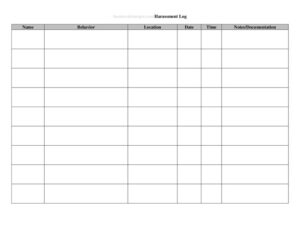
Harassment Log
Download a free Harassment Log template in PDF or DOCX to document incidents, dates, witnesses, and details clearly and consistently for your records.
PDF
DOCX
8 downloads
0
likes
Download Files
- DOCX
A Harassment Log is a written record used to document incidents of harassment, intimidation, or unwanted behavior over time, capturing what happened, when, where, and who was involved. People most commonly use it to build a clear, organized timeline of events before reporting to HR, management, or another authority. You can download this Harassment Log template for free in both PDF and DOCX formats, with no signup required.
What Is a Harassment Log?
A Harassment Log is a chronological document that records each instance of harassing or hostile conduct as it occurs. It is typically kept by the person experiencing the behavior, though a manager, HR representative, or advocate may maintain one on someone’s behalf. The log captures objective details — dates, times, locations, the people involved, what was said or done, and any witnesses — so that a pattern can be demonstrated rather than relying on memory alone. Because harassment often unfolds gradually through repeated small incidents, a single complaint may seem minor, but a documented series of entries shows frequency and severity. A well-kept log supports internal complaints, investigations, and, where applicable, formal grievances.
When Do You Need a Harassment Log?
You may need to keep a Harassment Log in a range of personal and workplace situations. Common scenarios include:
- Workplace harassment — documenting repeated offensive comments, unwanted advances, or hostile behavior from a coworker, supervisor, or client.
- Before filing an HR complaint — assembling a factual timeline so your report is specific, credible, and easy to investigate.
- Bullying or intimidation — tracking ongoing verbal abuse, exclusion, threats, or sabotage that creates a hostile environment.
- Discrimination patterns — recording incidents that appear tied to race, gender, age, religion, disability, or another protected characteristic.
- Neighbor or tenant disputes — logging persistent threatening, abusive, or disruptive conduct for a landlord, property manager, or local authority.
- Online or telephone harassment — noting messages, calls, or posts, including screenshots or message IDs, to show a sustained course of conduct.
What a Harassment Log Should Have
To be useful and credible, a Harassment Log should focus on facts rather than opinions. Each entry should be able to stand on its own while contributing to the overall picture. Strong logs generally include:
- The date and time of each incident, recorded as precisely as possible.
- The location where it happened — office, meeting room, parking lot, or an online platform.
- A factual description of what was said or done, ideally quoting exact words.
- The name and role of the person responsible.
- Any witnesses present and how to reach them.
- The impact on you and any action you took in response.
- References to supporting evidence such as emails, texts, or screenshots.
How to Fill Out a Harassment Log
This template is designed to be completed entry by entry, with one row or block per incident. Follow these steps:
- Add your details. At the top, enter your name and, if relevant, your job title, department, and the employer or organization the log relates to.
- Date and time each entry. For every incident, write the exact date and approximate time it occurred. Accuracy strengthens the record.
- Record the location. Note where it happened — a specific room, building, video call, or messaging app.
- Identify the person involved. Write the harasser’s full name and role or relationship to you.
- Describe what happened. Use plain, factual language and quote exact words where you can. Avoid labels or conclusions; describe the behavior itself.
- List witnesses. Add the names of anyone who saw or heard the incident, with contact details if available.
- Note evidence. Reference any screenshots, emails, recordings, or documents that support the entry, and store the originals safely.
- Describe the impact and your response. Record how it affected you and whether you reported it, who you told, and when.
Keeping Your Log Credible and Confidential
The value of a Harassment Log comes from consistency and objectivity. Complete each entry as soon as possible after an incident, while details are fresh, rather than reconstructing events weeks later. Stick to what you personally observed and heard; separate facts from how you felt by keeping descriptions and impact statements distinct. Store the log somewhere private and secure — ideally on a personal device or account rather than a shared work computer — and keep backups. If you reference emails or messages, preserve the originals in a safe location so the log and the underlying evidence stay consistent. A calm, factual tone makes the log far more persuasive than emotional or speculative language.
How a Harassment Log Differs From a Formal Complaint
A Harassment Log is not the same as a formal complaint or grievance. The log is your private working document — an ongoing diary that helps you remember and organize events. A formal complaint is a deliberate submission to HR, a manager, a regulator, or another authority asking them to act. Many people use their log as the backbone of a later complaint, drawing dates and quotes directly from it. Keeping the two separate lets you decide when and whether to escalate, while ensuring that if you do, your account is detailed and consistent.
Common Mistakes to Avoid
- Waiting too long to record incidents — memory fades and specific dates, times, and quotes are easily lost.
- Writing opinions instead of facts — conclusions like “he was being sexist” are weaker than the exact words and actions you observed.
- Leaving out witnesses — failing to note who else was present misses valuable corroboration.
- Storing the log insecurely — keeping it only on a shared or employer-controlled device risks loss or exposure.
- Mixing unrelated complaints — padding the log with minor grievances can dilute the credibility of serious incidents.
- Editing earlier entries — altering past records undermines reliability; add a new dated entry instead.
Frequently Asked Questions
What is a Harassment Log used for? It is used to document a series of harassing or hostile incidents over time so you can show a pattern rather than relying on memory. People typically use it to prepare for an HR report, an investigation, or a formal complaint. It keeps dates, details, and witnesses organized in one place.
How do I fill out a Harassment Log? Create one entry per incident and record the date, time, location, the person involved, a factual description of what happened, any witnesses, and your response. Complete each entry as soon as possible after the event while details are fresh. Stick to objective facts and quote exact words where you can.
Is a Harassment Log legally binding? A log is not a contract or a legal filing, so it is not “binding” in that sense. However, a detailed, consistently kept log can serve as supporting documentation in HR investigations or disputes. Its weight depends on accuracy, consistency, and any underlying evidence it references.
Does a Harassment Log need to be signed or witnessed? No signature or witness is required for the log itself, since it is your personal record. That said, noting witnesses to each incident strengthens it considerably. If you later submit it as part of a formal complaint, the receiving party may ask you to confirm or attest to its contents.
Should I tell my employer I am keeping a log? You are generally not required to announce that you are keeping a personal record of incidents that affect you. Many people keep it private until they decide to report. Policies vary by organization, so review your employee handbook or speak with a trusted advisor if you are unsure.
How much does this Harassment Log template cost? It is completely free to download from Business Forms Pro in both PDF and DOCX formats, with no signup required. You can fill out the PDF by hand or edit the DOCX version on your computer. Save a copy and keep adding entries as needed.
This Harassment Log template is provided as a general example for informational purposes only and does not constitute legal, HR, or professional advice. Laws, workplace policies, and reporting requirements vary by jurisdiction and organization. Consult a qualified attorney or appropriate professional for guidance on your specific situation.
Official resource: for the rules that apply to your situation, see the U.S. Department of Labor.
Related Forms
- Disciplinary Action Form
- Consent To Drug Test
- Employment Confirmation Letter
- Employee Official Warning Letter
- Proof Of Employment
- Harassment Report Form
Browse more in Employment.