
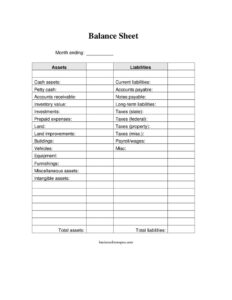
Balance Sheet Blank
Download a free blank balance sheet template in PDF or DOCX to organize assets, liabilities, and equity and snapshot your financial position in minutes.
PDF
DOCX
5 downloads
0
likes
Download Files
- DOCX
A blank balance sheet is a financial statement template that captures everything your business owns and owes on a specific date, so you can see your net worth at a glance. People most often use it to summarize assets and liabilities at month-end for bookkeeping, lender requests, or internal reviews. This template is free to download in both PDF and DOCX, with no signup required.
What Is a Blank Balance Sheet?
A blank balance sheet is a ready-to-fill form that organizes a company’s finances into two halves: what it owns (assets) and what it owes (liabilities), with owner’s equity making up the difference. It is typically prepared by a business owner, bookkeeper, or accountant and reflects a single moment in time rather than a span of activity. Unlike an income statement that tracks performance over a period, the balance sheet is a snapshot ists includes line items such as cash, accounts receivable, inventory, equipment, accounts payable, notes payable, and various tax obligations. The core idea is the accounting equation: assets must equal liabilities plus equity. Completing this form gives you a clear, structured view of your financial position at any chosen month ending.
When Do You Need a Blank Balance Sheet?
This form is useful any time you need to document your financial standing in an organized format. Common situations include:
- Applying for a loan or line of credit — banks routinely request a current balance sheet to evaluate solvency and collateral.
- Closing the books each month — recording cash, receivables, payables, and tax liabilities for the month ending.
- Preparing for tax season — summarizing state, federal, and property tax obligations alongside payroll and wages owed.
- Attracting investors or partners — showing the value of land, buildings, vehicles, and equipment against outstanding debts.
- Tracking growth over time — comparing month-end snapshots to see how inventory, investments, and liabilities shift.
- Internal budgeting and expense review — pairing the balance sheet with expense reports to understand the full financial picture.
What a Balance Sheet Should Have
A complete balance sheet separates assets from liabilities clearly and totals each side. On the asset side, you need current assets that convert to cash quickly, such as cash, petty cash, accounts receivable, inventory, and prepaid expenses, alongside fixed and long-term assets like land, buildings, vehicles, equipment, and investments. The liability side should distinguish current liabilities (due within a year, such as accounts payable and short-term notes payable) from long-term liabilities. Tax categories — state, federal, property, and miscellaneous — plus payroll and wages owed must also appear. A reliable balance sheet always lists the reporting date (month ending), shows subtotals for each section, and confirms that total assets equal total liabilities plus equity.
How to Fill Out a Blank Balance Sheet
- Set the date: Enter the month ending at the top so the snapshot is tied to a specific point in time.
- List current assets: Record cash assets, petty cash, accounts receivable, inventory value, and prepaid expenses.
- Add investments and intangibles: Enter investments, miscellaneous assets, and any intangible assets such as goodwill or patents.
- Enter fixed assets: Fill in land, land improvements, buildings, vehicles, equipment, and furnishings at their book values.
- Total your assets: Sum every asset line to get total assets.
- Record current liabilities: Under liabilities and current liabilities, list accounts payable and short-term notes payable.
- Add long-term and tax items: Enter long-term liabilities, then taxes (state), taxes (federal), taxes (property), taxes (misc.), payroll/wages, and misc.
- Total liabilities and confirm balance: Sum all liabilities; total assets minus total liabilities equals owner’s equity.
Understanding Assets vs. Liabilities
The clearest way to read this form is to keep the two halves distinct. Assets are resources with value — they generate income or could be sold. The template groups them logically: liquid items like cash and petty cash come first, followed by receivables and inventory you expect to convert soon, then long-lived holdings like land, buildings, and equipment that support operations for years. Liabilities are claims against those assets. Current liabilities such as accounts payable and short-term notes payable come due within twelve months, while long-term liabilities stretch beyond. Tax lines deserve special attention because state, federal, property, and miscellaneous taxes accrue continuously even when not yet paid. Listing payroll and wages as a liability ensures money owed to employees is never overlooked.
Tips for an Accurate Snapshot
Use consistent valuation methods from one month to the next so comparisons stay meaningful. Reconcile your cash assets and petty cash against bank statements before finalizing. Record inventory at the same basis (cost or market) each period, and keep depreciation in mind when listing vehicles, equipment, and furnishings — book values typically decline over time. If your two sides do not balance, recheck for a missing entry, a transposed figure, or an item placed in the wrong column. Saving a dated copy each month builds a useful history you can hand to lenders or accountants.
Common Mistakes to Avoid
- Forgetting the date: A balance sheet without a clear month ending is meaningless because values change daily.
- Mixing current and long-term items: Placing a long-term note under current liabilities distorts your short-term obligations.
- Omitting accrued taxes and payroll: Skipping unpaid state, federal, property taxes or wages understates what you truly owe.
- Using outdated asset values: Listing equipment or vehicles at purchase price without depreciation overstates assets.
- Not balancing the equation: If assets do not equal liabilities plus equity, there is an error to find before relying on the numbers.
- Double-counting: Recording the same investment or receivable in two lines inflates your totals.
Frequently Asked Questions
What is a blank balance sheet used for? It is used to summarize everything a business owns and owes on a specific date. Owners, bookkeepers, and accountants rely on it for loan applications, month-end closing, tax preparation, and tracking financial health over time. It provides a structured snapshot rather than a record of activity over a period.
How do I fill out the balance sheet template? Start by entering the month ending, then list each asset — cash, receivables, inventory, land, buildings, equipment, and more — and total them. Next, list current and long-term liabilities, including accounts payable, notes payable, taxes, and payroll. Confirm that total assets equal total liabilities plus owner’s equity.
Does a balance sheet need to balance exactly? Yes. The fundamental rule is that total assets must equal total liabilities plus owner’s equity. If your two sides differ, it signals a missing entry, a miscalculation, or an item placed in the wrong category that you should locate before using the report.
What is the difference between a balance sheet and an income statement? A balance sheet captures your financial position at a single point in time, showing assets, liabilities, and equity. An income statement covers a period and reports revenue, expenses, and profit. The two work together to give a complete view of your finances.
Is this balance sheet template free? Yes. You can download this blank balance sheet at no cost in both PDF and DOCX formats, with no account or signup required. Use the DOCX version to type values directly or print the PDF to fill it out by hand.
Do I need an accountant to complete it? Many small business owners complete a basic balance sheet themselves using this template. However, if you are preparing financials for a loan, audit, investors, or complex tax situations, having an accountant review your figures helps ensure accuracy and proper categorization.
This balance sheet template is provided as a general example for informational purposes only and does not constitute legal, financial, or tax advice. Accounting standards and reporting requirements vary by jurisdiction and business type — consult a qualified accountant or financial professional before relying on it for official purposes.
Related Forms
- Business Trip Details List
- Event Budget Worksheet
- Credit Card Minimum Payment
- Travel Expense Report
- Gas Mileage Reimbursement
- Bill Tracker
Browse more in Expense Reports.