
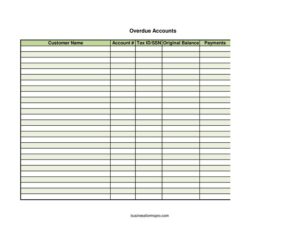
Company Overdue Accounts
Track unpaid customer balances with this free Company Overdue Accounts template, available as a free download in PDF and DOCX for fast collections.
PDF
XLSX
2 downloads
0
likes
Download Files
- XLSX
A Company Overdue Accounts form is a simple tracking document that lists customers who owe your business past-due balances, capturing each account number, the original amount, payments received, and the balance still owed. Businesses use it most often to consolidate delinquent receivables into one clear, actionable list before sending reminders or escalating collections. You can download this Company Overdue Accounts template for free in PDF and DOCX, with no signup required.
What Is a Company Overdue Accounts Form?
A Company Overdue Accounts form is an internal record that summarizes the customers who have not paid invoices by their due dates. It is typically prepared by a bookkeeper, accounts receivable clerk, or small-business owner, and it pulls together the essential numbers needed to chase payment: who owes money, how much they originally owed, what they have paid so far, and what remains outstanding. Rather than digging through dozens of individual invoices, this form gives you a single snapshot of your aging receivables. It supports cash-flow planning, informs collection decisions, and creates a paper trail that documents the status of each delinquent account at a specific point in time.
When Do You Need a Company Overdue Accounts Form?
This form earns its place whenever unpaid balances start piling up and you need a clear way to manage them. Common situations include:
- Monthly receivables review: Pulling together every account past its due date so you can prioritize follow-up calls and emails.
- Before sending collection letters: Confirming exact balances owed and any payments already applied so your reminders are accurate.
- Cash-flow forecasting: Estimating how much of your outstanding revenue is at risk and when it may actually arrive.
- Handing accounts to a collections agency: Providing a documented summary of each delinquent customer and the precise amount due.
- Year-end or audit preparation: Supporting bad-debt write-offs and giving your accountant a clean list of unpaid balances.
- Owner or management reporting: Showing leadership exactly which customers are behind and the total exposure across all accounts.
What a Company Overdue Accounts Form Should Have
A useful overdue accounts form keeps the numbers tight and verifiable. At minimum, each line should clearly identify the customer and tie back to a specific account, then walk through the math from the original balance to the amount still owed. Include the customer name and account number for unambiguous matching, a tax ID or SSN field where you track that identifier for reporting or collections, the original balance, total payments received, and the resulting balance owed. A title, the company name, and the date the report was prepared round out the document so anyone reading it knows the source and the as-of point in time.
How to Fill Out a Company Overdue Accounts Form
Work through the form one account at a time, transferring figures directly from your accounting records so the totals reconcile:
- Customer name: Enter the full legal or business name of the delinquent customer exactly as it appears on the original invoice or in your system.
- Account #: Record the unique account number so this entry can be matched to invoices, statements, and ledger records without confusion.
- Tax ID/SSN: If you track this identifier, enter the customer’s tax identification number or, for an individual, their Social Security number. Handle this data securely and only collect it when you have a legitimate business reason.
- Original balance: Write the full amount the customer originally owed on the account before any payments.
- Payments: Total all amounts the customer has paid toward that balance to date, including partial payments.
- Balance owed: Subtract payments from the original balance to show the current amount still outstanding. Double-check this figure against your ledger.
Repeat for every overdue account, then total the balance-owed column to see your overall exposure.
Keeping Sensitive Data Secure
Because this form may capture a tax ID or Social Security number alongside financial balances, treat it as confidential. Store printed copies in a locked location and restrict the digital file to staff who genuinely need it for billing or collections. Avoid emailing the full list with sensitive identifiers in plain text; use a password-protected file or a secure shared drive instead. When an account is resolved or written off, archive or dispose of the record according to your retention policy. Collecting a tax ID or SSN only when there is a clear business purpose — such as 1099 reporting or formal collections — reduces your risk and keeps you in line with common data-handling expectations.
From Tracking to Collecting
An overdue accounts list is most valuable when it triggers action. Once the form is complete, sort entries by balance owed or by how long they have been past due, then decide on a step for each: a friendly reminder, a formal demand letter, a payment-plan offer, or escalation to a collection partner. Update the payments and balance-owed columns as money comes in, and re-run the report on a regular schedule so it always reflects current reality. Pairing this form with consistent follow-up turns a static report into a working collections tool that steadily reduces what your business is owed.
Common Mistakes to Avoid
- Stale figures: Forgetting to subtract recent payments, which overstates the balance owed and embarrasses you when a customer disputes it.
- Missing account numbers: Leaving the account number blank makes it hard to match the entry to invoices and slows every follow-up.
- Mismatched names: Using nicknames or abbreviations instead of the exact account name, causing confusion during collections.
- Exposing sensitive IDs: Storing tax IDs or SSNs in unsecured files or sharing the list too widely.
- No prepared date: Omitting the as-of date, so readers cannot tell how current the balances are.
- Math errors: Failing to reconcile the balance-owed total against your accounting system, which undermines trust in the whole report.
Frequently Asked Questions
What is a Company Overdue Accounts form? It is an internal report that lists customers with past-due balances, showing each account’s original balance, payments made, and amount still owed. Businesses use it to organize collections and monitor outstanding receivables in one place.
How do I fill out the balance owed? Subtract the total payments received from the original balance for each account. Always reconcile the result against your accounting records so the figure is accurate before you contact the customer.
Do I need to include a tax ID or SSN? Only if you have a legitimate business reason, such as 1099 reporting or formal collections. When you do collect it, store and share the form securely to protect that sensitive information.
Is this form legally binding? No. It is an internal tracking document, not a contract or demand. The underlying invoices and agreements establish the debt; this form simply summarizes the status of those balances.
How often should I update it? Most businesses refresh the report monthly or whenever payments come in. Keeping it current ensures your follow-up efforts and cash-flow estimates are based on accurate numbers.
How much does this template cost? It is completely free to download from Business Forms Pro in both PDF and DOCX formats, with no signup required. You can edit the DOCX version to add columns like due dates or aging buckets.
This template is a general example provided for informational purposes only and is not legal, financial, or tax advice. Requirements for debt collection, recordkeeping, and handling of sensitive identifiers vary by jurisdiction — consult a qualified professional for guidance specific to your situation.
Related Forms
- Credit Card Minimum Payment
- Travel Expenses
- Expense Report
- Expense Reimbursement Request Report
- Event Budget Worksheet
- Bill Tracker
Browse more in Expense Reports.