
Credit Card Minimum Payment
Use our free Credit Card Minimum Payment calculator template to figure the minimum due from your balance and rate — free PDF and DOCX download.
PDF
XLSX
4 downloads
0
likes
Download Files
- XLSX
A Credit Card Minimum Payment worksheet helps you calculate the smallest amount you must pay on a credit card balance for a given billing cycle, using your starting balance and the card’s minimum payment percentage. People most often reach for it to confirm the figure on a statement, plan a tight month’s budget, or understand how minimum-only payments affect a balance over time. It’s free to download here in both PDF and DOCX formats — no signup required.
What Is a Credit Card Minimum Payment Worksheet?
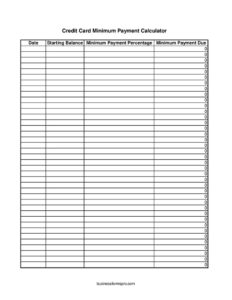
A Credit Card Minimum Payment worksheet is a simple calculation form used to determine the minimum amount due on a credit card for a specific date. Cardholders, bookkeepers, and anyone tracking expenses use it to translate a balance and a percentage into a concrete dollar figure. It documents the date of calculation, the starting balance carried on the account, the minimum payment percentage set by the issuer, and the resulting minimum payment due. While the credit card company ultimately defines the official minimum, this worksheet lets you verify it, forecast future payments, and keep a clean record alongside your other expense reports.
When Do You Need a Credit Card Minimum Payment Worksheet?
- Verifying a statement: You want to double-check that the minimum payment printed on your bill matches the issuer’s stated percentage of your balance.
- Budgeting a tight month: You need to know the absolute minimum you can pay this cycle without missing a payment.
- Forecasting future payments: You’re estimating what the minimum will be next month if your balance stays roughly the same.
- Comparing cards: You’re deciding which balance to prioritize and want each card’s minimum laid out side by side.
- Expense reporting: A bookkeeper or small business owner is logging recurring credit card obligations as part of a monthly expense report.
- Teaching or coaching: A financial educator or counselor demonstrates how minimum payments are derived from a percentage of the balance.
What a Minimum Payment Worksheet Should Have
A complete worksheet captures four core elements so the result is reproducible and easy to audit. First, a date ties the calculation to a specific statement or billing cycle. Second, the starting balance records the amount owed at the moment of calculation. Third, the minimum payment percentage reflects the rate your issuer applies — commonly a small single-digit percentage of the balance. Fourth, the minimum payment due shows the calculated result. Together these fields make the math transparent: anyone reviewing the sheet can see exactly how the final figure was reached, which is essential if you ever need to reconcile it against an official statement.
How to Fill Out a Credit Card Minimum Payment Worksheet
- Enter the date. Write the date you are performing the calculation, ideally matching your statement closing date or the date you’re planning a payment so the figure stays relevant.
- Record the starting balance. Enter the current balance owed on the card. Use the statement balance or your live account balance, and note which one you chose for consistency.
- Enter the minimum payment percentage. Input the percentage your card issuer uses to calculate the minimum — this is usually found in your cardholder agreement or on the statement. Enter it exactly as stated (for example, a small percent of the balance).
- Calculate the minimum payment due. Multiply the starting balance by the minimum payment percentage. For example, a balance times its percentage gives the percentage-based minimum. Record the result in the minimum payment due field.
- Check the issuer’s floor. Many issuers also set a flat minimum (such as a fixed small dollar amount) that applies when the percentage result is lower. Compare your figure to any stated minimum and record the larger of the two as your actual minimum due.
Understanding How the Percentage Works
Most credit card issuers calculate a minimum payment as either a small percentage of the outstanding balance, a flat dollar amount, or whichever is greater — sometimes plus interest and fees. This worksheet focuses on the percentage method, which is the most transparent to estimate. Because the minimum is a percentage of the balance, it shrinks as the balance drops, meaning minimum-only payments stretch repayment over a long period. Keep that in mind when you use the worksheet: the figure it produces is the least you can pay, not the amount that clears the debt efficiently. If your goal is to pay down the card faster, treat the calculated minimum as a floor and add extra whenever your budget allows.
Tips for Using the Worksheet Effectively
Save a copy each month so you build a running history of balances and minimums — this makes it easy to spot trends, such as a balance that keeps climbing. If you carry several cards, fill out one worksheet per card and store them together in your expense file. When your statement arrives, compare the official minimum to your calculated figure; small differences usually come from interest, fees, or an issuer floor. If you find a large discrepancy, contact your card company before assuming the worksheet is wrong, since issuer formulas can include components beyond a simple percentage.
Common Mistakes to Avoid
- Confusing the percentage format: Entering a whole number where a decimal is needed (or vice versa) throws off the result dramatically — double-check your math.
- Using an outdated balance: Calculating from last month’s balance instead of the current one gives a figure that won’t match your statement.
- Ignoring the flat-dollar floor: Forgetting that issuers often charge a fixed minimum when the percentage result is tiny.
- Treating the minimum as a goal: Paying only the minimum keeps you in debt far longer and accrues more interest.
- Leaving out interest and fees: Some issuers add accrued interest to the percentage, so the true minimum can be higher than a plain percentage calculation.
- Not dating the sheet: Without a date, you can’t tell which billing cycle the figure applies to later on.
Frequently Asked Questions
What is a credit card minimum payment? It’s the smallest amount your card issuer requires you to pay by the due date to keep your account in good standing. It is typically calculated as a percentage of your balance, a flat dollar amount, or whichever is greater. This worksheet helps you estimate the percentage-based portion.
How do I calculate the minimum payment? Multiply your starting balance by the minimum payment percentage your issuer uses. Then compare that result against any flat-dollar minimum your card sets and use the larger of the two figures. The worksheet walks you through each of those values step by step.
Where do I find my minimum payment percentage? Your minimum payment formula is described in your cardholder agreement and is often referenced on your monthly statement. If you can’t locate it, contact your issuer’s customer service and ask how the minimum is calculated for your specific card.
Is the calculated figure the exact amount I owe? Not always. Issuers may add accrued interest, past-due amounts, or fees to the percentage, so your official statement minimum can be slightly higher. Always treat the worksheet result as an estimate and defer to your statement for the binding amount.
Should I only pay the minimum each month? Paying only the minimum keeps your account current but extends repayment and increases the total interest you pay. Whenever your budget allows, paying more than the minimum reduces your balance faster and saves money over time.
Is this worksheet really free? Yes. You can download the Credit Card Minimum Payment worksheet for free in both PDF and DOCX formats with no signup required. Use it as many times as you like for personal or business expense tracking.
This template is a general example provided for informational purposes only and does not constitute financial, tax, or legal advice. Minimum payment formulas vary by card issuer and may include interest and fees, and your actual obligation is determined by your cardholder agreement. For guidance specific to your situation, consult a qualified financial professional or your card issuer.
Related Forms
- Travel Expense Report
- Event Budget Worksheet
- Gas Mileage Reimbursement
- Check Register
- Business Trip Details List
- Mileage Reimbursement Form
Browse more in Expense Reports.