
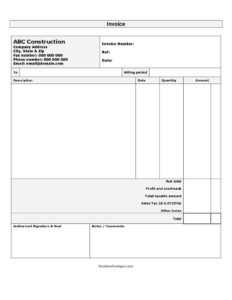
Construction Invoice
Download a free Construction Invoice template in PDF and DOCX to bill clients for labor, materials, overheads, and tax with a clear professional layout.
PDF
DOCX
0
likes
Download Files
- DOCX
A Construction Invoice is a billing document that a contractor, builder, or trade professional sends to a client to request payment for completed construction work, materials, labor, and related charges. Most people use it to bill a client at the end of a project phase or billing period and to create a clear paper trail of what was charged and why. You can download this Construction Invoice free in both PDF and DOCX formats — no signup required.
What Is a Construction Invoice?
A Construction Invoice is an itemized payment request issued by a contractor or construction company to a property owner, general contractor, or developer. Unlike a simple sales receipt, it breaks work down by description, rate, and quantity, then layers on construction-specific costs such as profit and overheads, sales tax, and other levies. It documents exactly what was performed during a defined billing period and what is owed. This particular template includes a company address block, invoice number, reference field, date, recipient details, and an authorized signature and seal — everything needed to present a professional, auditable bill that both parties can rely on for their records.
When Do You Need a Construction Invoice?
Contractors and trades use this form throughout a project, not just at the end. Common situations include:
- Progress billing — invoicing for a completed phase or percentage of a long-running project, using the billing period field to define the dates covered.
- Final payment — submitting the closing bill once the job is finished and walked through with the client.
- Time-and-materials jobs — billing by rate and quantity for labor hours, equipment, and supplies on work that wasn’t fixed-price.
- Subcontractor billing — when a trade contractor invoices the general contractor for their portion of the scope.
- Change orders — charging for additional work beyond the original contract, referenced clearly so the client knows it’s extra.
- Material reimbursement — recovering the cost of purchased materials, with overheads and tax applied where appropriate.
Because it accommodates subtotal, taxable amount, sales tax, and other levies, the form works for everything from a small renovation to a multi-trade commercial build.
What a Construction Invoice Should Have
A complete construction invoice leaves no room for confusion about who owes what. The essentials are: your company name and address; a unique invoice number for tracking; a reference or job number tying the invoice to a contract or project; the invoice date and billing period; the client’s name and details in the “to” field; a clear line-item description of work or materials; the rate, quantity, and amount for each item; a subtotal; an allowance for profit and overheads; the total taxable amount; sales tax and any other levies; the grand total due; and an authorized signature and seal. A notes or comments area for payment terms and remarks rounds it out.
How to Fill Out a Construction Invoice
- Company address: Enter your business name, address, and contact details at the top so the client knows exactly who is billing them.
- Invoice number: Assign a unique, sequential number for your records and the client’s accounts payable.
- Ref: Add the contract, purchase order, or job reference number that links this invoice to the project.
- Date: Record the date the invoice is issued.
- To: Enter the client or general contractor’s name, company, and billing address.
- Billing period: Specify the date range or project phase this invoice covers.
- Description, rate, quantity, amount: List each line of work or material, the unit rate, the quantity (hours, units, or square footage), and the resulting amount.
- Subtotal: Add up all line amounts.
- Profit and overheads: Apply your markup or overhead allowance as a line or percentage.
- Total taxable amount: Show the base on which tax is calculated.
- Sales tax and other levies: Add applicable tax and any additional charges.
- Total: State the final amount due, then sign with your authorized signature and seal and add any notes.
Understanding Profit, Overheads, and Levies
One feature that sets a construction invoice apart from an ordinary invoice is the dedicated line for profit and overheads. Overheads cover indirect costs — office expenses, insurance, equipment depreciation, and supervision — that aren’t tied to a single line item but still must be recovered. Profit is your margin on the job. Listing them transparently (often as a percentage applied to the subtotal) helps clients understand the pricing and supports cost-plus contracts where this breakdown is expected. The “other levies” field captures charges beyond sales tax, such as local construction fees, environmental surcharges, or permit-related pass-through costs. Always confirm what is genuinely taxable in your area before calculating the total taxable amount, since rules differ widely by jurisdiction.
Tips for Getting Paid Faster
Clear invoices get paid sooner. Use the notes field to state payment terms plainly — for example, net 15 or net 30 — along with accepted payment methods and any late-payment terms agreed in the contract. Reference the original contract or change order so the client can match the charge against approved work. Send the invoice promptly at the close of each billing period rather than batching them, and keep a copy of the signed and sealed version for your records. Attaching supporting documents, such as timesheets, material receipts, or lien waivers where applicable, reduces disputes and speeds approval through the client’s accounts payable process.
Common Mistakes to Avoid
- Reusing invoice numbers — duplicate numbers create accounting confusion and make tracking payments difficult.
- Vague descriptions — “construction work” tells the client nothing; specify the task, location, and unit.
- Math errors — double-check that rate times quantity matches each amount and that the subtotal, tax, and total add up.
- Omitting the billing period — without dates, progress invoices overlap and clients dispute what was already billed.
- Applying tax to the wrong base — labor and materials may be taxed differently; confirm local rules before filling the taxable amount.
- Forgetting the signature and seal — an unsigned invoice may be treated as a draft and held up in approval.
Frequently Asked Questions
What is a construction invoice used for? It is used to bill a client for construction labor, materials, and related costs over a defined billing period. It itemizes each charge, adds overheads, tax, and levies, and states the total amount due, giving both parties a clear record of the transaction.
How do I fill out a construction invoice? Start with your company details, a unique invoice number, and a job reference, then enter the client’s information and billing period. List each item with its rate, quantity, and amount, total the subtotal, add profit and overheads, sales tax, and other levies, then sign and seal the final total.
Does a construction invoice need to be notarized? No. A standard construction invoice does not require notarization to be valid; an authorized signature and company seal are normally sufficient. Some clients or contracts may request supporting documents like lien waivers, but the invoice itself is simply a payment request.
Is a construction invoice legally binding? An invoice is a formal demand for payment based on an underlying contract or agreed scope of work. While the invoice itself documents what is owed, the enforceability of the debt rests on the contract behind it, so keep your agreements and change orders on file.
How much does this template cost? Nothing — this Construction Invoice template is completely free to download in PDF and DOCX formats with no signup or account required. You can edit the DOCX version in your word processor to match your branding.
What’s the difference between a construction invoice and a quote? A quote estimates the cost of work before it begins, while an invoice requests payment for work that has been performed. The invoice includes a billing period, actual quantities, and applicable taxes, whereas a quote is a non-binding projection.
This Construction Invoice template is provided as a general example for informational purposes only and does not constitute legal, financial, or tax advice. Tax treatment, levies, and billing requirements vary by jurisdiction and contract — consult a qualified accountant or attorney to ensure your invoices meet local rules.
Need to work out sales tax? Use our free Sales Tax Calculator to add or remove sales tax from any amount in seconds.
Official resource: for the rules that apply to your situation, see the U.S. Small Business Administration.
Related Forms
- Business Quote Form
- Packing Slips Multiple
- Features Comparison Chart
- Numbered Purchase Order
- Tax Invoice Statement Book
- Rain Check Wide
Browse more in Invoices and Order Forms.