
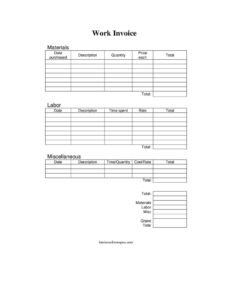
Work Invoice Labor
Free work invoice template in PDF & DOCX for labor and materials, with line items and totals. Bill customers for a completed job — download and print today.
PDF
DOCX
0
likes
Download Files
- DOCX
A work invoice is a bill for a completed job that itemizes both the materials used and the labor performed, then totals them into the amount the customer owes. It’s the document tradespeople, contractors, and service businesses use to get paid clearly and on time. Download this free work invoice template in PDF or DOCX, fill it in, and send it. No signup required.
What Is a Work Invoice?
A work invoice is a request for payment that breaks a job down into its real costs: the parts and supplies consumed, the hours of labor at an agreed rate, and any miscellaneous charges. Unlike a simple receipt, it shows the customer exactly what they’re paying for, which builds trust and heads off disputes. For a service business — a mechanic, electrician, handyman, repair shop, or freelance tradesperson — the work invoice is both the bill and the record of what was done, and it’s what your bookkeeping and tax records are built on.
When Do You Need a Work Invoice?
- Billing a customer after completing a repair, installation, or service call.
- Charging separately for parts and labor so the customer can see each cost.
- Documenting the materials used and the time spent for your own records.
- Providing a professional bill that supports a warranty or follow-up claim.
- Keeping a clear paper trail for accounting, taxes, and proof of work performed.
- Quoting and then invoicing a job where labor and materials are both significant.
What a Work Invoice Should Include
A complete work invoice leaves no ambiguity about the charge. It separates materials (each item with quantity and unit price) from labor (time spent at an hourly rate), adds any miscellaneous charges, and totals everything into a grand total. Including the date, a description of the work, and your business details turns it from a scrap of paper into a professional document the customer can pay against and file.
How to Fill Out a Work Invoice
- Under materials, list each item with the date purchased, a description, the quantity, the price each, and the line total.
- Add up the material line totals for a materials subtotal.
- Under labor, enter the time spent and the rate, and multiply time × rate for the labor cost.
- Record any miscellaneous charges — disposal fees, travel, or small sundries.
- Add materials, labor, and miscellaneous together for the grand total.
- Include the date, a short description of the job, and your payment terms, then send it to the customer and keep a copy.
Tips for Getting Paid Faster
Clarity speeds payment. Describe the work in plain terms the customer recognizes, and make the math easy to follow so there’s nothing to question. State your payment terms plainly — due on receipt, net 15, or net 30 — and include how to pay. Number your invoices sequentially so both you and the customer can reference them, and keep a copy of every one for your records and tax time. For larger jobs, an estimate up front and an invoice that matches it at the end prevents surprises and disputes.
Common Mistakes to Avoid
- Lumping materials and labor together so the customer can’t see what they’re paying for.
- Math errors in line totals or the grand total — always double-check.
- Vague descriptions that invite questions or disputes about the work.
- Leaving off payment terms or how to pay, which slows the customer down.
- Forgetting to number invoices, making them hard to track and reconcile.
- Not keeping a copy for your own accounting and tax records.
Work Invoice vs. Estimate vs. Receipt
These three documents are easy to mix up, but each plays a distinct role in a job. An estimate comes first, before any work begins: it’s your best projection of what the materials and labor will cost, given to the customer so they can approve the job and budget for it. A work invoice comes at the end, once the job is done: it’s the actual bill, based on the real materials used and the real time spent, and it’s the document the customer pays against. A receipt comes last of all, after payment: it simply confirms that the invoiced amount was paid. Keeping them straight protects you and the customer alike. When your final invoice closely matches the estimate you gave, trust is reinforced and disputes rarely arise; when the job runs over, the itemized invoice shows exactly why — extra materials, additional hours, an unforeseen complication — so the higher figure is understood rather than resented. For your own bookkeeping, the invoice is the key record: it’s what you report as income and what your accountant works from at tax time. Number your invoices in sequence, keep a copy of every one, and match each to the estimate that preceded it and the receipt that follows. That simple discipline turns a stack of jobs into a clean, defensible financial trail and makes month-end and tax season far less stressful.
Frequently Asked Questions
What is a work invoice? It’s a bill for a completed job that itemizes materials and labor, adds any extra charges, and totals the amount owed. It serves as both the request for payment and the record of work performed.
How do I fill out a work invoice? List the materials with quantities and prices, record the labor time and rate, add any miscellaneous charges, and total everything into a grand total. The template above includes a line for each.
What’s the difference between a work invoice and an estimate? An estimate is given before the work as an expected cost; a work invoice is the final bill after the job is done, based on the actual materials and time. Ideally the invoice closely matches the estimate.
Should labor and materials be listed separately? Yes. Separating them shows the customer exactly what each part costs, builds trust, and makes the invoice far easier to question-proof and reconcile.
How do I calculate the labor charge? Multiply the time spent by your hourly rate. For example, three hours at $60 per hour is a $180 labor charge, which is then added to materials and any miscellaneous costs.
How much does this template cost? Nothing — it’s free to download in PDF and DOCX, with no signup required.
Need to work out sales tax? Use our free Sales Tax Calculator to add or remove sales tax from any amount in seconds.
Official resource: for the rules that apply to your situation, see the U.S. Small Business Administration.
Related Forms
- Outstanding Invoices
- Invoice
- Tax Invoice Statement Book
- Trade Credit Discount Calculator
- Replacement Parts Order Form
- Rain Check Wide
Browse more in Invoices and Order Forms.