
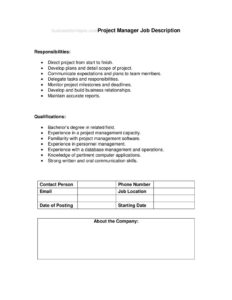
Project Manager Job Description
Download a free Project Manager job description template in PDF and DOCX to attract qualified candidates and define responsibilities and qualifications clearly.
PDF
DOCX
4 downloads
0
likes
Download Files
- DOCX
A Project Manager job description is a structured document that defines the responsibilities, qualifications, and expectations for someone who plans, executes, and closes projects. Companies most often use it to write a clear, consistent job posting and to align hiring managers on exactly what the role requires. You can download this template free in both PDF and DOCX formats — no signup needed.
What Is a Project Manager Job Description?
A Project Manager job description is an internal and external reference that explains what a project manager does and what skills, experience, and credentials the role demands. Hiring teams, recruiters, and HR professionals issue it to attract suitable candidates, screen applicants, and set performance expectations once someone is hired. The document typically captures two core sections — Responsibilities and Qualifications — and frames them around your organization’s projects, industry, and team structure. A well-written version reduces unqualified applications, speeds up shortlisting, and gives the new hire a clear understanding of their scope. It also doubles as a foundation for performance reviews, onboarding plans, and future job-leveling decisions across your project management function.
When Do You Need a Project Manager Job Description?
This template is useful any time you need to define, advertise, or evaluate the project manager role. Common situations include:
- Posting a new opening — you are hiring your first or next project manager and need a clear job ad for job boards and your careers page.
- Replacing a departing employee — you want to refine the role’s scope before backfilling the position.
- Restructuring a team — you are splitting or combining responsibilities and need to document each person’s remit.
- Promoting from within — you are formalizing the duties and qualifications for an internal candidate stepping up.
- Setting performance expectations — managers need a baseline to write goals and conduct reviews.
- Engaging recruiters or staffing agencies — external partners need an accurate brief to source the right talent.
Types of Project Manager Roles
Project management spans many industries, so tailor the description to the seniority and context you are hiring for. A junior or associate project manager supports senior staff and handles smaller workstreams. A mid-level project manager owns end-to-end delivery of defined projects. A senior or program manager oversees multiple projects, budgets, and stakeholders, and may manage other PMs. You may also specialize the role by industry — construction, IT and software, marketing, healthcare, or events — each carrying distinct tools, methodologies (such as Agile or Waterfall), and compliance considerations. Adjust both the responsibilities and qualifications to match.
What a Project Manager Job Description Should Have
A complete description gives candidates a realistic picture of the job. Strong versions include a short summary of the role and how it fits the company, a detailed Responsibilities list, a clear Qualifications section covering required and preferred items, reporting lines, and any methodology or tool requirements. It is good practice to add the employment type, location or remote status, and a note about salary range and benefits where appropriate. Keep language inclusive and avoid jargon that could deter qualified applicants.
How to Fill Out a Project Manager Job Description
This template centers on two editable sections. Follow these steps to complete it:
- Add a job title and summary line at the top (for example, “Project Manager — IT Delivery”) and a one- to two-sentence overview of the role’s purpose.
- Complete the Responsibilities section. List the core duties as bullet points: planning project scope and timelines, defining deliverables, managing budgets and resources, coordinating cross-functional teams, tracking progress and risks, communicating with stakeholders, and reporting on outcomes.
- Prioritize the responsibilities so the most important duties appear first, and keep each line action-oriented (start with a verb).
- Complete the Qualifications section. Separate “required” from “preferred.” Include education, years of experience, certifications (such as PMP, PRINCE2, or CSM), methodology familiarity, software proficiency, and soft skills like leadership and communication.
- Add context details such as reporting structure, team size, location, and employment type.
- Review and proofread to confirm the duties and qualifications match the seniority and reality of the role before publishing.
Writing Responsibilities That Attract the Right Candidates
The responsibilities section does the heavy lifting in any job description. Aim for six to ten concrete bullets rather than a long, vague paragraph. Use measurable language where you can — “manage project budgets up to $500K” communicates scope better than “manage budgets.” Reflect the methodologies your team actually uses; if you run Agile sprints, say so, and if you rely on tools like Jira, Asana, or MS Project, name them. Distinguish between what the person will own versus what they will support. This precision helps applicants self-select and gives interviewers a shared reference for evaluating fit.
Setting Realistic Qualifications
Overloading the qualifications list with “must-haves” can shrink your candidate pool unnecessarily. Be honest about what is genuinely required to succeed versus what is nice to have. A bachelor’s degree, a few years of relevant experience, and demonstrated stakeholder management are common baselines. Certifications such as PMP or Scrum credentials can be listed as preferred rather than mandatory unless your industry requires them. Emphasizing transferable skills — organization, communication, problem-solving — often surfaces strong candidates who might otherwise screen themselves out.
Common Mistakes to Avoid
- Listing too many requirements — long “required” lists deter qualified applicants and slow hiring.
- Being vague about scope — failing to specify budget size, team size, or project type leaves candidates guessing.
- Mixing duties with qualifications — keep responsibilities and qualifications in their own clearly labeled sections.
- Ignoring methodology and tools — omitting Agile, Waterfall, or specific software can attract mismatched candidates.
- Using exclusionary language — biased or overly demanding wording can discourage diverse applicants.
- Forgetting to update it — reusing an outdated description that no longer reflects the real role.
Frequently Asked Questions
What is a Project Manager job description? It is a document that outlines the responsibilities and qualifications for a project manager role. Employers use it to advertise openings, screen candidates, and set clear expectations for the person hired. It typically separates the duties the person will perform from the skills and experience they need.
How do I fill out this template? Add a job title and short summary, then complete the Responsibilities section with concrete, action-oriented duties and the Qualifications section with required and preferred skills, education, and certifications. Tailor everything to the seniority, industry, and tools relevant to your team, then proofread before posting.
What responsibilities should a project manager have? Common responsibilities include planning project scope and schedules, managing budgets and resources, coordinating teams, tracking risks and progress, communicating with stakeholders, and reporting on outcomes. The exact mix depends on the seniority of the role and your industry.
Should a project manager need a PMP certification? It depends on your needs. A PMP or similar credential signals formal training, but many effective project managers succeed without one. Unless your industry or client requirements demand it, consider listing certifications as preferred rather than mandatory to widen your candidate pool.
Is this job description legally binding? A job description is not a contract on its own; it is a descriptive document used for hiring and performance reference. Employment terms are governed by your offer letter, contract, and applicable laws. Avoid wording that could be read as a guarantee of employment.
How much does this template cost? Nothing — it is completely free to download in PDF and DOCX formats with no signup required. You can edit the DOCX version to match your company’s branding, role specifics, and tone before publishing it.
This template is a general example provided for informational purposes only and does not constitute legal, HR, or employment advice. Employment laws and hiring requirements vary by jurisdiction, so consult a qualified HR or legal professional before finalizing or publishing a job description.
Official resource: for the rules that apply to your situation, see the U.S. Department of Labor.
Related Forms
- Dental Hygienist Job Description
- Catering Assistant Job Description
- Business Development Manager Job Description
- Website Designer Job Description
- Flash Animator Job Description
- Car Salesperson Job Description
Browse more in Job Descriptions.