
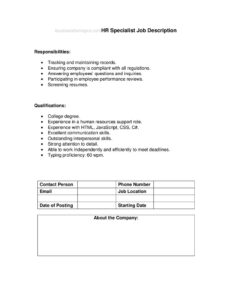
HR Specialist Job Description
Define the HR Specialist role clearly with this free job description template—outline responsibilities and qualifications, then download as PDF or DOCX.
PDF
DOCX
4 downloads
0
likes
Download Files
- DOCX
An HR Specialist job description is a structured document that defines what a human resources specialist does day to day and the skills required to succeed in the role. Companies most often use it to advertise an open position and align hiring managers, recruiters, and candidates on expectations. It’s free to download here in both PDF and DOCX formats, with no signup required.
What Is an HR Specialist Job Description?
An HR Specialist job description is a written summary of the duties, scope, and qualifications attached to a specialist role within a human resources department. It’s typically created by an HR manager, talent acquisition lead, or business owner and shared with applicants, internal teams, and job boards. The document explains what the HR Specialist will own—areas such as recruitment support, onboarding, benefits administration, employee records, or compliance—and the education, experience, and competencies needed to perform well. Beyond recruiting, it serves as a reference for performance reviews, salary benchmarking, and clarifying where the role fits between an HR generalist and a more senior HR business partner.
When Do You Need an HR Specialist Job Description?
- You’re opening a new HR Specialist position and need a posting to publish on job boards or your careers page.
- Your HR team is growing and you want to clearly divide duties between specialists, generalists, and coordinators.
- A current employee is being promoted into a specialist role and needs documented expectations.
- You’re conducting a performance review and want measurable responsibilities to evaluate against.
- HR or legal asks for an updated, accurate role description to support compliance and pay-equity reviews.
- You’re restructuring the department and need to map each function—recruiting, benefits, records—to a defined position.
Types of HR Specialist Roles
The phrase “HR Specialist” covers several focused tracks, and tailoring the description to the right specialty makes it far more useful. Common variations include a recruitment specialist who manages sourcing and interview scheduling, a benefits specialist who administers health plans and open enrollment, a compensation specialist who handles salary structures and market data, an employee relations specialist who supports investigations and conflict resolution, and a compliance or HRIS specialist who maintains records and reporting. Use the responsibilities and qualifications sections to reflect whichever focus the role actually requires.
What an HR Specialist Job Description Should Have
A complete and effective job description usually includes a short role summary, a clear list of responsibilities, and a defined set of qualifications. The two core sections in this template—Responsibilities and Qualifications—form the backbone. Strong descriptions also note reporting relationships (who the role reports to), required versus preferred skills, the work location or arrangement, and any certifications such as PHR or SHRM-CP that add value. The clearer and more specific each item is, the easier it becomes to attract qualified candidates and screen out poor fits.
How to Fill Out an HR Specialist Job Description
- Add a brief job title and one- or two-sentence summary at the top describing the role’s overall purpose and which HR function it supports.
- In the Responsibilities section, list the core duties as separate bullet points—for example, posting job openings, screening resumes, coordinating interviews, onboarding new hires, maintaining employee records, administering benefits, and supporting compliance. Start each line with an action verb.
- Order responsibilities by importance, placing the most time-consuming or critical duties first so candidates immediately understand the focus.
- In the Qualifications section, specify required education (such as a bachelor’s degree in HR or a related field), years of experience, and technical skills like HRIS or applicant-tracking software.
- Separate “required” from “preferred” qualifications so strong candidates aren’t discouraged by nice-to-haves.
- Note any certifications, soft skills (communication, discretion, organization), and physical or location requirements.
- Review for clarity, remove jargon, and confirm every listed duty matches what the role will truly involve before publishing or saving.
Tips for Writing a Stronger Description
Specificity wins. Instead of “handles recruiting,” write “sources candidates, schedules interviews, and manages offer letters for roles across two departments.” Quantify where you can—number of employees supported, hires per quarter, or systems used. Keep responsibilities to a focused list of roughly six to twelve items so the role doesn’t read as overloaded. Use inclusive, neutral language and avoid requirements that aren’t genuinely necessary, since overly long qualification lists can shrink your applicant pool. Finally, revisit the description whenever the role changes so it stays an accurate reference for both hiring and performance management.
How It Differs From an HR Generalist Description
An HR Specialist typically owns one focused area in depth, while an HR generalist covers a broad range of functions at a higher level. Reflect this in the document: a specialist description should drill into a particular discipline—benefits, recruiting, or compliance—with detailed, specific duties, whereas a generalist description spans many areas more briefly. Clarifying this distinction prevents overlap on your team and helps candidates self-select into the role that matches their strengths.
Common Mistakes to Avoid
- Listing vague duties like “various HR tasks” instead of concrete, measurable responsibilities.
- Bundling specialist and generalist work into one role so it becomes too broad to fill effectively.
- Requiring excessive years of experience or certifications that the role doesn’t truly need.
- Forgetting to note the reporting line, work arrangement, or department the role supports.
- Copying a generic template without tailoring it to your company’s actual HR functions and systems.
- Letting the description go stale—failing to update it when the role’s duties shift over time.
Frequently Asked Questions
What does an HR Specialist do? An HR Specialist focuses on a specific area of human resources, such as recruitment, benefits, compensation, or compliance. Day-to-day duties often include posting jobs, screening candidates, onboarding new hires, maintaining employee records, and supporting HR policies. The exact mix depends on the specialty defined in the job description.
How do I fill out this HR Specialist job description template? Add a short role summary, then complete the Responsibilities section with action-driven bullet points covering the role’s core duties. In the Qualifications section, list required and preferred education, experience, skills, and certifications. Tailor every line to your company’s actual HR function before publishing.
What qualifications should an HR Specialist have? Most roles ask for a bachelor’s degree in human resources, business, or a related field, plus some HR experience and familiarity with HRIS or applicant-tracking software. Certifications like PHR or SHRM-CP are often preferred but not always required. Strong communication, organization, and discretion are commonly expected.
Is this job description legally binding? A job description is generally a guideline and reference document rather than a binding contract on its own. However, it can support employment decisions, performance reviews, and compliance efforts, so accuracy matters. Many companies include a clause noting that duties may change as business needs evolve.
How is an HR Specialist different from an HR Coordinator? A coordinator usually handles administrative and support tasks across HR, while a specialist owns a defined function with deeper responsibility and expertise. The specialist role often requires more experience and may involve decision-making within its area. Use the responsibilities section to make the distinction clear.
How much does this template cost? This HR Specialist job description template is completely free to download from Business Forms Pro in both PDF and DOCX formats. There’s no signup or payment required. You can edit it freely to match your organization’s needs.
This template is a general example provided for informational purposes only and does not constitute legal, HR, or employment advice. Employment laws and requirements vary by jurisdiction, so consult a qualified HR or legal professional before finalizing or relying on any job description.
Official resource: for the rules that apply to your situation, see the U.S. Department of Labor.
Related Forms
- Web Developer Job Description
- Business Development Manager Job Description
- Business Systems Analyst Job Description
- Fitness Instructor Job Description
- Bookkeeper Job Description
- Hotel Front Desk Staff Job Description
Browse more in Job Descriptions.