
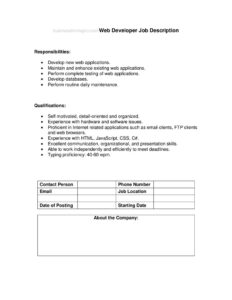
Web Developer Job Description
Download a free Web Developer job description template in PDF and DOCX to define responsibilities and qualifications and attract qualified candidates fast.
PDF
DOCX
0
likes
Download Files
- DOCX
A Web Developer job description is a hiring document that outlines the duties, skills, and qualifications expected of someone who builds and maintains websites and web applications. Companies most often use it to write a clear, accurate job posting that attracts the right candidates and sets expectations from day one. You can download this template free in PDF and DOCX, with no signup required.
What Is a Web Developer Job Description?
A Web Developer job description is a structured outline of what a web development role involves and who is qualified to fill it. It is typically created by a hiring manager, HR team, or recruiter, and it documents two core areas: the responsibilities the developer will own and the qualifications a candidate must bring. Beyond recruiting, the document doubles as an internal reference for performance reviews, compensation benchmarking, and onboarding. It clarifies whether the role is front-end, back-end, or full-stack, and signals the technologies, seniority level, and team context. A well-written version reduces unqualified applications and helps both the employer and the candidate understand the scope of the job before an offer is made.
When Do You Need a Web Developer Job Description?
You need a clear job description any time you are formalizing a web development role or its expectations. Common situations include:
- Opening a new req: You are hiring your first or next web developer and need a posting for job boards, your careers page, or a recruiter.
- Replacing a departing developer: You want to capture the role’s real duties before institutional knowledge leaves with the employee.
- Defining front-end vs. back-end vs. full-stack: You need to distinguish the specific stack and responsibilities to avoid mismatched applicants.
- Working with a staffing agency: Recruiters need a precise scope and qualification list to source candidates efficiently.
- Setting performance and review criteria: Managers reference the responsibilities to evaluate output and growth fairly.
- Restructuring a team: You are splitting, merging, or promoting roles and need updated documentation for each position.
Types of Web Developer Roles
This template adapts to several variations of the role. A front-end developer focuses on user-facing interfaces using HTML, CSS, JavaScript, and frameworks like React or Vue. A back-end developer handles servers, databases, APIs, and application logic. A full-stack developer spans both. You may also tailor it for a junior, mid-level, or senior position, or for a contract versus full-time arrangement. Adjust the responsibilities and qualifications accordingly so the posting matches the actual work.
What a Web Developer Job Description Should Have
Although this template centers on two essential sections, a complete and effective description usually covers more context around them. The key elements include:
- A clear job title and, ideally, the seniority level and department.
- A brief summary of the role and how it fits the team or product.
- A Responsibilities section listing the day-to-day duties and deliverables.
- A Qualifications section covering required and preferred skills, experience, and education.
- The technology stack and tools the developer is expected to use.
- Work arrangement details such as location, remote options, and reporting line.
How to Fill Out a Web Developer Job Description
Use the template’s two sections as your foundation and build outward. Follow these steps:
- Add a job title and summary. Above the listed sections, state the exact title (for example, “Senior Full-Stack Web Developer”) and write two or three sentences describing the role and team.
- Complete the Responsibilities section. List concrete duties such as building responsive web pages, writing and testing code, integrating APIs, optimizing site performance, fixing bugs, and collaborating with designers and product managers. Start each line with an action verb.
- Complete the Qualifications section. Separate required from preferred. Specify years of experience, proficiency in relevant languages and frameworks, version control (Git), and any degree or equivalent experience you accept.
- Layer in stack and tools. Name the specific technologies the candidate will use so applicants can self-screen.
- Note logistics. Add location, remote/hybrid status, employment type, and who the role reports to.
- Review and trim. Cut requirements that are nice-to-have and keep the posting honest and focused.
Writing Responsibilities and Qualifications That Attract Talent
The two sections in this template carry the most weight, so write them deliberately. For Responsibilities, describe outcomes, not just tasks — “build and maintain accessible, responsive interfaces” tells a candidate more than “write code.” Aim for five to eight focused bullets; an exhaustive list of twenty duties discourages strong applicants. For Qualifications, be realistic about what is truly required versus preferred. Inflated requirements (such as demanding ten years of experience with a five-year-old framework) shrink your candidate pool and screen out capable people. Where possible, accept “equivalent practical experience” alongside formal degrees, since many excellent developers are self-taught or bootcamp-trained. Clear, honest language in both sections improves the quality of applications and shortens your time to hire.
Common Mistakes to Avoid
- Listing every technology imaginable: Overloading the stack signals the role lacks focus and deters specialists.
- Confusing front-end and back-end duties: Mixing them without labeling the role as full-stack creates mismatched applicants.
- Vague responsibilities: Phrases like “help with the website” tell candidates nothing about the actual work.
- Unrealistic experience requirements: Demanding senior-level experience for a junior salary scares off good people.
- Omitting work arrangement details: Leaving out remote, hybrid, or location specifics generates wasted screening calls.
- Forgetting to update it: Reusing an outdated description means hiring against duties the role no longer involves.
Frequently Asked Questions
What is a Web Developer job description used for? It is used primarily to create accurate job postings that attract qualified candidates. It also serves as an internal reference for onboarding, performance evaluations, and salary benchmarking, ensuring everyone agrees on what the role involves.
How do I fill out this template? Add a job title and short summary, then complete the Responsibilities section with concrete duties and the Qualifications section with required and preferred skills. Finish by adding the technology stack, employment type, and reporting details so the posting is complete.
What should go in the Responsibilities section? Include the developer’s main duties, such as building responsive web pages, writing and testing code, integrating APIs, optimizing performance, debugging, and collaborating with the team. Keep it to a focused set of outcome-oriented bullets rather than an exhaustive list.
What qualifications should I require? List the languages, frameworks, and tools essential to the role, a realistic experience level, and version control familiarity. Separate must-have requirements from nice-to-haves, and consider accepting equivalent practical experience alongside formal education.
Is this job description legally binding? A job description itself is generally not a contract or binding agreement; it describes the role and expectations. Employment terms are typically set by an offer letter or contract, so avoid wording that promises specific tenure or guarantees.
How much does this template cost? It is completely free to download here in both PDF and DOCX formats, with no signup required. You can edit the DOCX version to match your company, stack, and seniority level before posting.
This template is a general example provided for informational purposes only and is not legal, HR, or employment advice. Employment laws and hiring requirements vary by jurisdiction, so consult a qualified HR or legal professional before finalizing any job posting or hiring decision.
Official resource: for the rules that apply to your situation, see the U.S. Department of Labor.
Related Forms
- Personal Assistant Job Description
- Call Center Operator Job Description
- System Administrator Job Description
- Dispatcher Job Description
- Business Development Manager Job Description
- Customer Service Representative Job Description
Browse more in Job Descriptions.