
30-Day Notice to Landlord
Download a free 30-Day Notice to Landlord template in PDF and DOCX to properly end your lease, request your deposit, and schedule a final inspection.
PDF
DOCX
3 downloads
0
likes
Download Files
- DOCX
A 30-Day Notice to Landlord is a written letter a tenant sends to formally announce they will move out and end their lease in 30 days. Renters most often use it to satisfy the advance-notice clause in their lease, protect their security deposit, and create a clear paper trail. You can download this template free in PDF and DOCX with no signup required.
What Is a 30-Day Notice to Landlord?
A 30-Day Notice to Landlord is a formal letter from a tenant to a landlord or property manager stating the tenant’s intent to vacate a rental unit on a specific date, at least 30 days in the future. It documents the end of a month-to-month tenancy or fulfills a written lease’s notice requirement. The letter typically confirms the move-out date, the unit being vacated, how and when keys will be returned, and where the security deposit should be sent. Because it is dated and in writing, it serves as proof that proper notice was given — which matters if a dispute later arises over rent owed, deposit deductions, or the move-out timeline.
When Do You Need a 30-Day Notice to Landlord?
This letter is useful any time you plan to leave a rental and your agreement requires advance notice. Common situations include:
- Ending a month-to-month tenancy when you’ve decided to move elsewhere.
- Letting a fixed-term lease expire and notifying your landlord you will not renew.
- Relocating for a new job, school, or family reasons before your lease’s natural end date.
- Moving into a home you’ve purchased and needing to coordinate your final rental days.
- Upgrading or downsizing to a different apartment and timing your exit cleanly.
- Documenting your move-out in writing because your lease specifically requires written notice rather than a verbal heads-up.
Even if your landlord is friendly and a phone call feels sufficient, a written notice protects both parties. It eliminates confusion about the exact date you intend to leave and gives the landlord a clear window to schedule cleaning, repairs, and showings to new applicants.
What a 30-Day Notice Should Have
A complete and effective notice includes a few essential elements. It should clearly identify you as the tenant and your landlord or property manager by name. It must state the specific apartment or unit number and the full property address. The exact move-out date should appear so there is no ambiguity about when 30 days begins and ends. The letter should confirm how and when keys will be returned, provide a forwarding address for the security deposit, and request a final walkthrough inspection. Finally, it should be dated and signed by the tenant. Including all of these details in one document reduces the chance of misunderstandings and strengthens your position if the deposit return is delayed.
How to Fill Out a 30-Day Notice to Landlord
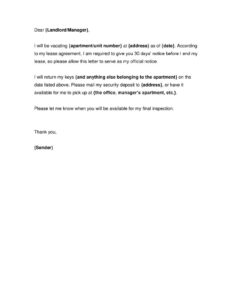
- Address the letter to your Landlord/Manager by name so it reaches the right person and reads professionally.
- Enter the apartment/unit number you are vacating to clearly identify the rental.
- Fill in the property address of the unit you currently occupy.
- State the date you will move out — make sure it is at least 30 days from the day you send the letter, in line with your lease.
- Confirm you will return your keys and anything else belonging to the apartment, such as gate remotes, parking passes, or amenity fobs, on that date.
- Provide the forwarding address where your security deposit should be mailed.
- If you’d rather collect the deposit in person, note where to pick it up — the office, manager’s apartment, etc.
- Request that the landlord tell you their availability for the final inspection walkthrough.
- Sign and date the letter as the Sender, and keep a copy for your records.
Delivering the Notice and Counting the Days
How you deliver the notice can matter as much as what it says. Many leases specify acceptable delivery methods, such as hand delivery, certified mail, or email. Sending it by a method that produces proof of delivery — like certified mail with a return receipt, or an email you can save — helps confirm the landlord actually received it. Pay close attention to how the 30 days are counted. Some leases and local rules require notice to align with a rent period, meaning your effective move-out date might shift to the end of the next full month. When in doubt, give a little extra notice rather than risk being short and owing additional rent.
Protecting Your Security Deposit
The forwarding address in your notice is the key to getting your deposit back promptly. Most jurisdictions require landlords to return a deposit within a set number of days after move-out, along with an itemized list of any deductions. To maximize your refund, leave the unit clean, repair any damage beyond normal wear and tear, and attend the final inspection so you can see and discuss any issues firsthand. Taking dated photos or a video of the empty unit on move-out day is smart documentation. If you owe nothing and the deposit is delayed, your written notice and forwarding address become valuable evidence.
Common Mistakes to Avoid
- Giving too little time. Counting fewer than 30 days, or miscounting from the wrong start date, can leave you liable for extra rent.
- Forgetting the forwarding address. Without it, your landlord may not know where to mail your deposit.
- Skipping the final inspection. Missing the walkthrough means you can’t dispute deductions in real time.
- Not keeping a copy. Always retain a dated copy and proof of how you delivered the letter.
- Vague move-out details. Failing to confirm key return or unit condition can cause disputes later.
- Ignoring your lease’s notice clause. Some agreements require more than 30 days or a specific delivery method — read it first.
Frequently Asked Questions
What is a 30-Day Notice to Landlord? It is a written letter in which a tenant informs their landlord that they intend to move out and end the tenancy in 30 days. It documents the move-out date, key return, and where to send the security deposit, creating a clear record for both parties.
How do I fill out a 30-Day Notice to Landlord? Address it to your landlord by name, list your unit number and address, state your move-out date at least 30 days ahead, confirm key return, provide a forwarding address for your deposit, and request a final inspection. Then sign, date, and keep a copy.
Does a 30-Day Notice need to be notarized or witnessed? No, a notice to vacate generally does not require notarization or witnesses. What matters most is that it is in writing, clearly dated, and delivered to your landlord in a way you can prove, such as certified mail or email.
Is a 30-Day Notice legally binding? Once properly delivered, it serves as your official notice to end the tenancy under your lease terms. Your obligation to pay rent typically continues through the notice period, so make sure the date you choose accounts for any rules tying notice to the rent cycle.
How much does this template cost? Nothing — this 30-Day Notice to Landlord template is completely free to download in PDF and DOCX, with no signup or account required. You can edit the DOCX version to match your situation.
Can my landlord refuse my 30-day notice? A landlord cannot refuse a notice that complies with your lease and local law; the lease ends on the date you specify after the notice period. However, you remain responsible for rent and unit condition through that date, so follow your agreement’s terms closely.
This template is a general example provided for informational purposes only and is not legal advice. Landlord-tenant rules, notice periods, and deposit deadlines vary by state and locality. For guidance on your specific situation, consult a qualified attorney or your local housing authority.
Official resource: for the rules that apply to your situation, see HUD.
Related Forms
- Tenant Utilities Increase Letter
- Landlord Maintenance Request
- Covid Rent Extension Landlord
- Tenant Late Rent Log
- Room Rental Agreement
- Landlord Lease Renewal
Browse more in Landlord Documents.