
Landlord Maintenance Request
Download a free Landlord Maintenance Request form template in PDF and DOCX to report repairs, log issues, and schedule access—free download, no signup.
PDF
DOCX
0
likes
Download Files
- DOCX
A Landlord Maintenance Request is a simple form a tenant uses to report a repair or maintenance issue to their landlord or property manager in writing. The most common reason people use it is to create a clear, dated record of a problem—like a leaking faucet or broken heater—so it gets fixed promptly and there’s proof the request was made. You can download this form free in both PDF and DOCX formats, with no signup required.
What Is a Landlord Maintenance Request?
A Landlord Maintenance Request is a written notice submitted by a tenant to a landlord describing a maintenance or repair problem at a rental property. It documents what is wrong, where it is located, how urgent it is, and how the tenant prefers it to be handled. Landlords and property management companies use these forms to track incoming issues, prioritize repairs, schedule contractors, and keep an organized maintenance history for each unit. For tenants, the form is valuable because it confirms when an issue was reported and what was requested. A consistent, written process protects both parties, reduces miscommunication, and helps ensure that habitability and safety concerns are addressed in a timely manner.
When Do You Need a Landlord Maintenance Request?
This form is useful any time a repair or service issue arises in a rented property. Common situations include:
- A plumbing problem such as a dripping tap, clogged drain, running toilet, or a leak under the sink.
- Heating, cooling, or appliance failures—no hot water, a furnace that won’t start, or a broken refrigerator.
- Electrical concerns like a dead outlet, flickering lights, or a tripped breaker that keeps resetting.
- Structural or weather damage, including a leaking roof, broken window, or a door that won’t lock.
- Pest control needs, mold, or other habitability issues that require professional attention.
- Routine upkeep requests such as servicing the HVAC filter, fixing a fence, or replacing a smoke-detector battery.
What a Landlord Maintenance Request Should Have
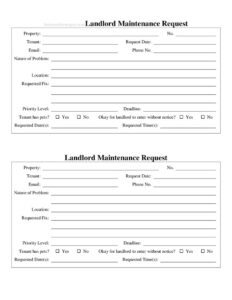
A complete request leaves no doubt about what needs fixing and how to reach the tenant. The strongest forms identify the property and unit, name the tenant, and provide current contact details. They describe the nature of the problem clearly, pinpoint its exact location, and state the requested fix. A priority level and a deadline set expectations for response time. Finally, the form should capture practical scheduling details—whether pets are present, whether the landlord may enter without notice, and the tenant’s preferred dates and times for access. Together these elements turn a vague complaint into an actionable work order.
How to Fill Out a Landlord Maintenance Request
- Property and No.: Enter the rental address and the unit or apartment number so the right property is identified.
- Tenant: Write your full name as it appears on the lease.
- Request Date: Record the date you are submitting the form—this establishes when the issue was reported.
- Email and Phone No.: Provide current contact details so the landlord or contractor can confirm scheduling.
- Nature of Problem: Describe the issue specifically—for example, “hot water heater not heating since yesterday.”
- Location: Note exactly where the problem is, such as “master bathroom” or “kitchen sink.”
- Requested Fix: State the outcome you want—repair, replacement, or inspection.
- Priority Level: Mark urgency (e.g., emergency, urgent, routine) to help with triage.
- Deadline: Suggest a reasonable date by which you hope the work is completed.
- Tenant has pets?: Check Yes or No so workers can prepare for animals on site.
- Okay for landlord to enter without notice?: Indicate whether entry without advance notice is permitted.
- Requested Date(s) and Requested Time(s): List the days and time windows when access works best for you.
Setting Priority and Deadlines
The priority and deadline fields help everyone agree on what “urgent” really means. An emergency—such as a gas smell, flooding, no heat in freezing weather, or a security risk like a broken exterior lock—generally warrants the fastest possible response and may be governed by local habitability rules. Urgent but non-emergency issues, like a non-functioning oven, can wait a few days. Routine cosmetic items, such as a sticky cabinet hinge, can be batched with other repairs. When you set a deadline, choose something realistic; landlords often need time to source parts or schedule a licensed contractor. Being reasonable about timing tends to get cooperative, faster results.
Scheduling Access the Right Way
The entry and scheduling fields matter because many jurisdictions require landlords to give advance notice before entering an occupied unit, except in genuine emergencies. By specifying whether you allow entry without notice and listing your preferred dates and times, you make access smooth while keeping a record of your consent. Noting that pets are present helps the contractor plan—some workers prop doors open or need pets secured. If you have a pet that must be contained, mention it in the nature-of-problem or requested-fix area so there are no surprises on the day of the visit. Clear scheduling reduces missed appointments and repeat trips.
Common Mistakes to Avoid
- Being vague—”sink broken” tells a contractor far less than “kitchen sink drain clogged, water backing up.”
- Leaving the location blank, forcing the worker to hunt for the problem and wasting a visit.
- Forgetting to date the request, which weakens your record of when the issue was reported.
- Omitting phone or email, so the landlord can’t confirm a time and the repair stalls.
- Marking everything as an emergency, which dilutes priority and frustrates scheduling.
- Not noting pets or access preferences, leading to canceled appointments or entry disputes.
Frequently Asked Questions
What is a Landlord Maintenance Request used for? It is a written form a tenant submits to report a repair or maintenance problem at a rental property. It documents the issue, its location, urgency, and preferred scheduling so the landlord or property manager can act on it. It also creates a dated record that protects both tenant and landlord.
How do I fill out a Landlord Maintenance Request? Enter the property and unit, your name and contact details, and the date. Describe the problem, its exact location, and the fix you want, then set a priority and deadline. Finally, indicate pets, entry permission, and your preferred dates and times for access.
Does this form need to be notarized or witnessed? No. A maintenance request is an everyday communication between tenant and landlord, not a legal contract, so it does not require notarization or witnesses. Simply complete it and deliver it to your landlord or property manager.
Is a maintenance request legally binding? The form itself is a record rather than a contract, but it can serve as important evidence that you reported an issue and when. Your repair rights generally come from your lease and local landlord-tenant laws, not the form. Keeping a copy strengthens your documentation if a dispute arises.
How much does this template cost? It is completely free to download from Business Forms Pro in both PDF and DOCX formats. There is no signup, subscription, or payment required. You can edit the DOCX version to match your property details or branding.
How should I submit the completed form to my landlord? Follow the method your lease specifies—email, an online portal, or hand delivery—and keep a timestamped copy for your records. For urgent or emergency issues, also call your landlord directly and note that you submitted the written request. A dated email is often the easiest way to prove delivery.
This template is a general example provided for informational purposes only and is not legal advice. Landlord and tenant rights, notice requirements, and repair timelines vary by jurisdiction and depend on your lease. Consult a qualified attorney or your local housing authority for guidance specific to your situation.
Official resource: for the rules that apply to your situation, see HUD.
Related Forms
- Notice of Overdue Rent
- Tenant Complaint Log
- Tenant Lease Breaking Request Letter
- Landlord Lead Disclosure Form
- Apartment Manager Individual Ledger
- Rent Demand Letter
Browse more in Landlord Documents.