
Apartment Manager Individual Ledger
Track every tenant charge, payment, and balance with this free Apartment Manager Individual Ledger template — download in PDF or DOCX, no signup needed.
PDF
DOCX
0
likes
Download Files
- DOCX
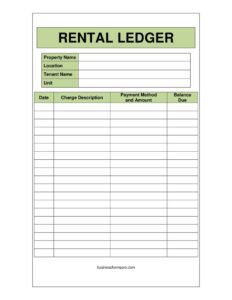
An Apartment Manager Individual Ledger is a running financial record that tracks every charge, payment, and outstanding balance for a single tenant in a single unit. Property managers use it most often to keep an accurate, date-by-date account of rent owed and rent received so disputes can be settled with hard numbers. You can download this Apartment Manager Individual Ledger free in PDF or DOCX, with no signup required.
What Is an Apartment Manager Individual Ledger?
An Apartment Manager Individual Ledger is a single-tenant accounting sheet maintained by a landlord, property manager, or leasing office. It records each financial event tied to one rental unit — rent charges, late fees, partial payments, deposits applied, and the resulting balance — in chronological order. Unlike a portfolio-wide rent roll that summarizes many units at once, this ledger zooms in on one tenant so the full payment history is visible at a glance. It serves as the official record of what was billed, what was paid, and what remains owed. Managers rely on it for monthly reconciliation, tax preparation, security-deposit accounting, and as supporting evidence in collection or eviction proceedings.
When Do You Need an Apartment Manager Individual Ledger?
Keeping a dedicated ledger for each tenant turns vague memory into documented fact. Common situations include:
- Monthly rent tracking — logging each rent charge and the payment that clears it so you always know who is current and who is behind.
- Partial or late payments — recording a payment that doesn’t cover the full charge and showing the carried-forward balance.
- Late-fee and utility charges — adding miscellaneous charges beyond base rent and documenting when they were assessed.
- Move-out and deposit reconciliation — reviewing the final balance to determine what is owed or refundable when a tenant vacates.
- Dispute resolution — answering a tenant who claims they paid by pointing to the exact dated entry.
- Eviction or small-claims support — providing a clear running balance a court can follow line by line.
What an Apartment Manager Individual Ledger Should Have
A useful ledger identifies the property and the tenant clearly, then captures every transaction in a way that always reconciles. The essentials are the property name and location at the top, the tenant name and unit the ledger covers, and a transaction grid with columns for date, charge, payment, and balance. Each row represents one event, and the balance column should update after every entry so the bottom figure is always the current amount owed. Consistency matters more than complexity: enter every event, never skip a month, and make sure charges and payments are placed in the correct column so the math holds.
How to Fill Out an Apartment Manager Individual Ledger
- Property name: Enter the name of the apartment community or building, such as “Maple Court Apartments,” so the ledger is tied to the right property.
- Location: Add the property’s street address or city to distinguish it from other holdings in your portfolio.
- Tenant name: Write the full legal name of the responsible tenant, matching the name on the lease.
- Unit: Record the specific apartment or unit number this ledger tracks.
- Date: For the first transaction, enter the date the charge or payment occurred. Use a consistent format throughout.
- Charge: In this column, enter amounts the tenant owes — monthly rent, late fees, or other assessments. Leave it blank on payment-only rows.
- Payment: Enter the amount the tenant paid on payment rows, leaving it blank when you are only recording a charge.
- Balance: Calculate the new running balance by adding any charge and subtracting any payment from the previous balance. This figure should reflect the total currently owed after each line.
- Repeat: Add a new dated row for every transaction going forward, keeping entries in chronological order.
Charges vs. Payments: Keeping the Balance Accurate
The single most important habit with this ledger is column discipline. A charge increases what the tenant owes — base rent posted on the first of the month, a late fee, a returned-check fee, or a utility pass-through. A payment reduces that obligation. After each entry, the balance equals the prior balance plus the charge minus the payment. A positive balance means the tenant owes money; a zero balance means they are current; and if you accept advance rent, a credit balance is possible. Posting rent on a predictable schedule — typically the first of each month — and entering payments the day they are received keeps the running total trustworthy and easy to audit.
Reconciling and Storing the Ledger
Reconcile each tenant ledger against your bank deposits monthly so recorded payments match money actually received. Keep a separate ledger for every unit rather than mixing tenants on one sheet, and retain completed ledgers for several years to support tax filings and respond to any future dispute. The DOCX version lets you type entries directly and update balances as you go, while the PDF version is handy for printing a clean copy to attach to a lease file or hand to an accountant. Whichever format you use, back up your records and avoid altering past entries — add a correcting line instead so the history stays intact.
Common Mistakes to Avoid
- Mixing charges and payments in the same column — this breaks the running balance and creates confusion at audit time.
- Skipping months — failing to post rent every period leaves gaps that make the ledger unreliable.
- Forgetting to update the balance — an entry without a recalculated balance defeats the purpose of the ledger.
- Combining multiple tenants on one sheet — each unit and tenant should have its own dedicated ledger.
- Recording payments late or from memory — enter transactions promptly and keep receipts to back them up.
- Editing old rows after the fact — correct errors with a new dated entry rather than overwriting history.
Frequently Asked Questions
What is an Apartment Manager Individual Ledger used for? It is a single-tenant record that tracks every charge, payment, and running balance for one rental unit. Managers use it to know who is current, document partial payments, and prepare for deposit reconciliation or collections. It turns scattered notes into one clear financial history.
How do I calculate the balance column? Start with the previous balance, add any new charge, and subtract any payment on that row. The result is the current amount the tenant owes after that transaction. Doing this on every line keeps the bottom figure accurate at all times.
Should I keep a separate ledger for each tenant? Yes. A dedicated ledger per unit and tenant keeps each payment history clean and easy to follow. Mixing several tenants on one sheet makes reconciliation harder and weakens the record if a dispute arises.
Is this ledger a legally binding document? The ledger itself is a record-keeping tool rather than a contract, but the entries can serve as evidence of charges and payments in disputes, small-claims cases, or eviction proceedings. Its value depends on being accurate, consistent, and contemporaneous with the events recorded.
How long should I keep tenant ledgers? Retention periods vary by jurisdiction and your tax situation, but many landlords keep ledgers for several years after a tenancy ends. Keeping them supports tax filings and lets you respond to deposit or balance questions long after move-out.
How much does this template cost? Nothing — the Apartment Manager Individual Ledger is free to download here in both PDF and DOCX formats with no signup required. You can use the PDF for printing or the DOCX to type and update entries on your computer.
This template is provided as a general example for informational purposes only and does not constitute legal, financial, or tax advice. Landlord-tenant and record-keeping requirements vary by jurisdiction. Consult a qualified attorney or accountant to ensure your records and practices comply with the rules that apply to you.
Official resource: for the rules that apply to your situation, see HUD.
Related Forms
- Landlord Proof of Residency
- Tenant Repair Deductible
- Notice Of Intent To Enter Dwelling
- Request for Tenant Repairs
- Move-Out Inspection
- Tenant Complaint Log
Browse more in Landlord Documents.