
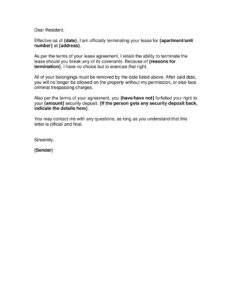
Notice of Lease Termination
Download a free Notice of Lease Termination template in PDF and DOCX to formally end a tenancy, document reasons, and address the security deposit — free download.
PDF
DOCX
2 downloads
0
likes
Download Files
- DOCX
A Notice of Lease Termination is a formal written letter a landlord sends to a tenant to officially end a lease agreement, most often because the tenant has breached one or more terms of that lease. It states the effective termination date, the unit involved, the reason for ending the tenancy, and what happens to the security deposit. You can download this template free in PDF and DOCX formats, with no signup required.
What Is a Notice of Lease Termination?
A Notice of Lease Termination is a written communication issued by a landlord or property manager that informs a resident their lease is being ended as of a specific date. It documents the landlord’s decision to exercise a contractual right — typically a clause allowing termination when the tenant violates the lease’s covenants — and creates a paper trail showing the tenant was properly notified. The notice identifies the rental unit and address, states the reason for termination, specifies the move-out deadline, and clarifies whether the security deposit is forfeited or partially refundable. While it is not a court eviction order, it is often the first formal step before further legal action if the tenant does not comply.
When Do You Need a Notice of Lease Termination?
Landlords reach for this letter when a tenancy must end on the landlord’s terms and a clear written record matters. Common situations include:
- A tenant repeatedly fails to pay rent on time or has fallen significantly behind.
- The resident has violated a specific lease covenant, such as unauthorized pets, subletting, or property damage.
- Ongoing disturbances, noise complaints, or illegal activity on the premises require ending the tenancy.
- A tenant has breached occupancy limits or allowed unauthorized residents to move in.
- You need a documented notice before beginning a formal eviction process in your jurisdiction.
- You want a professional, clearly worded letter rather than an informal text or verbal warning that cannot be proven later.
What a Notice of Lease Termination Should Have
A complete and effective termination notice leaves no ambiguity. It should clearly identify the tenant and the rental property by unit number and full address. It must state the effective termination date and the deadline by which belongings must be removed. The notice should cite the lease provision being relied upon and describe the specific reason for termination. It should also address the security deposit — whether it is being returned, partially withheld, or forfeited — and provide contact information so the tenant can ask questions. Finally, it should be dated and signed by the sender to confirm authenticity.
How to Fill Out a Notice of Lease Termination
- Address the letter to the resident at the top, opening with “Dear Resident” or the tenant’s name if you prefer a personalized greeting.
- Enter the effective date of termination — the date the lease officially ends and by which the tenant must vacate.
- Fill in the apartment/unit number and the full property address so there is no confusion about which unit is affected.
- In the reasons for termination field, describe the specific lease violation or grounds, such as nonpayment of rent or breach of a named covenant.
- Confirm the requirement that all belongings be removed by the stated date and the warning about trespassing after that point.
- Indicate whether the tenant has or has not forfeited the right to the security deposit, and enter the deposit amount.
- If any portion of the deposit will be returned, fill in the details — the refund amount, deductions, and how it will be sent.
- Close by inviting questions, then sign as the sender and keep a dated copy for your records.
Delivering the Notice and Keeping Records
How you deliver this notice can matter as much as what it says. Many jurisdictions require service by a specific method — personal delivery, certified mail with return receipt, or posting on the door — and some require a minimum number of days’ notice before the termination date. Always keep a signed copy and proof of delivery, such as a mailing receipt or a photo of a posted notice. If a dispute later reaches court, this documentation demonstrates that the tenant was properly informed and given the required time to respond or vacate.
How It Differs From an Eviction
A Notice of Lease Termination is not the same as an eviction. The notice is a communication telling the tenant the lease is ending and asking them to leave by a set date. An eviction is a court-supervised legal process that a landlord may pursue only if the tenant refuses to vacate after proper notice. This letter is often a required precursor to that process, but it does not by itself authorize you to remove the tenant or their belongings. Self-help measures like changing locks or shutting off utilities are illegal in most places, so always follow the formal procedure if the tenant does not comply.
Common Mistakes to Avoid
- Failing to state a clear, specific reason tied to an actual lease covenant rather than a vague complaint.
- Setting a termination date that does not give the legally required notice period for your area.
- Forgetting to specify the move-out deadline for removing belongings.
- Mishandling the security deposit — withholding it without itemized justification or returning it incorrectly.
- Delivering the notice in a way that leaves no proof it was received.
- Treating the letter as permission to physically remove the tenant instead of following the formal legal process.
Frequently Asked Questions
Is a Notice of Lease Termination legally binding? The notice itself is a formal communication of your intent to end the lease under its terms, and it carries weight as evidence that the tenant was informed. However, it does not grant authority to forcibly remove a tenant. If the tenant does not leave, you must follow your jurisdiction’s eviction process to enforce the termination.
How much notice do I have to give the tenant? Required notice periods vary widely by location and by the reason for termination, ranging from a few days for serious violations to thirty days or more in some cases. Check your local landlord-tenant laws and your lease agreement, then set the effective date accordingly.
Can I keep the security deposit when I terminate the lease? It depends on your lease terms and local law. The template lets you indicate whether the deposit is forfeited or partially returned, but most jurisdictions require you to provide an itemized list of any deductions for damage or unpaid rent.
Does this notice need to be notarized or witnessed? Notarization is generally not required for a lease termination notice. What matters most is that the notice is properly worded, signed, dated, and delivered using an accepted method so you can prove the tenant received it.
What happens if the tenant refuses to leave? If the tenant remains after the termination date, you cannot remove them yourself. You would typically need to file for eviction through your local court, where this notice serves as documentation that you gave proper warning.
How much does this template cost? The Notice of Lease Termination template is completely free to download here in both PDF and DOCX formats. There is no signup, subscription, or hidden fee, and you can edit the DOCX version to fit your specific situation.
This template is a general example provided for informational purposes only and is not legal advice. Landlord-tenant laws, notice requirements, and security deposit rules vary by jurisdiction. Consult a qualified attorney or local housing authority before terminating a lease.
Official resource: for the rules that apply to your situation, see HUD.
Related Forms
- Tenant Late Rent Log
- Landlord Change of Ownership
- Landlord Non-Renewal Letter
- Landlord Maintenance Request
- Consent To Assignment Of Lease
- Tenant Complaint Log
Browse more in Landlord Documents.