
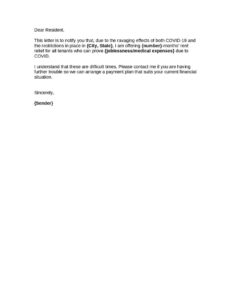
Covid Rent Relief Landlord
Download a free COVID Rent Relief Landlord form template in PDF and DOCX to document tenant rent assistance, verify arrears, and request payment — free download.
DOCX
2 downloads
0
likes
Download Files
- DOCX
A COVID Rent Relief Landlord form is a document landlords use to participate in pandemic-related rental assistance programs by verifying a tenant’s lease, rent owed, and the unpaid balance they are seeking to recover. Property owners most often use it to certify outstanding rent so a relief program or government agency can release funds directly to the landlord. It is free to download here in both PDF and DOCX formats, with no signup required.
What Is a COVID Rent Relief Landlord Form?
A COVID Rent Relief Landlord form is a certification and request document completed by a landlord or property manager to support a tenant’s application for emergency rental assistance tied to COVID-19 hardship. The form confirms the rental relationship, the monthly rent amount, the period of unpaid rent, and the landlord’s banking or payment details so funds can be disbursed. It typically accompanies a tenant-side application and serves as the owner’s official statement of arrears. Agencies, nonprofits, and housing authorities use these documents to verify claims, prevent duplicate payments, and create a paper trail. The form benefits both parties: tenants stay housed, and landlords recover legitimately owed rent.
When Do You Need a COVID Rent Relief Landlord Form?
Landlords reach for this form whenever a rental assistance program asks them to verify the tenant’s account. Common situations include:
- A tenant has applied for emergency rental assistance and the program requires the landlord to certify the amount owed.
- You want to recover back rent that accrued during a period of COVID-related income loss or eviction protections.
- A housing authority or nonprofit will only pay funds directly to the property owner and needs your banking details.
- You are documenting an agreement to accept relief payment in exchange for forbearance on eviction.
- An auditor or program administrator requests proof of the lease, rent amount, and balance before releasing funds.
- You manage multiple units and need a consistent, repeatable certification for each tenant’s relief claim.
What a COVID Rent Relief Landlord Form Should Have
To be accepted by most programs, the form should clearly identify the landlord and tenant, the rental property address, and the lease terms. It should state the monthly rent, the months in arrears, and the total balance being claimed. Strong forms also include the landlord’s contact information, a payment method or bank account for disbursement, a certification statement attesting that the information is true, and a signature with date. Many programs require supporting attachments such as a copy of the lease, a rent ledger, and a W-9 for tax reporting. Including a clear breakdown of how the total was calculated reduces back-and-forth and speeds approval.
How to Fill Out a COVID Rent Relief Landlord Form
- Landlord information: Enter your full legal name or business entity name, mailing address, phone number, and email so the program can reach you.
- Property details: List the full rental address, including unit number, and the type of dwelling.
- Tenant information: Add the tenant’s full name and the names of any co-tenants on the lease.
- Lease terms: State the lease start date, the monthly rent amount, and whether the lease is active or expired.
- Rent owed: Identify each month of unpaid rent, the amount due for each, and the total arrears being claimed.
- Payment details: Provide the bank account or payment method where relief funds should be sent, plus any required tax identification.
- Certification: Read the attestation confirming the information is accurate and that you have not received duplicate payment for the same period.
- Signature: Sign and date the form, and have a co-owner or property manager sign if required.
Documentation That Speeds Approval
Programs move faster when your certification is backed by clean records. Attach a copy of the signed lease showing the monthly rent and the tenant’s name. Include a rent ledger or payment history that shows when payments stopped and how the balance accumulated month by month. A completed W-9 lets the program issue payment without delay and handles tax reporting. If your program requires it, add proof of ownership such as a deed, tax bill, or mortgage statement. Keep your figures consistent across every document — the rent on the lease, the ledger, and this form should all match exactly. Mismatched numbers are the single most common reason claims get flagged for review.
How This Differs From a Standard Demand for Rent
A COVID Rent Relief Landlord form is a cooperative certification aimed at getting a third party to pay arrears, while a demand for rent or pay-or-quit notice is an enforcement tool directed at the tenant. The relief form generally requires the landlord to pause or forgo eviction for the covered period in exchange for the payment. Always read the program terms carefully, because accepting relief funds may come with conditions such as agreeing not to charge late fees on the covered months or not to evict for nonpayment during a set window. Treat the form as part of an agreement, not just a request.
Common Mistakes to Avoid
- Listing a different rent amount on the form than what the lease and ledger show.
- Claiming months that fall outside the program’s eligible relief period.
- Forgetting to provide a W-9 or accurate banking details, which stalls disbursement.
- Submitting a claim for rent you have already been paid for elsewhere, which can be flagged as duplicate.
- Leaving the certification unsigned or undated, making the form invalid.
- Continuing eviction proceedings after accepting funds when the program prohibits it.
Frequently Asked Questions
What is a COVID Rent Relief Landlord form used for? It is used by a landlord to certify a tenant’s unpaid rent and request that a rental assistance program pay those arrears directly to the property owner. It confirms the lease, the monthly rent, and the total balance owed. Programs rely on it to verify the claim before releasing funds.
How do I fill out the form correctly? Enter your landlord and property details, the tenant’s name, the lease terms, and an itemized list of the months and amounts owed. Add your payment and tax information, then read and sign the certification. Make sure every number matches your lease and rent ledger.
Does this form need to be notarized or witnessed? Most rental assistance programs do not require notarization, but they do require a signed certification attesting the information is true. Some programs may ask for a notarized signature or additional verification. Always follow the specific instructions for the program you are applying through.
Is the landlord required to stop an eviction after receiving relief funds? Many programs require landlords to forgo eviction for nonpayment during the covered period as a condition of receiving funds. The exact terms vary by program and jurisdiction. Read the agreement carefully before signing so you understand any obligations.
How much does this template cost? This template is completely free to download here in both PDF and DOCX formats with no signup required. You can customize it for your property and tenant before submitting it to your program. There is no charge to use or edit it.
Can I use one form for multiple tenants or units? Generally you should complete a separate form for each tenant and unit, since the lease terms, rent amount, and arrears differ for each. Using one form per tenant keeps records clean and prevents confusion during review. Some programs require a distinct application per household.
This template is a general example provided for informational purposes only and is not legal, financial, or tax advice. Rental assistance program rules and landlord-tenant requirements vary by jurisdiction and by program. Consult a qualified attorney or the administering agency before relying on this form.
Official resource: for the rules that apply to your situation, see HUD.
Related Forms
- Move-In Letter
- Agreement To Terminate Lease
- Room Rental Agreement
- Rental Unit HVAC Filter Log
- Tenant Late Rent Log
- Notice of Lease Termination
Browse more in Landlord Documents.