
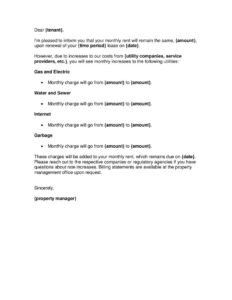
Tenant Utilities Increase Letter
Download a free Tenant Utilities Increase Letter template to notify renters of utility cost changes clearly and professionally—free PDF and DOCX download.
PDF
DOCX
23 downloads
2
likes
Download Files
- DOCX
A Tenant Utilities Increase Letter is a written notice a landlord or property manager sends to a tenant to inform them that the cost they pay toward utilities is going up. The most common reason people use it is to formally document a change in shared utility billing or a new rate before it takes effect, keeping the relationship transparent and on record. You can download this template free in both PDF and DOCX formats—no signup required.
What Is a Tenant Utilities Increase Letter?
A Tenant Utilities Increase Letter is a formal communication that notifies a renter their portion of utility charges—such as water, gas, electricity, trash, sewer, or a flat utility fee—will increase. It is typically issued by the landlord, property manager, or leasing office to one or more tenants in a rental property. The letter documents what is changing, by how much, when the new amount applies, and why the adjustment is being made. While it is not a lease amendment on its own, it creates a clear paper trail showing the tenant was given advance notice, which helps prevent confusion, billing disputes, and missed payments down the line.
When Do You Need a Tenant Utilities Increase Letter?
This letter is useful any time a tenant’s utility responsibility changes. Common situations include:
- Rising utility rates: Your municipal water, sewer, or trash provider raises rates and you pass a portion through to tenants as allowed by the lease.
- Switching to submetered or proportional billing: You move from including utilities in rent to charging tenants based on usage or square footage.
- Annual cost adjustments: A yearly review shows shared utility expenses have outpaced what tenants currently contribute.
- New services added: You begin providing or billing for a service such as recycling, landscaping water, or common-area electricity.
- Lease renewal changes: A renewing tenant agrees to a revised utility arrangement that takes effect with the new term.
- Correcting an under-billed amount: A flat utility fee that has not changed in years is brought in line with actual costs.
What a Tenant Utilities Increase Letter Should Have
A complete and effective letter is clear, dated, and specific. At minimum it should include the date of the letter, the tenant’s name and rental address, and the property manager or landlord’s name and contact details. It must state the current utility amount, the new amount or rate, and the effective date the change begins. A brief, honest explanation of the reason adds credibility, and a reference to the relevant lease clause shows the increase is permitted. Finally, the letter should offer a point of contact for questions and close with a courteous, professional tone that preserves goodwill.
How to Fill Out a Tenant Utilities Increase Letter
- Add the date: Enter the date you are sending the letter—this sets the start of the notice period.
- Identify the tenant: Write the tenant’s full name and the complete rental address, including unit number, so the notice is unambiguous.
- State your details: Fill in your name (or the company name), role, and contact information as the sender.
- Describe the current charge: List the utility or utilities affected and the amount the tenant currently pays.
- State the new amount: Clearly write the increased amount or new rate and how it will be calculated if usage-based.
- Set the effective date: Specify exactly when the new charge begins, allowing the notice period your lease or local law requires.
- Explain the reason: Add a short sentence on why the increase is happening, such as a provider rate hike.
- Reference the lease: Cite the clause that authorizes utility pass-throughs or adjustments.
- Sign and deliver: Sign the letter and keep a dated copy for your records before delivering it.
How to Deliver the Letter and Keep Records
How you deliver this letter matters as much as what it says. Many leases and local rules specify acceptable delivery methods—hand delivery, certified mail with return receipt, or email if the tenant has agreed to electronic notice. Whichever method you use, keep proof of delivery and a copy of the signed letter in your tenant file. If you manage multiple units affected by the same increase, send each tenant an individually addressed letter rather than a single group notice, so each renter has a clear record specific to their unit. Note the date sent and the method on your copy, which becomes valuable evidence if a payment dispute arises later.
Notice Periods and Lease Considerations
The amount of advance notice required before a utility charge can increase depends on your lease terms and local landlord-tenant rules. Some jurisdictions treat changes to utility billing as a material change to the tenancy that requires the same notice as a rent increase, while others permit pass-through adjustments mid-term if the lease clearly allows them. Always confirm what your lease says about utilities before sending the letter, and align your effective date with any required notice window. When utilities are bundled into rent, increasing them usually means amending the rent itself, which can require a separate process and its own notice period.
Common Mistakes to Avoid
- Giving too little notice: Failing to allow the notice period your lease or local law requires can make the increase unenforceable.
- Being vague about amounts: Listing only a percentage or a rough figure invites disputes—state the exact current and new amounts.
- Skipping the reason: Tenants are far more receptive when they understand why costs are rising.
- Ignoring the lease: Increasing a charge the lease doesn’t authorize can expose you to a tenant challenge.
- Not keeping proof: Without a delivery record, you may struggle to prove the tenant was notified.
- Mixing up multiple tenants: Sending a generic letter without the correct names, units, and figures creates confusion.
Frequently Asked Questions
What is a Tenant Utilities Increase Letter? It is a formal written notice from a landlord or property manager telling a tenant that their utility charges will increase. It states the current amount, the new amount, the effective date, and usually the reason for the change. The letter creates a documented record that the tenant was given proper notice.
How do I fill out the letter? Enter the date, the tenant’s name and rental address, and your contact details, then state the current utility charge and the new amount. Add the effective date, a brief reason, and a reference to the relevant lease clause before signing. Keep a copy for your records and note how you delivered it.
How much notice do I have to give before raising utility charges? Notice requirements vary by lease terms and local landlord-tenant law, so there is no single answer. Some areas treat a utility increase like a rent change requiring 30 days’ notice or more. Always check your lease and local rules and set the effective date accordingly.
Does the letter need to be notarized or witnessed? No, a utility increase letter generally does not require notarization or witnesses to be valid. What matters most is clear content, proper notice, and proof that it was delivered to the tenant. Keeping a dated copy and a delivery receipt is usually sufficient.
Is this letter legally binding on its own? The letter is a notice rather than a contract, so it relies on the underlying lease for authority to change utility charges. If your lease permits utility pass-throughs or adjustments, the letter properly implements that right with advance notice. If utilities are included in rent, you may need a lease amendment instead.
How much does this template cost? This Tenant Utilities Increase Letter template is completely free to download here in both PDF and DOCX formats, with no signup required. You can edit the DOCX version to add your specific amounts, dates, and lease references. Use it as many times as you need across your properties.
This template is a general example provided for informational purposes only and is not legal, financial, or tax advice. Landlord-tenant requirements, notice periods, and rules on utility charges vary by jurisdiction and by the terms of your individual lease. Consult a qualified attorney or local housing authority before relying on this document.
Official resource: for the rules that apply to your situation, see HUD.
Related Forms
- Eviction Notice Letter
- Tenant Vehicle Log
- Notice of Overdue Rent
- Noise Complaint Letter
- Agreement On Tenant Alterations To Rental Unit
- Covid Rent Extension Landlord
Browse more in Landlord Documents.