
Equipment Inventory
Track and document business assets with our free Equipment Inventory template, available as a free download in PDF and DOCX with no signup required.
PDF
DOCX
3 downloads
0
likes
Download Files
- DOCX
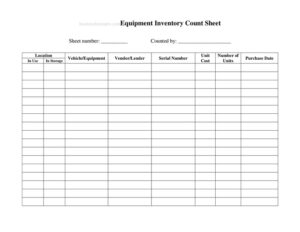
An Equipment Inventory is a structured count sheet used to record, track, and value the physical assets a business owns or leases, from vehicles and machinery to tools and electronics. People most often use it to keep an accurate, up-to-date list of equipment for insurance, accounting, and maintenance purposes. It’s free to download here in both PDF and DOCX formats, with no signup required.
What Is an Equipment Inventory?
An Equipment Inventory is a documented log that captures the key details of every piece of equipment in an organization, including where it is located, who supplied it, what it cost, and whether it is currently in use. It is typically maintained by an operations manager, asset coordinator, facilities team, or small-business owner. The form documents both the identity of each asset (through serial numbers and descriptions) and its financial and operational status. Businesses rely on it to support depreciation schedules, verify physical counts against accounting records, plan replacements, and prove ownership when filing insurance claims. A well-kept inventory turns scattered receipts and memory into a single reliable reference.
When Do You Need an Equipment Inventory?
This count sheet is useful in many everyday operational situations. Common reasons to create or update one include:
- Annual physical counts — reconciling what you actually have on hand against your fixed-asset register or accounting books.
- Insurance documentation — providing your insurer with serial numbers, purchase dates, and unit costs to support coverage levels and claims.
- New equipment purchases — logging each item as it arrives, including its vendor or lender and cost.
- Maintenance and replacement planning — identifying aging assets and tracking which units are in use versus idle.
- Business sale, merger, or audit — presenting a clear schedule of owned and leased assets to buyers, lenders, or auditors.
- Multi-location operations — keeping track of where each vehicle or machine is assigned across sites.
Types of Equipment You Might Track
The same sheet works across many asset categories. You might use it for fleet vehicles like vans and trucks, heavy machinery such as forklifts and generators, shop tools, IT hardware including laptops and servers, or specialized equipment rented or financed through a lender. Whether items are owned outright or leased, the inventory captures them in one consistent format.
What an Equipment Inventory Should Have
To be genuinely useful, the count sheet should capture enough detail to identify and value each asset without ambiguity. The essential elements are a clear location, a precise equipment description, the source vendor or lender, a unique serial number, the unit cost and quantity, the purchase date, and the current use status. Together these fields let anyone reading the sheet understand what the item is, where it sits, what it’s worth, and whether it’s actively contributing to operations. A dated, signed sheet also creates a snapshot you can compare against future counts.
How to Fill Out an Equipment Inventory
- Location: Enter where the item physically resides — a building, department, job site, or storage yard. Be specific so others can find it during a physical count.
- Vehicle/Equipment: Describe the asset clearly, including make, model, and type (for example, “Ford Transit cargo van” or “Caterpillar generator”).
- Vendor/Lender: Record the supplier you purchased from, or the lender or leasing company if the item is financed or rented.
- Serial Number: Copy the manufacturer’s serial or VIN exactly. This is the single most important identifier for insurance and theft recovery.
- Unit Cost: Enter the per-unit purchase or replacement price. Keep amounts consistent (pre-tax or post-tax) across the sheet.
- Number of Units: Note how many identical items this line represents so totals are accurate.
- Purchase Date: Record when the item was acquired; this supports depreciation and warranty tracking.
- In Use / In Storage: Mark the current status so you can distinguish active assets from idle or surplus equipment.
Keeping the Inventory Accurate Over Time
An inventory is only valuable if it stays current. Set a recurring schedule — quarterly or annually — to walk through each location and verify items against the sheet. Add new purchases as they arrive and flag disposed, sold, or scrapped equipment so the list reflects reality. Store the completed sheet alongside purchase invoices and warranty documents, and keep a backup copy digitally. If you manage assets across several sites, consider maintaining one master file with separate sheets per location, then rolling up unit costs and quantities for a company-wide total. Photographing high-value items and attaching the photos to your records strengthens both insurance and audit support.
How It Differs From a Fixed-Asset Register
An Equipment Inventory count sheet is a practical, physical-count tool, while a fixed-asset register is usually an accounting record that tracks depreciation, book value, and disposal entries. The two should agree, and the inventory is often the field document used to reconcile and update the formal register. Using this simpler sheet first makes the accounting reconciliation faster and more accurate.
Common Mistakes to Avoid
- Skipping serial numbers — without them, two identical machines are impossible to tell apart during a claim or audit.
- Vague descriptions — “laptop” tells you little; record the make, model, and configuration.
- Forgetting to update status — leaving sold or scrapped items marked “in use” inflates your totals.
- Mixing cost bases — switching between purchase price and replacement value across rows makes totals unreliable.
- Ignoring leased items — equipment from a lender still belongs on the sheet, clearly noted as financed or leased.
- No date stamp — an undated inventory can’t be compared to prior counts to spot losses.
Frequently Asked Questions
What is an Equipment Inventory used for? It is used to record and track every piece of equipment a business owns or leases, including its location, cost, serial number, and use status. Organizations rely on it for insurance, accounting reconciliation, maintenance planning, and audits. It gives you one trusted source of truth instead of scattered receipts.
How do I fill out the Equipment Inventory count sheet? Complete one row per item or group of identical items, entering the location, description, vendor or lender, serial number, unit cost, number of units, purchase date, and whether it is in use or in storage. Be precise with serial numbers and descriptions so each asset is uniquely identifiable. Date the sheet when you complete it so it can serve as a point-in-time snapshot.
Does an Equipment Inventory need to be notarized? No, an internal equipment inventory is an operational record and does not require notarization or witnesses. It simply needs to be accurate, dated, and ideally reviewed by the person responsible for the assets. If it’s submitted as part of a formal legal or financial process, follow that process’s own signing requirements.
How often should I update my equipment inventory? Most businesses review it at least once a year, often quarterly, and update it whenever they buy, sell, or dispose of equipment. Frequent updates keep your insurance coverage and accounting records aligned with what you actually own. Regular physical counts also help catch loss, theft, or misplacement early.
Should leased or financed equipment be included? Yes. Record financed or leased items and note the lender or leasing company in the Vendor/Lender field. Tracking them keeps your operational picture complete, even though their accounting treatment may differ from owned assets.
Is this Equipment Inventory template free to download? Yes, it is completely free to download in both PDF and DOCX formats with no signup required. You can use the PDF for quick printing and physical counts, or edit the DOCX to add columns, totals, or your company branding.
This Equipment Inventory template is provided as a general example for informational purposes only and does not constitute legal, financial, accounting, or tax advice. Recordkeeping, depreciation, and insurance requirements vary by jurisdiction and by business. Consult a qualified accountant, insurer, or other professional to ensure your inventory practices meet your specific obligations.
Related Forms
- Fire Drill Log
- Flood Emergency Checklist
- Pledge Log
- Beauty Salon Supplies Inventory Card
- Document Tracker
- Volunteer Hours Tracker
Browse more in Log and Inventory.