
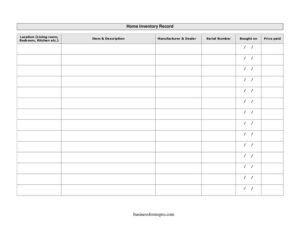
Home Inventory List of Possessions
Document your belongings with a free Home Inventory List of Possessions template—organize by room, track values, and protect insurance claims with a free download.
PDF
DOCX
2 downloads
0
likes
Download Files
- DOCX
A Home Inventory List of Possessions is a room-by-room record of everything you own, including descriptions, serial numbers, purchase dates, and prices paid. People most often create one to support a homeowners or renters insurance claim after theft, fire, or water damage—and you can download this template free in PDF or DOCX with no signup required.
What Is a Home Inventory List of Possessions?
A Home Inventory List of Possessions is a written catalog of the personal property inside your home, organized by location and detailed enough to prove ownership and value. Homeowners, renters, and condo owners typically create and maintain it themselves, though insurance agents and professional organizers often recommend it. The document records each item’s description, who made and sold it, its serial number, when it was purchased, and how much it cost. Its purpose is twofold: to give you a clear picture of what you own and what it’s worth, and to provide documentation an insurer can rely on if you ever file a claim. A complete inventory turns vague memories into verifiable facts when it matters most.
When Do You Need a Home Inventory List?
An up-to-date inventory is useful in more situations than most people expect. Common reasons to create one include:
- Buying or renewing insurance — to set accurate coverage limits and avoid being underinsured for your belongings.
- Filing a claim after a loss — fire, flood, burglary, or storm damage all require you to list and value what was lost or destroyed.
- Moving to a new home — to confirm everything arrived and to document the condition of high-value items before transit.
- Estate planning or settling an estate — to record possessions for heirs, executors, or probate.
- Divorce or separation — to divide property fairly with a clear record of who owns what.
- Disaster preparedness — keeping a copy off-site or in the cloud so you have proof even if the originals are gone.
What a Home Inventory List Should Have
A useful inventory balances completeness with accuracy. At minimum, it should group items by location so nothing is overlooked, and capture enough identifying detail to distinguish one item from another. For each entry, include a clear item and description, the manufacturer and dealer, a serial number where one exists, the date purchased, and the price paid. Supporting evidence strengthens the record: receipts, photographs, appraisals for jewelry or art, and warranty documents. Keep totals per room and an overall estimated value so you can compare it against your coverage limits. Finally, store the finished list somewhere safe—ideally a second copy outside the home or in secure cloud storage.
How to Fill Out a Home Inventory List
Work through your home methodically, one space at a time, using the template’s fields:
- Choose a location. Start with a single room—living room, bedroom, kitchen, garage, or storage—and label that section so each item is tied to where it lives.
- Record the item and description. Name the object and add distinguishing details such as model, size, color, or material (for example, “55-inch LED television” rather than just “TV”).
- Note the manufacturer and dealer. List who made the item and the store or retailer where you bought it. This helps verify authenticity and replacement cost.
- Enter the serial number. Copy serial or model numbers from electronics, appliances, tools, and equipment exactly as printed.
- Add the date bought on. Record the purchase date, even if approximate, to establish age and depreciation.
- Fill in the price paid. Enter the original purchase amount; attach or reference the receipt when you have one.
Repeat for every room until each space is covered, then tally values and save your file.
Tips for a Stronger Inventory
A few habits make your inventory far more credible and useful. Photograph or video each room as you go, opening drawers and closets so the footage matches your written list. For high-value categories—jewelry, watches, cameras, musical instruments, collectibles—keep appraisals and original receipts alongside the entry. Don’t forget items that are easy to overlook: contents of the attic, basement, garage, outdoor furniture, and tools in the shed. Update the list at least once a year and whenever you make a significant purchase. Because the template is available in editable DOCX, you can add columns for replacement cost or condition if your insurer asks for them.
Keeping and Storing Your Records
An inventory only helps if it survives the event you’re documenting against. Save at least one copy away from the home itself—email it to yourself, store it in a cloud account, or keep a printed copy with a trusted relative or in a safe-deposit box. Pair the spreadsheet or PDF with your photos and receipts in the same folder so everything is together when you need it. After a loss, your insurer will compare your claim to this record, so the more organized and detailed it is, the smoother and faster the process tends to be.
Common Mistakes to Avoid
- Vague descriptions — “laptop” tells an adjuster little; include brand, model, and serial number.
- Skipping the price paid or date — without these, valuing a claim becomes guesswork.
- Forgetting low-visibility areas — garages, attics, and storage closets often hold valuable tools and seasonal items.
- Keeping the only copy at home — if it burns or is stolen with everything else, it’s useless.
- Never updating it — an inventory from five years ago misses recent purchases and overstates items you’ve replaced.
- Ignoring receipts and photos — written entries alone are weaker proof than entries backed by documentation.
Frequently Asked Questions
What is a Home Inventory List of Possessions used for? It’s used to document the personal property in your home so you can prove what you own and what it’s worth. The most common use is supporting an insurance claim after theft, fire, or other damage, but it also helps with moving, estate planning, and setting accurate coverage limits.
How do I fill out the home inventory template? Go room by room and, for each item, record the location, a detailed description, the manufacturer and dealer, the serial number, the date purchased, and the price paid. Adding photos and receipts to match each entry makes the record far more reliable.
Does a home inventory need to be notarized or witnessed? No. A home inventory is a personal record, not a legal contract, so it does not require notarization or witnesses. To make it more credible to an insurer, support entries with dated photos, receipts, and professional appraisals for valuable items.
Is this home inventory template free to download? Yes. You can download the Home Inventory List of Possessions template free in both PDF and DOCX formats, with no account or signup required. The DOCX version is editable so you can add rooms, items, or extra columns.
How often should I update my home inventory? Review it at least once a year and update it whenever you make a significant purchase or dispose of major items. Keeping it current ensures your coverage matches your belongings and that a claim won’t be undervalued.
Will my insurance company accept this inventory for a claim? A detailed, organized inventory backed by receipts and photos is exactly the kind of documentation insurers look for, though each company has its own claims process and requirements. Check your policy and ask your agent whether they prefer a specific format or additional details.
This template is a general example provided for informational purposes only and is not legal, financial, or insurance advice. Coverage rules and claim requirements vary by insurer and jurisdiction—consult your insurance provider or a qualified professional for guidance specific to your situation.
Related Forms
- Computer Fault List
- List of Vehicles
- Cleaning Checklist
- Employee Password Tracker
- Inventory Report
- Basic Inventory Card
Browse more in Log and Inventory.