
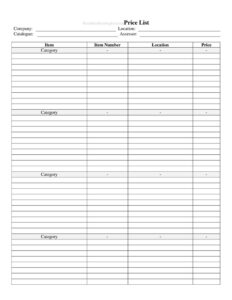
Price List
Download a free Price List template to organize items, item numbers, categories, and prices in seconds — clean PDF and DOCX, no signup required.
PDF
DOCX
2 downloads
0
likes
Download Files
- DOCX
A price list is a structured document that records the products or services a business offers alongside their current prices, item numbers, and categories. People most often use one to give customers a clear, up-to-date reference for what they sell and what it costs — and you can download this template free in both PDF and DOCX formats with no signup required.
What Is a Price List?
A price list is a catalogue-style document, usually issued by a company, that itemizes goods or services and assigns each a set price. It is used by sales teams, retailers, wholesalers, service providers, and warehouses to communicate pricing consistently and to keep internal records accurate. This particular template captures the company name, the location it applies to, the catalogue or product line, the assessor who prepared or verified the figures, and a row-by-row breakdown of each item, its item number, category, and price. Because it doubles as both a customer-facing quote sheet and an internal inventory reference, a well-kept price list reduces pricing disputes, speeds up order processing, and ensures everyone is working from the same numbers.
When Do You Need a Price List?
A price list is useful any time you need to present or track costs in an organized way. Common situations include:
- Sending quotes to customers — sharing a clean, professional list of your products and current prices.
- Updating seasonal or annual pricing — revising figures across a catalogue and distributing the new version to your team.
- Managing multiple locations — keeping separate or consolidated price lists where the same item may differ by store or warehouse.
- Onboarding sales or front-desk staff — giving new employees a single reference for what to charge.
- Reconciling inventory with pricing — pairing item numbers and categories with prices during stock audits.
- Submitting bids or vendor catalogues — providing a buyer with an itemized, comparable price sheet.
Types of Price Lists
Not every price list serves the same audience. A retail price list shows the prices customers pay at the counter or online. A wholesale or trade price list reflects discounted bulk pricing for resellers. An internal price list records cost and margin data for staff use only and is rarely shared outside the company. A service price list itemizes labor, packages, or hourly rates rather than physical goods. This template is flexible enough to handle any of these — the Category column lets you group items logically, while the Location field lets you tailor the list to a specific branch, store, or warehouse.
What a Price List Should Have
A complete, trustworthy price list includes a clear identification of who issued it and a consistent structure for every entry. At minimum it should show the company name, the relevant location, the catalogue or product line it covers, and the name of the assessor responsible for the figures. Each line item needs an item name, a unique item number, a category for grouping, and a price. Adding an effective date or version note is also good practice so readers know whether the prices are current.
How to Fill Out a Price List
Work through the template top to bottom, then complete each item row:
- Company: Enter your full business or trading name exactly as customers recognize it.
- Location: Record the store, branch, or warehouse this list applies to, especially if you operate in more than one place.
- Catalogue: Name the product line, season, or catalogue edition this list represents (for example, “Spring 2025” or “Hardware Range A”).
- Assessor: Write the name of the person who compiled or verified the prices, so questions can be directed to the right contact.
- Item: For each row, enter the product or service name clearly enough that any reader knows exactly what it is.
- Item Number: Add the unique SKU, code, or catalogue number that identifies the item in your system.
- Location: Where the item is stored or sold — use this second location field to note shelf, bin, or branch-level placement if needed.
- Category: Group the item (for example, beverages, fasteners, or consulting) to keep related products together.
- Price: State the current price, using a consistent currency and unit (per item, per kilogram, per hour) throughout.
Keeping Your Price List Accurate
A price list is only as useful as it is current. Set a regular review cadence — monthly, quarterly, or whenever supplier costs change — and update the assessor name and date with each revision. When you reuse the DOCX version, save each update under a new file name (such as “PriceList_Catalogue_2025-Q2”) so older versions are not mistaken for the latest. If you distribute the list externally, consider exporting the final version to PDF so the formatting and figures cannot be accidentally altered by the recipient.
Price List vs. Invoice and Quote
It helps to know how a price list differs from related documents. A price list is a standing reference of what you charge — it is not tied to a single transaction. A quote applies your price list to a specific customer’s request for a fixed period. An invoice records an actual sale that has occurred and requests payment. The same item numbers and prices flow from your price list into quotes and invoices, which is why keeping the master list accurate prevents errors downstream.
Common Mistakes to Avoid
- Forgetting the effective date — readers cannot tell whether prices are still valid.
- Inconsistent currencies or units — mixing per-item and per-pack prices causes confusion.
- Duplicate or missing item numbers — breaks the link between the list and your inventory system.
- Leaving the assessor field blank — no one knows who to ask about a disputed price.
- Vague item names — “Box” or “Unit A” tells the reader nothing useful.
- Sharing an editable file externally — invites accidental or deliberate changes to your prices.
Frequently Asked Questions
What is a price list used for? A price list is used to present and record the prices of products or services in one organized document. Businesses share it with customers as a reference and use it internally to keep inventory and pricing aligned. It speeds up quoting, ordering, and stock reconciliation.
How do I fill out this price list template? Start by entering your company, location, catalogue, and assessor at the top, then add one row per item. For each item, fill in the name, item number, location, category, and price. Keep your units and currency consistent across every row for clarity.
Is a price list a legally binding document? A price list is generally a reference rather than a binding contract on its own, though it can become part of an agreement once a customer accepts a quote based on it. Many businesses add a note reserving the right to change prices. Rules vary by jurisdiction, so check your local consumer and pricing regulations.
What is the difference between a price list and an invoice? A price list is a standing reference of what you charge, while an invoice is a request for payment tied to a specific completed sale. The prices and item numbers on your list typically carry over into invoices. Keeping the list accurate keeps your invoices accurate.
Can I use this template for multiple locations? Yes. The Location fields let you create a separate list per branch or warehouse, or note where each item is stored within a single list. This makes the template suitable for businesses that price the same item differently across sites.
How much does this price list template cost? It is completely free to download here in both PDF and DOCX formats, with no signup or payment required. Use the editable DOCX to customize it for your business and export to PDF when you are ready to share a final version.
This price list template is a general example provided for informational purposes only and is not legal, financial, or tax advice. Pricing, disclosure, and consumer-protection requirements vary by jurisdiction and industry. Consult a qualified professional before relying on this document for any commercial or regulatory purpose.
Related Forms
- Work Search Log
- Bird Strike Form
- Firearm Inventory
- Weekly Blog Planner
- Semi Annual Safety And Maintenance Update
- Cigar Tasting Log
Browse more in Log and Inventory.