
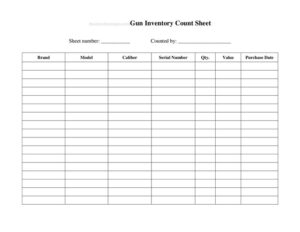
Firearm Inventory
Track your firearms with a free Firearm Inventory template—log brand, model, caliber, serial number, value and purchase date. Free download in PDF and DOCX.
PDF
DOCX
4 downloads
0
likes
Download Files
- DOCX
A Firearm Inventory is a count sheet used to record every gun you own or manage, capturing details like brand, model, caliber, and serial number in one organized place. The most common reason people use it is to keep an accurate, up-to-date record for insurance, estate planning, or simple personal accountability. You can download this Firearm Inventory template for free in both PDF and DOCX formats, with no signup required.
What Is a Firearm Inventory?
A Firearm Inventory is a structured log that documents each firearm in a collection along with its identifying characteristics and value. It is used by private collectors, hunters, sport shooters, gunsmiths, dealers, and estate executors to maintain a clear written or digital record of what is owned, how much it is worth, and when it was acquired. Unlike a casual list, a proper inventory ties each entry to a unique serial number, making it possible to identify, verify, and recover specific items. The document serves as a reference for insurance claims, tax and estate matters, and routine self-audits, and it provides a reliable snapshot that can be updated whenever firearms are bought, sold, or transferred.
When Do You Need a Firearm Inventory?
A Firearm Inventory is useful any time you need a precise, defensible record of the guns in your possession. Common situations include:
- Insurance coverage and claims — documenting serial numbers and values so you can prove ownership and replacement cost after theft, fire, or loss.
- Estate planning and probate — giving executors and heirs a clear list of firearms to be valued, distributed, or sold.
- Buying and selling — tracking acquisitions and disposals so your collection records always match what you physically hold.
- Theft recovery and police reports — providing law enforcement with exact make, model, caliber, and serial number details.
- Dealer or range operations — performing periodic physical counts to reconcile stock against records.
- Personal organization — keeping a running ledger of value and purchase history for larger collections.
What a Firearm Inventory Should Have
A complete inventory sheet should let you uniquely identify every firearm and total the collection’s value. Key elements include a sheet number for multi-page records, the name of the person who performed the count, and a row for each firearm capturing brand, model, caliber, serial number, quantity, value, and purchase date. The serial number is the single most important field because it distinguishes otherwise identical firearms. A value column supports insurance and estate figures, while purchase dates help establish acquisition history. Leaving room to total values and to note the count date adds usefulness for audits and reconciliation.
How to Fill Out a Firearm Inventory
- Sheet number: Number each page (for example, 1 of 3) so multi-page inventories stay in order and nothing is lost.
- Counted by: Enter the full name of the person performing the count. This creates accountability and is helpful during audits or insurance reviews.
- Brand: Record the manufacturer or maker, such as Smith & Wesson, Glock, or Remington.
- Model: List the specific model name or number exactly as marked on the firearm.
- Caliber: Note the caliber or gauge, such as 9mm, .45 ACP, or 12-gauge.
- Serial Number: Copy the serial number precisely from the firearm’s frame or receiver. Double-check every character.
- Qty.: Enter the quantity for that line. Most firearm entries are a quantity of one because each has a unique serial number.
- Value: Record the current estimated or appraised value for insurance and estate purposes.
- Purchase Date: Enter the date the firearm was acquired to track ownership history.
Tips for Keeping an Accurate Record
Treat your Firearm Inventory as a living document. Update it the same day you buy, sell, or transfer any firearm so the sheet never drifts out of sync with reality. Photograph each firearm alongside its serial number and store the images with the inventory—visual proof strengthens insurance claims and recovery efforts. Keep at least one copy somewhere secure and separate from the firearms themselves, such as a fireproof safe, a safe-deposit box, or encrypted cloud storage, so a single fire or theft cannot destroy both your guns and the only record of them. When estimating value, use recent comparable sale prices or a professional appraisal for collectible, antique, or custom pieces, since their worth can far exceed standard retail.
Storing and Protecting Your Inventory
Because a Firearm Inventory contains sensitive information—serial numbers, values, and the implication of what you own—handle it carefully. Limit access to trusted individuals and consider keeping a digital copy that is password-protected. If you maintain multiple sheets, the sheet-number field helps you confirm the complete set is present. Reconcile the inventory against your physical firearms on a regular schedule, such as annually or whenever you reorganize storage, and initial or date each completed count. A disciplined routine turns a simple list into a dependable, audit-ready record.
Common Mistakes to Avoid
- Transposing serial numbers — even one wrong character can make a firearm impossible to verify; read each one twice.
- Letting the inventory go stale — failing to update after a purchase or sale leaves your records inaccurate when you need them most.
- Guessing at values — rough estimates can shortchange an insurance claim; base figures on real market data or appraisals.
- Storing the only copy with the guns — a single theft or fire could destroy both; always keep a backup elsewhere.
- Vague brand or model entries — abbreviations and nicknames create confusion later; record exact markings.
- Skipping the counted-by and sheet fields — without them, multi-page records lose accountability and order.
Frequently Asked Questions
What is a Firearm Inventory used for? It is used to document every firearm you own or manage, recording brand, model, caliber, serial number, value, and purchase date in one place. People rely on it for insurance, estate planning, theft reporting, and routine self-audits.
How do I fill out the Firearm Inventory sheet? Start with the sheet number and the name of whoever is counting, then add one row per firearm with its brand, model, caliber, serial number, quantity, value, and purchase date. Copy serial numbers exactly and total the values when you finish.
Is this Firearm Inventory legally binding? The template itself is a record-keeping tool, not a contract, so it is not a legally binding agreement. However, an accurate inventory can serve as valuable supporting evidence for insurance claims, estate matters, and police reports.
How much does this template cost? It is completely free to download here in both PDF and DOCX formats, with no signup or account required. You can print it or edit the editable version to fit your collection.
How often should I update my firearm inventory? Update it immediately whenever you buy, sell, or transfer a firearm, and perform a full physical count at least once a year. Frequent updates ensure your records always match what you actually possess.
Where should I store my completed inventory? Keep at least one copy in a secure location separate from your firearms, such as a fireproof safe, safe-deposit box, or encrypted cloud storage. Limit access to trusted people because the sheet contains sensitive details.
This Firearm Inventory template is a general example provided for informational purposes only and is not legal, financial, tax, or insurance advice. Firearm record-keeping, registration, and ownership requirements vary by jurisdiction—consult a qualified professional or your local authorities to ensure you comply with applicable laws.
Related Forms
- Auto Maintenance Log
- Short Term Disability Claims Tracker
- Zombie Survival Checklist
- Credit History Record
- Phone Tree
- Hotel Reservation Request
Browse more in Log and Inventory.