
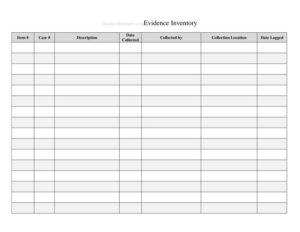
Evidence Inventory
Track and document seized items with a free Evidence Inventory template, ensuring a clean chain of custody — free download in PDF and DOCX.
PDF
DOCX
2 downloads
0
likes
Download Files
- DOCX
An Evidence Inventory is a structured record used to list, describe, and account for physical or digital items collected during an investigation, audit, or legal matter. People most often use it to maintain a reliable chain of custody so that every item can be traced from the moment it was collected to its final disposition. This template is free to download in both PDF and DOCX formats, with no signup required.
What Is an Evidence Inventory?
An Evidence Inventory is a documentation tool that catalogs each item of evidence connected to a case, incident, or examination. It is typically created and maintained by law enforcement officers, security teams, internal investigators, attorneys, insurance adjusters, or compliance personnel. The form records what each item is, where it came from, who handled it, and where it is stored. Its purpose is twofold: it provides an accurate accounting of all collected materials and it preserves the integrity of that evidence by establishing a clear, verifiable record. A complete inventory makes it far harder for anyone to claim an item was lost, altered, or improperly introduced, which is why it sits at the heart of any credible investigation.
When Do You Need an Evidence Inventory?
Any time items are collected and must be accounted for over time, an inventory protects everyone involved. Common situations include:
- Law enforcement investigations — logging items seized at a crime scene, during a search, or upon arrest.
- Internal corporate investigations — documenting devices, files, or records gathered during a workplace misconduct or fraud inquiry.
- Insurance claims — recording damaged property or salvage items examined by an adjuster.
- Litigation and discovery — tracking documents, samples, or exhibits that may be introduced in court.
- Security and loss-prevention teams — cataloging recovered merchandise, surveillance media, or confiscated items.
- Regulatory and compliance audits — accounting for samples, paperwork, or equipment pulled for review.
In each of these scenarios, the inventory becomes the single source of truth describing exactly what was collected and how it has been handled since.
What an Evidence Inventory Should Have
A complete Evidence Inventory captures enough detail to identify each item uniquely and trace its movement. The core elements typically include a case or reference number, the date and location of collection, the name of the person who collected each item, and a sequential item number. Each entry should carry a clear description, quantity, and condition, along with notes on packaging or labeling. Chain-of-custody columns record every transfer — who released the item, who received it, and the date and time. Finally, the form should note the current storage location and any final disposition, such as return, destruction, or transfer to another agency. Signature lines confirm the accuracy of the record.
How to Fill Out an Evidence Inventory
Because this is a flexible log template, complete it methodically so the record stands up to scrutiny:
- Enter the case identifier. At the top, record the case number, incident name, or matter reference so the inventory links to the correct file.
- Record the date and location. Note where and when the collection took place, and the name and title of the responsible custodian.
- Number each item. Assign a unique, sequential item number to every piece of evidence.
- Describe the item. Write a clear, objective description — make, model, color, serial number, quantity, and any identifying marks.
- Note the condition and packaging. State the item’s physical condition and how it was sealed, bagged, or tagged.
- Log the collection details. Record who collected the item and the exact date and time.
- Document chain of custody. For each transfer, list the releasing party, the receiving party, and the date and time of the handoff.
- Specify storage and disposition. Indicate where the item is stored and its final outcome.
- Sign and date. Have the custodian sign to certify the entries.
Maintaining a Defensible Chain of Custody
An Evidence Inventory is only as strong as the chain of custody it documents. Every time an item changes hands, the transfer should be recorded immediately rather than reconstructed later. Use tamper-evident packaging and reference the seal or tag number directly in the inventory so the physical item and the paper record match. Limit access to stored evidence and require anyone who removes an item — even briefly for examination — to sign it out and back in. Keeping these entries contemporaneous, legible, and free of erasures helps demonstrate that the evidence was never compromised, which is exactly what a reviewer, auditor, or court will look for.
Storing and Preserving Evidence Properly
Different items demand different handling. Electronics and digital media should be protected from static and magnetic interference; biological or chemical materials may need refrigeration or specialized containment; documents should be kept flat and dry. Record the specific storage conditions in your inventory notes so anyone reviewing the file understands how each item was preserved. Periodic audits of the stored inventory — confirming that every listed item is physically present and properly sealed — help catch discrepancies early and reinforce the reliability of the record.
Common Mistakes to Avoid
- Vague descriptions — “a phone” is far weaker than “black iPhone, model A2403, IMEI ending 7781.”
- Gaps in the chain — failing to log a transfer creates a break that can undermine the entire record.
- Backdating or altering entries — corrections should be lined through, initialed, and dated, never erased.
- Skipping item numbers — non-sequential or reused numbers make the inventory confusing and unreliable.
- Leaving condition notes blank — undocumented damage can later be blamed on mishandling.
- Not securing the form itself — store the inventory with the same care as the evidence it describes.
Frequently Asked Questions
What is an Evidence Inventory used for? It is used to list and account for every item collected during an investigation, audit, or legal matter. The inventory documents each item’s description, who handled it, and where it is stored, which preserves a clear chain of custody from collection to final disposition.
How do I fill out an Evidence Inventory? Start with the case identifier, collection date, and location, then assign a unique number to each item and describe it in detail. Record the collector, log every transfer of custody, note the storage location and disposition, and sign to certify the entries are accurate.
Why is chain of custody so important? Chain of custody proves that evidence has not been lost, tampered with, or substituted between collection and use. Each documented transfer shows continuous, accountable control, which is essential if the evidence is reviewed in an audit or introduced in court.
Is an Evidence Inventory a legal document? It can serve as an official record that supports investigations and proceedings, and its credibility depends on accuracy and consistency. Whether it carries formal legal weight depends on the context and the rules of the agency, organization, or jurisdiction involved.
Can I customize this template for my agency or company? Yes. The DOCX version is fully editable, so you can add columns, branding, agency-specific fields, or internal reference numbers. Adapt it to match your organization’s evidence-handling policies and any applicable procedural requirements.
How much does this Evidence Inventory template cost? It is completely free to download from Business Forms Pro in both PDF and DOCX formats, with no signup or payment required. You can use the PDF for quick printing or edit the DOCX to fit your specific process.
This Evidence Inventory template is a general example provided for informational purposes only and does not constitute legal, investigative, or compliance advice. Evidence-handling requirements vary by jurisdiction, agency, and organization — consult a qualified professional or your governing policies before relying on this form.
Related Forms
- Document Tracker
- Maintenance Log
- Warranty Log
- Observation Log
- Emergency Supplies List
- Inventory Report
Browse more in Log and Inventory.