
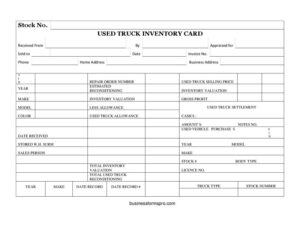
Used Truck Inventory Card
Track every used truck on your lot with this free Used Truck Inventory Card template — record VIN, costs, reconditioning, and profit. Free download.
PDF
DOCX
2 downloads
0
likes
Download Files
- DOCX
A Used Truck Inventory Card is a single-truck tracking record that follows a used truck from the moment it arrives on your lot through reconditioning and final sale. Dealers and fleet managers use it most often to keep every cost, valuation, and identifying detail for one unit in one place, so profit is easy to calculate at settlement. You can download this template free in PDF and DOCX with no signup required.
What Is a Used Truck Inventory Card?
A Used Truck Inventory Card is an internal accounting and inventory document used by truck dealerships, equipment resellers, and fleet operations to track an individual used truck. It captures where the truck came from, how it was appraised, what was spent reconditioning it, and how it was eventually sold. Unlike a master inventory log that lists many vehicles in rows, this card is dedicated to one unit identified by its stock number and VIN. It serves as a running ledger of valuation, allowances, repair orders, and gross profit, giving managers a clear paper trail for accounting reconciliation, audits, and pricing decisions throughout the time the truck sits in inventory.
When Do You Need a Used Truck Inventory Card?
- When a used truck is taken in on trade or purchased outright and needs to be entered into inventory with an appraised value.
- When you want to track reconditioning and repair-order costs against a specific unit before it goes up for sale.
- When calculating the true gross profit on a unit at the time it is sold and settled.
- When reconciling lot inventory during a month-end or year-end physical count and accounting close.
- When transferring a truck between storage, warehouse, or display locations and you need to log its current whereabouts.
- When responding to an auditor, lender, or owner who needs a documented cost-and-sale history for a single vehicle.
What a Used Truck Inventory Card Should Have
A complete card answers three questions clearly: what is the truck, what does it cost us, and what did we make on it. That means accurate vehicle identification (VIN, year, make, model, body type), a clear acquisition record (received from, appraised value, allowances), a reconditioning tally tied to repair orders, and a settlement summary that produces gross profit. It should also capture the people involved — who received it, the salesperson, and who it sold to — plus dates that establish how long the unit was in inventory. The valuation math should flow logically from acquisition cost to selling price.
How to Fill Out a Used Truck Inventory Card
- Assign a Stock No. and note who the truck was Received From, the staff member who took it in under By, and the date received.
- Record full identification: VIN, Year, Make, Model, Color, Body Type, and Licence No. Double-check the VIN against the title.
- Enter the Appraised for amount and any Used Truck Allowance or Less Allowance that applies to the acquisition.
- Log where the unit is stored (Stored W.H.), the Sales Person assigned, and any Repair Order Number opened for work.
- Add Estimated Reconditioning, then total it as Total Used Truck Reconditioning, and combine with cost to reach Total Inventory Valuation.
- At sale, fill in Sold to, contact details (Phone, Home Address, Business Address), Invoice No., and the Used Truck Selling Price.
- Complete the Used Truck Settlement block — Cash $, Amount $, Notes No., Used Vehicle Purchase $ — and calculate Gross Profit.
Understanding the Valuation and Profit Math
The financial heart of this card is the chain from acquisition to gross profit, and getting it right keeps your books honest. Start with the Appraised for figure, then subtract any Less Allowance and factor in the Used Truck Allowance to establish your base Inventory Valuation. Add the Total Used Truck Reconditioning to reach the Total Inventory Valuation — the all-in cost of the unit ready for sale. When the truck sells, take the Used Truck Selling Price and subtract that total valuation to produce Gross Profit. Because the card separates appraisal, allowance, and reconditioning into distinct lines, you can see exactly where margin was earned or lost, which is invaluable for pricing the next trade-in and spotting units that absorbed more repair cost than expected.
Tracking Location and Reconditioning
Beyond the numbers, the card doubles as a physical-location and work-status tracker. The Stored W.H. field and the Date Received tell you where a unit is and how long it has been aging in inventory — a key signal for deciding when to discount. The Repair Order Number links the card to the shop work so you can verify reconditioning charges against actual invoices rather than estimates. Updating these fields as the truck moves through the lot keeps your physical count and your accounting record in sync, which dramatically reduces friction at month-end.
Common Mistakes to Avoid
- Transposing or mistyping the VIN — always verify it against the title and the truck’s stamped plate, not just the paperwork handed over.
- Leaving Estimated Reconditioning in place after the actual repair order closes, which distorts your true cost and gross profit.
- Forgetting to log the Date Received, making it impossible to measure aging or carrying cost.
- Skipping the Sold to contact details, so there is no buyer record if a title or warranty issue arises later.
- Mixing up the Inventory Valuation and Total Inventory Valuation lines, which throws off the final gross profit figure.
- Not updating the Stored W.H. location when a unit is moved, leaving the physical count out of sync with the card.
Frequently Asked Questions
What is a Used Truck Inventory Card used for? It is an internal record that tracks one used truck from acquisition through reconditioning to final sale. Dealers use it to document the VIN and vehicle details, log every cost, and calculate gross profit at settlement. It keeps a complete history for one unit in a single place.
How do I fill out the valuation section correctly? Start with the appraised amount, subtract any allowances to get the inventory valuation, then add total reconditioning to reach the total inventory valuation. When the truck sells, subtract that total from the selling price to find gross profit. Always use actual figures from closed repair orders rather than estimates for accuracy.
Is this Used Truck Inventory Card legally binding? No, it is an internal accounting and inventory tracking document, not a contract or title transfer. The actual sale is governed by your bill of sale, invoice, and title paperwork. The card simply supports your records and accounting for the unit.
Do I need the VIN to complete the card? Yes, the VIN is the most important identifier on the card because it uniquely links every cost and the eventual sale to the exact truck. Always copy it carefully from the title or the vehicle itself and cross-check it. An incorrect VIN can cause serious problems during audits or title transfer.
How much does this template cost? This Used Truck Inventory Card template is completely free to download from Business Forms Pro in both PDF and DOCX formats. There is no signup, subscription, or payment required. You can edit the DOCX version to match your dealership’s specific fields.
Can I use this for trucks taken in on trade? Yes, the card includes fields for the appraised value, used truck allowance, and less allowance, which are designed for trade-in scenarios. Simply enter who the truck was received from and the agreed allowance, then proceed with reconditioning and sale tracking as normal. It works equally well for outright purchases.
This Used Truck Inventory Card template is a general example provided for informational purposes only and is not legal, financial, or tax advice. Inventory accounting practices, title requirements, and dealer regulations vary by jurisdiction. Consult a qualified accountant or attorney to ensure your records meet applicable requirements.
Related Forms
- Beneficiaries List
- Change Log
- Computer Time Tracker
- Sterilization Log
- New Car Inventory Card
- Employee Covid Attestation Log
Browse more in Log and Inventory.