
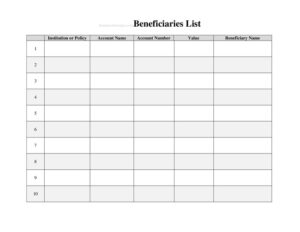
Beneficiaries List
Organize who inherits your assets with a free Beneficiaries List template—record beneficiaries, shares, and contact details. Free PDF and DOCX download.
PDF
DOCX
0
likes
Download Files
- DOCX
A Beneficiaries List is a simple worksheet that records the people, organizations, or trusts you intend to inherit your assets, along with their contact details and the share each is meant to receive. People most often use it to keep their estate planning organized so executors, family members, and advisors can quickly see who gets what. You can download it free in PDF and DOCX formats, with no signup required.
What Is a Beneficiaries List?
A Beneficiaries List is an inventory-style document that gathers, in one place, the names and details of everyone you have named—or plan to name—to receive assets after your death. It is typically created by an individual doing personal estate planning, but it is also used by financial advisors, attorneys, and account holders managing life insurance policies, retirement plans, and bank accounts. The list documents who each beneficiary is, how to reach them, their relationship to you, and the portion or specific asset they are designated to receive. It is not a will or a binding legal instrument on its own; rather, it is a working reference that supports your formal estate documents and helps your executor or trustee carry out your wishes accurately.
When Do You Need a Beneficiaries List?
This list is useful any time you want a clear, current record of who stands to inherit. Common situations include:
- Drafting or updating a will or trust — to map out distributions before meeting with an attorney.
- Opening or reviewing accounts — life insurance, 401(k), IRA, and payable-on-death bank accounts each request named beneficiaries.
- After a major life event — marriage, divorce, a new child, or the death of a loved one often means designations need to change.
- Organizing estate documents for an executor — so the person settling your affairs knows exactly whom to contact.
- Coordinating with multiple advisors — giving your attorney, accountant, and family a single consistent reference.
- Periodic estate reviews — an annual check that contact information and intended shares are still accurate.
What a Beneficiaries List Should Have
A complete and useful list goes beyond names. To be genuinely helpful to whoever relies on it later, it should capture:
- The full legal name of each beneficiary.
- Their relationship to you (spouse, child, sibling, friend, charity).
- Current contact information—address, phone, and email.
- The specific asset, account, or percentage share assigned to each person.
- Whether the beneficiary is primary or contingent (a backup).
- Notes such as date of birth, guardian information for minors, or special instructions.
- The date the list was last reviewed or updated.
How to Fill Out a Beneficiaries List
Because this is a flexible inventory form, you can adapt the columns to your situation. Work through it row by row:
- Add a header. Write your full name, the date, and a note that this list supports your will, trust, or account designations.
- Enter each beneficiary’s full legal name. Use names exactly as they appear on official documents to avoid confusion.
- Record the relationship. Note how each person relates to you so the list is clear at a glance.
- Add contact details. Include mailing address, phone number, and email for each beneficiary.
- Specify the asset or share. List the account, property, or percentage each beneficiary is intended to receive.
- Mark primary or contingent status. Indicate who inherits first and who serves as backup.
- Add notes. Capture dates of birth, guardian names for minors, or any special conditions.
- Date and store the list. Record the review date and keep it with your estate documents.
Beneficiaries List vs. Your Will or Account Designations
It is important to understand that a Beneficiaries List is an organizational tool, not a substitute for legally binding designations. Many assets—life insurance policies, retirement accounts, and payable-on-death accounts—pass directly to whoever is named on the financial institution’s own beneficiary forms, and those designations generally override what a will says for those specific assets. Your will, meanwhile, governs assets that do not have a separate beneficiary designation. Use your list to confirm that your account forms and your will actually reflect your current wishes and match each other. If you spot a gap—say, an ex-spouse still listed on a policy—your list flags it so you can update the official paperwork directly with the provider or attorney.
Keeping Your List Current and Secure
A beneficiaries list is only valuable if it is accurate and findable. Review it at least once a year and after any major change in your family or finances. Because it contains personal information, store it securely—in a locked file, a safe, or an encrypted digital folder—and tell a trusted person, such as your executor or attorney, where to find it. Avoid including full account numbers or sensitive identifiers; reference accounts by institution and type instead. Keeping the document tidy and dated ensures that whoever eventually relies on it can act quickly and confidently.
Common Mistakes to Avoid
- Letting it go stale — outdated contact info or shares can cause delays and disputes.
- Forgetting contingent beneficiaries — naming only primary beneficiaries leaves a gap if one predeceases you.
- Assuming the list overrides official forms — financial institution designations control those assets.
- Using nicknames or incomplete names — ambiguity can complicate identification later.
- Including minors without a plan — note guardian or custodian arrangements for any underage beneficiaries.
- Storing it where no one can find it — tell a trusted person where the list is kept.
Frequently Asked Questions
What is a Beneficiaries List used for? It is used to keep an organized, at-a-glance record of everyone you intend to inherit your assets, along with their contact details and assigned shares. It helps you, your advisors, and your executor stay coordinated and spot designations that need updating.
Is a Beneficiaries List legally binding? No, on its own it is generally an informational worksheet rather than a binding legal document. The legally effective designations are those on your will, trust, or the official beneficiary forms held by financial institutions, so always make sure those match your list.
How do I fill out the Beneficiaries List? Add your name and the date at the top, then enter each beneficiary’s full legal name, relationship, contact details, and the asset or percentage they are to receive. Mark whether each is primary or contingent, add any notes, and record the date you last reviewed it.
How often should I update it? Review the list at least once a year and any time you experience a major life event such as marriage, divorce, the birth of a child, or the death of a named beneficiary. Regular reviews keep contact information and intended shares accurate.
Does a Beneficiaries List need to be notarized or witnessed? Because it is an organizational reference rather than a binding instrument, it typically does not require notarization or witnesses. Notarization and witness requirements usually apply to the formal documents it supports, such as a will, so check your local rules for those.
How much does this template cost? It is completely free to download from Business Forms Pro in both PDF and DOCX formats, with no signup required. You can print it, fill it in by hand, or edit the editable version to fit your situation.
This template is provided as a general example for informational purposes only and is not legal, financial, or tax advice. Estate planning requirements and the effect of beneficiary designations vary by jurisdiction and by financial institution—consult a qualified attorney or financial professional before relying on this document.
Related Forms
- Pest Sighting
- Donations Log
- List of Non-Negotiables
- Monthly Project Timetable
- Telephone Time Tracker
- Cigar Tasting Log
Browse more in Log and Inventory.