
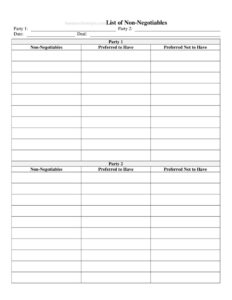
List of Non-Negotiables
Free List of Non-Negotiables template to clarify deal-breakers and priorities before any negotiation, available as a free download in PDF and DOCX.
PDF
DOCX
0
likes
Download Files
- DOCX
A List of Non-Negotiables is a simple worksheet that helps two parties lay out their absolute deal-breakers and softer preferences before sitting down to negotiate. People most often use it to walk into a conversation knowing exactly what they cannot bend on and where they have room to compromise. It is free to download in both PDF and DOCX formats, with no signup required.
What Is a List of Non-Negotiables?
A List of Non-Negotiables is a side-by-side document where each party records the terms they refuse to give up, the terms they would prefer to have, and the things they would prefer to avoid. It is typically created by the people directly involved in a deal — whether that is a business partnership, a vendor contract, a rental arrangement, or a major personal agreement. Rather than a binding contract, it functions as a clarity tool: it documents priorities, surfaces hidden assumptions, and gives both sides a shared reference point. By writing down what is fixed versus flexible, parties reduce misunderstandings and negotiate faster, with fewer surprises late in the process.
When Do You Need a List of Non-Negotiables?
This worksheet earns its place any time two parties are about to enter a discussion where stakes, expectations, or money are involved. Common situations include:
- Business partnerships: two founders defining ownership splits, decision rights, and exit terms before drafting a formal agreement.
- Vendor or supplier deals: clarifying which delivery dates, pricing tiers, or quality standards are firm and which are open to discussion.
- Real estate transactions: a buyer and seller mapping out price floors, closing timelines, and which repairs or contingencies are mandatory.
- Employment or contractor terms: an employer and candidate aligning on salary, remote-work expectations, and start dates before an offer letter.
- Joint projects or collaborations: two organizations agreeing on credit, budget, and scope boundaries up front.
- Personal agreements: roommates, co-buyers, or family members documenting what each person considers essential versus nice-to-have.
In every case the goal is the same — to separate the hard limits from the soft wishes so the actual negotiation focuses on the gray areas rather than fighting over fixed points.
What a List of Non-Negotiables Should Have
A complete worksheet keeps the structure balanced and easy to compare at a glance. It should clearly identify both parties and the deal being discussed, and give each side equal space to record their position. The core elements are:
- The names of Party 1 and Party 2 so the document is unambiguous.
- The date the list was prepared, since priorities can change over time.
- A short description of the deal or matter under discussion.
- Three categories for each party: Non-Negotiables, Preferred to Have, and Preferred Not to Have.
Keeping the three tiers distinct is what makes the tool useful — it forces honest ranking instead of treating every wish as a demand.
How to Fill Out a List of Non-Negotiables
- Enter Party 1 and Party 2. Write the full names (or company names) of the two people or organizations involved so there is no confusion later.
- Add the Date. Record the day you complete the worksheet; if priorities shift, you can create an updated version with a new date.
- Describe the Deal. In a sentence or two, summarize what is being negotiated — for example, “50/50 partnership in a catering business” or “12-month office lease.”
- Complete Party 1’s Non-Negotiables. List the terms this party will not give up under any circumstances. Be specific — “minimum $5,000 monthly retainer” beats “fair pay.”
- Add Party 1’s Preferred to Have. Note the items this party wants but could live without if needed.
- Add Party 1’s Preferred Not to Have. Record things this party hopes to avoid but might accept in a trade.
- Repeat for Party 2. Fill in Party 2’s Non-Negotiables, Preferred to Have, and Preferred Not to Have using the same level of detail.
- Review side by side. Compare both columns to spot conflicts between non-negotiables and overlap you can use as compromise material.
How to Use the List During a Negotiation
The worksheet is most powerful when both parties fill it out independently first, then compare. Where two non-negotiables directly clash, you have identified a genuine obstacle to address early — sometimes it means the deal cannot work as imagined, which is valuable to know before investing more time. Where one party’s “preferred not to have” matches the other’s “preferred to have,” you have a natural trade. The middle tiers give you currency for concessions: giving up a preference to protect a non-negotiable is a healthy, intentional move rather than a panic compromise. Treat the list as a living reference and revisit it if the conversation drifts.
List of Non-Negotiables vs. a Contract
It is important to understand what this document is and is not. A List of Non-Negotiables records intentions and priorities; it is generally not a legally binding agreement on its own. The binding terms come later, in a formal contract that lawyers or the parties draft and sign. Think of the list as the planning stage that feeds into a contract — it helps you negotiate the right terms, but it does not replace the signed document that actually holds parties accountable. Keep both: the list shows why you agreed to something, and the contract enforces it.
Common Mistakes to Avoid
- Calling everything non-negotiable. If half your list is fixed, you leave no room to bargain and the tool loses its value.
- Being vague. “Good terms” or “reasonable price” cannot be negotiated; name numbers, dates, and specifics.
- Skipping the deal description. Without context, the list is hard to interpret weeks later.
- Filling it out together too soon. Drafting each side independently first produces more honest priorities.
- Forgetting the date. Priorities change, and an undated list creates confusion about which version is current.
- Treating it as a contract. Don’t assume the list binds anyone — capture agreed terms in a proper signed agreement.
Frequently Asked Questions
What is a List of Non-Negotiables used for? It is used to clarify, before a negotiation, which terms each party will not compromise on and which are merely preferences. This helps both sides focus their energy on the flexible points and avoid wasting time arguing over fixed limits. It is a planning and communication tool, not a binding contract.
How do I fill out a List of Non-Negotiables? Enter both parties’ names, the date, and a short description of the deal, then complete the three tiers — Non-Negotiables, Preferred to Have, and Preferred Not to Have — for each party. Be specific with numbers and dates so the items are actually negotiable. Compare the two columns side by side to find conflicts and potential trades.
Is a List of Non-Negotiables legally binding? No, on its own it is generally not a legally binding agreement. It documents intentions and priorities to guide a negotiation. Any terms you agree on should be put into a formal, signed contract to make them enforceable.
Should both parties fill it out separately? Yes, filling out the worksheet independently before comparing usually produces the most honest results. It prevents one party from anchoring the other’s answers and reveals genuine priorities. You can then sit down and review both versions together.
What is the difference between a non-negotiable and a preference? A non-negotiable is a term you will walk away over if it isn’t met, while a preference is something you want but can trade away. Sorting items into these tiers keeps your real deal-breakers protected and gives you flexibility everywhere else.
How much does this template cost? Nothing — this List of Non-Negotiables template is completely free to download in PDF and DOCX, with no signup or payment required. You can reuse and customize it for any negotiation you have.
This template is a general example provided for informational purposes only and does not constitute legal, financial, or professional advice. Requirements and best practices vary by situation and jurisdiction, so consult a qualified professional before finalizing any agreement.
Related Forms
- Yearly Project Timetable
- Short Term Disability Claims Tracker
- Restroom Cleaning Checklist
- Elapsed Time Log
- Inventory Cards Management System — BW
- Bill Payment Reminder
Browse more in Log and Inventory.