
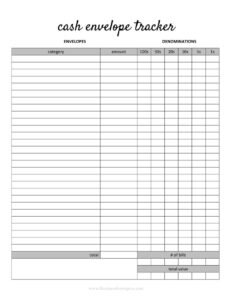
Cash Envelope Tracker
Track spending by category with a free Cash Envelope Tracker template, available as a free PDF and DOCX download to stick to your budget.
PDF
DOCX
2 downloads
0
likes
Download Files
- DOCX
A Cash Envelope Tracker is a simple budgeting worksheet used to record how much cash you place in each spending envelope and how much you spend from it over a given period. People most often use it to stay disciplined with the cash envelope budgeting method, keeping every category from running over. It’s free to download here in both PDF and DOCX formats with no signup required.
What Is a Cash Envelope Tracker?
A Cash Envelope Tracker is a personal-finance log that pairs with the popular cash envelope system, where you withdraw physical money and divide it into labeled envelopes for categories like groceries, gas, dining, and entertainment. The tracker records the starting amount in each envelope, every transaction you make from it, and the running balance that remains. It is used by individuals, couples, and families who prefer spending tangible cash to curb overspending. Rather than guessing whether you have money left for the week, the tracker gives you a written record so the envelope and the paper always agree. It documents intentions, actual spending, and the difference between the two.
When Do You Need a Cash Envelope Tracker?
The tracker is useful any time you want a clear, low-tech view of where your cash actually goes. Common situations include:
- Starting a new monthly budget and assigning a fixed cash amount to each category.
- Trying to break a habit of overspending on dining out, coffee, or impulse purchases.
- Paying down debt and needing to limit discretionary spending to a strict weekly allowance.
- Sharing a household budget with a partner who also pulls from the same envelopes.
- Saving toward a short-term goal, such as a holiday fund or emergency cushion, in a dedicated envelope.
- Reviewing the end of the month to see which envelopes ran dry and which had leftover cash to roll over.
What a Cash Envelope Tracker Should Have
A complete tracker captures enough detail to reconcile the cash in your hand against the numbers on paper. Key elements include the envelope or category name, the budgeted starting amount, a dated list of each transaction with a short description, the amount spent or added, and a running balance. Many trackers also include a period label (week or month), a notes line for context, and a summary that totals spending across all envelopes. The most important feature is the running balance column, because it tells you at a glance how much you can still spend without opening a different envelope or dipping into savings.
How to Fill Out a Cash Envelope Tracker
- Write the envelope or category name at the top, such as Groceries, Gas, or Entertainment.
- Enter the budget period, whether it covers one week, two weeks, or the full month.
- Record the starting balance — the cash amount you placed in the envelope at the beginning of the period.
- Each time you spend, add a line with the date of the transaction.
- Write a brief description identifying the purchase, like “weekly grocery run” or “fuel.”
- Enter the amount spent for that transaction in the spending column.
- If you add cash mid-period, note it in the amount added or deposit column so the balance stays accurate.
- Update the running balance by subtracting each expense from the previous balance.
- At the end of the period, total your spending and compare it to the starting amount to find any remaining cash to roll over.
- Use the notes line to flag anything unusual, such as a planned overspend or a borrowed amount.
How the Cash Envelope Method Works
The cash envelope system is built on a simple principle: once the cash in an envelope is gone, spending in that category stops until the next budget cycle. The tracker is what makes the system reliable, because it lets you verify your remaining balance without counting bills every time. Some people keep one tracker page per envelope, while others use a single sheet with a row for every category. Whichever layout you choose, the discipline comes from writing down each transaction immediately, before you forget the amount. Over a few months, the recorded data reveals patterns — which categories consistently run short and which routinely have cash left over — so you can adjust your allocations.
Tips for Reconciling Your Envelopes
At the end of each week or month, count the physical cash in each envelope and compare it to the running balance on your tracker. If the two match, your records are accurate and you can move on with confidence. If they don’t, look for a missed transaction or a math error in the balance column. Decide ahead of time what to do with leftover cash: many budgeters roll surplus into the next period, while others sweep it into a savings goal. Keeping past tracker pages also gives you a history you can review when planning future budgets.
Common Mistakes to Avoid
- Forgetting to log a transaction right away, which throws off the running balance.
- Borrowing from one envelope to cover another without writing it down, hiding the real shortfall.
- Setting the starting amount based on hope rather than actual past spending in that category.
- Skipping the end-of-period reconciliation, so small errors compound over time.
- Combining too many unrelated purchases into one vague envelope, which obscures where money goes.
- Failing to plan for irregular expenses, leaving no envelope for things like annual fees or gifts.
Frequently Asked Questions
What is a Cash Envelope Tracker used for? It is used to record the starting cash, individual transactions, and running balance for each spending envelope in a cash budgeting system. The goal is to know exactly how much money remains in a category at any time. It helps you avoid overspending and makes monthly budgets easier to review.
How do I fill out a Cash Envelope Tracker? Label the envelope, enter the budget period and starting balance, then log each purchase with its date, description, and amount. Subtract every expense from the previous balance to keep a running total. At the end of the period, compare the recorded balance with the actual cash left in the envelope.
Is a Cash Envelope Tracker free to download? Yes. You can download this Cash Envelope Tracker template for free in both PDF and DOCX formats, with no signup or account required. Print as many copies as you need for each envelope or budget cycle.
Should I use one tracker per envelope or one sheet for all of them? Either approach works, and the choice depends on how many categories you manage. A separate page per envelope gives more room to log transactions, while a single combined sheet offers a quick overview of every category at once. Many people use a per-envelope page for high-traffic categories like groceries.
What do I do with leftover cash at the end of the month? That is a personal choice you can record in the notes line. Common options are rolling the surplus into the same envelope next month, moving it to a savings goal, or redistributing it to a category that ran short. The key is to write down what you did so your records stay accurate.
Can I use this tracker with a digital budget too? Yes. Even if most of your money is digital, you can use the tracker to manage a small cash allowance for everyday spending. Simply treat the cash you withdraw as your starting balance and log each in-person purchase against it.
This Cash Envelope Tracker template is a general example provided for informational purposes only and does not constitute financial, tax, or budgeting advice. Personal financial situations vary, so consider consulting a qualified financial professional for guidance tailored to your circumstances.
Related Forms
- Interview Preparation Worksheet
- Safe Deposit Box Inventory
- Incoming Mail Log
- Emergency Supplies List
- Weekly Bathroom Cleaning Checklist
- Volunteer Hours Tracker
Browse more in Log and Inventory.