
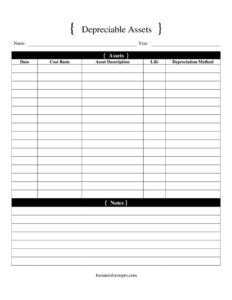
Depreciable Assets Log
Track fixed assets, costs, and depreciation with this free Depreciable Assets Log template, available as a free download in PDF and DOCX.
PDF
DOCX
0
likes
Download Files
- DOCX
A Depreciable Assets Log is a record-keeping sheet used to track the fixed assets a business owns and how their value is written down over time through depreciation. People most often use it to keep an accurate, audit-ready summary of equipment, furniture, vehicles, and other long-lived purchases for accounting and tax purposes. You can download this Depreciable Assets Log free in both PDF and DOCX formats, with no signup required.
What Is a Depreciable Assets Log?
A Depreciable Assets Log is a structured list that captures each depreciable asset a business owns along with the details needed to calculate and report depreciation. Depreciable assets are tangible items expected to last more than one year — machinery, computers, office furniture, vehicles, and similar property — whose cost is spread across their useful life rather than expensed all at once. The log is typically maintained by a bookkeeper, accountant, office manager, or business owner. It documents when an asset was acquired, what it cost, how it is being depreciated, and how much value remains. Kept current, it becomes the backbone of accurate financial statements and tax filings.
When Do You Need a Depreciable Assets Log?
A dedicated log is valuable any time a business holds property that loses value over time and must be accounted for systematically. Common situations include:
- Year-end tax preparation — when you or your accountant need a single source listing every asset, its cost basis, and accumulated depreciation.
- Buying new equipment — adding a machine, vehicle, or computer that will be capitalized rather than expensed in the year of purchase.
- Preparing financial statements — supporting the fixed-asset and accumulated-depreciation lines on a balance sheet.
- Selling or disposing of an asset — calculating any gain or loss requires knowing the remaining book value.
- Insurance and audits — proving what you own, when you bought it, and what it is worth if there is a claim or review.
- Applying for financing — lenders often want a clear picture of the company’s capital assets and their depreciated value.
What a Depreciable Assets Log Should Have
A complete log gives you everything needed to recompute depreciation without digging through receipts. The essential elements are: a clear description of each asset; a date placed in service; the original cost or cost basis; the depreciation method and useful life; the salvage value if any; the depreciation taken each period; the accumulated depreciation to date; and the current net book value. A serial number or asset tag and the location or department help with physical tracking. A notes column captures disposals, transfers, repairs that affect basis, and other events.
How to Fill Out a Depreciable Assets Log
- Identify the asset. Write a clear description (for example, “Dell laptop” or “Ford Transit van”) and assign an asset ID or tag number so it can be matched to the physical item.
- Record acquisition details. Enter the purchase date and the date placed in service, since depreciation usually begins when the asset is ready for use, not necessarily the purchase date.
- Enter the cost basis. Include the purchase price plus freight, installation, and setup costs that are part of the asset’s capitalized value.
- Note salvage value. Record the estimated residual value at the end of the useful life, if applicable.
- Choose method and useful life. List the depreciation method (such as straight-line or declining balance) and the number of years over which it will be depreciated.
- Calculate periodic depreciation. Enter the depreciation amount for the current period and add it to the accumulated depreciation column.
- Update net book value. Subtract accumulated depreciation from cost basis to show the remaining value.
- Add notes. Record location, department, and any disposals, sales, or changes in status.
Common Depreciation Methods to Know
The log itself is method-neutral, but understanding the basics helps you fill it in correctly. Straight-line depreciation spreads the depreciable cost evenly across the useful life and is the simplest to record. Declining balance (including double-declining) front-loads depreciation so more is taken in the early years. Units-of-production ties depreciation to actual usage, which suits machinery measured by hours or output. Many small businesses also use accelerated tax provisions for certain assets. Whichever method applies, note it in the log and keep it consistent for each asset so your accumulated depreciation always reconciles. If you change methods, document why in the notes column.
Keeping the Log Accurate Over Time
A Depreciable Assets Log is only useful if it is maintained. Set a recurring reminder — monthly, quarterly, or at year end — to add new purchases, record the period’s depreciation, and remove or flag assets that were sold, scrapped, or fully depreciated. When an asset is disposed of, do not simply delete the row; mark the disposal date and proceeds so you have a complete history for tax and audit purposes. Reconcile the log totals against your accounting software’s fixed-asset and accumulated-depreciation accounts periodically. Keep supporting documents such as invoices and disposal records filed alongside or referenced in the log.
Common Mistakes to Avoid
- Using the purchase date instead of the in-service date — depreciation generally starts when the asset is ready for use.
- Omitting installation and freight costs from the cost basis, which understates the asset’s true value.
- Forgetting to record disposals, leaving sold or scrapped assets on the books indefinitely.
- Mixing depreciation methods for the same asset between periods without documentation.
- Skipping the accumulated-depreciation update, so net book value drifts away from reality.
- Failing to reconcile the log with your accounting records, leading to mismatched financial statements.
Frequently Asked Questions
What is a Depreciable Assets Log used for? It is used to track every fixed asset a business owns and how its value is written down over its useful life. The log supports tax filings, financial statements, insurance claims, and audits by keeping cost, depreciation, and book value in one place. It also makes it easy to calculate gain or loss when an asset is sold.
How do I fill out a Depreciable Assets Log? List each asset with a description and ID, then record its in-service date, cost basis, salvage value, depreciation method, and useful life. Each period, enter the depreciation amount, update accumulated depreciation, and recalculate the net book value. Add notes for location, transfers, or disposals.
Which assets belong in the log? Tangible property expected to last more than one year and used in the business — equipment, computers, furniture, vehicles, and machinery. Items expensed immediately or held for resale as inventory generally do not belong here. When in doubt about capitalizing an item, check your accounting policy or ask your accountant.
Does a Depreciable Assets Log need to be notarized? No. It is an internal accounting and record-keeping document, not a legal instrument, so it does not require notarization or witnesses. It simply needs to be accurate, consistent, and supported by your purchase and disposal records.
Is this Depreciable Assets Log free to download? Yes. You can download it free in PDF and DOCX formats with no signup required. The DOCX version is fully editable so you can add columns, rename headings, or adjust it to match your accounting system.
How is this different from a general asset inventory? An asset inventory simply lists what you own and where it is located, while a Depreciable Assets Log adds the financial dimension — cost basis, method, useful life, and accumulated depreciation. The depreciation log feeds your books and tax returns, whereas an inventory is mainly for tracking and accountability.
This Depreciable Assets Log template is a general example provided for informational purposes only and is not accounting, tax, or legal advice. Depreciation rules and reporting requirements vary by jurisdiction and by your specific circumstances — consult a qualified accountant or tax professional before relying on this document.
Related Forms
- Travel Abroad Packing Checklist
- Gas Mileage Log
- Employee Computer Accounts Tracker
- Warranty Log
- Donation Record
- Monthly Cleaning Log
Browse more in Log and Inventory.